Ray
Spotted eagle ray
Aetobatus narinari
Reef edges, sandy flats, and coastal lagoons
Find locations for this species ↓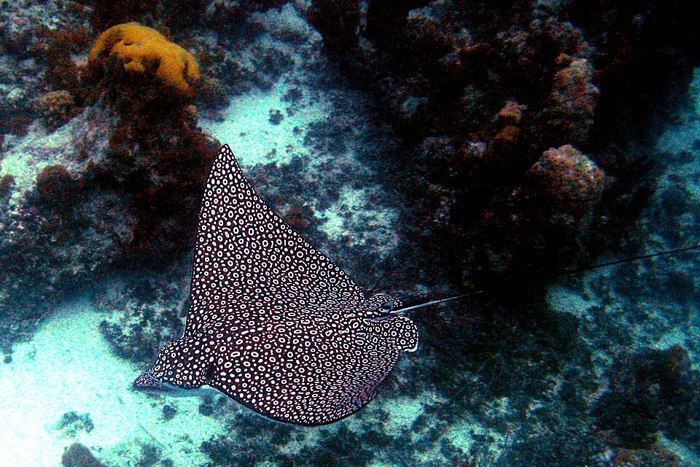
Photo: Keithmccall; color adjustments by Hwttdz and Togabi · Public domain (author dedication) · Source and license. Displayed as a resized crop. Photograph illustrates the species.
- Habitat
- Reef edges, sandy flats, and coastal lagoons
- Typical viewing depth
- 1–30 m
- Viewing activities
- Snorkeling · Scuba diving
RECORDED PRESENCE
Where has Spotted eagle ray been recorded?
These destination links use the same area and date cutoff as the map: 40 km circles, except for the four named regional rectangles. Checked 2026-09-19. Counts describe source records, not individual animals or sighting odds.
ArubaAruba40 km radius · 8 source records since 2016About this destination →Belize Barrier ReefBelize40 km radius · 15 source records since 2016About this destination →BiminiThe Bahamas40 km radius · 5 source records since 2016About this destination →BonaireCaribbean Netherlands40 km radius · 52 source records since 2016About this destination →CozumelMexico40 km radius · 88 source records since 2016About this destination →CuraçaoCuraçao40 km radius · 15 source records since 2016About this destination →Florida KeysFlorida, United StatesRegional rectangle · 90 source records since 2016About this destination →Grand CaymanCayman Islands40 km radius · 93 source records since 2016About this destination →GrenadaGrenada40 km radius · 3 source records since 2016About this destination →Little CaymanCayman Islands40 km radius · 8 source records since 2016About this destination →NassauThe Bahamas40 km radius · 28 source records since 2016About this destination →RoatánHonduras40 km radius · 63 source records since 2016About this destination →SabaCaribbean Netherlands40 km radius · 17 source records since 2016About this destination →Turks & CaicosTurks and Caicos Islands40 km radius · 9 source records since 2016About this destination →U.S. Virgin IslandsUnited States40 km radius · 182 source records since 2016About this destination →