
Species & behavior
Why Collector Urchins Carry Shells and Seaweed on Their Backs
Watch the edge of a shell climb a collector urchin’s spines to see how a piece of reef rubble becomes portable shade.
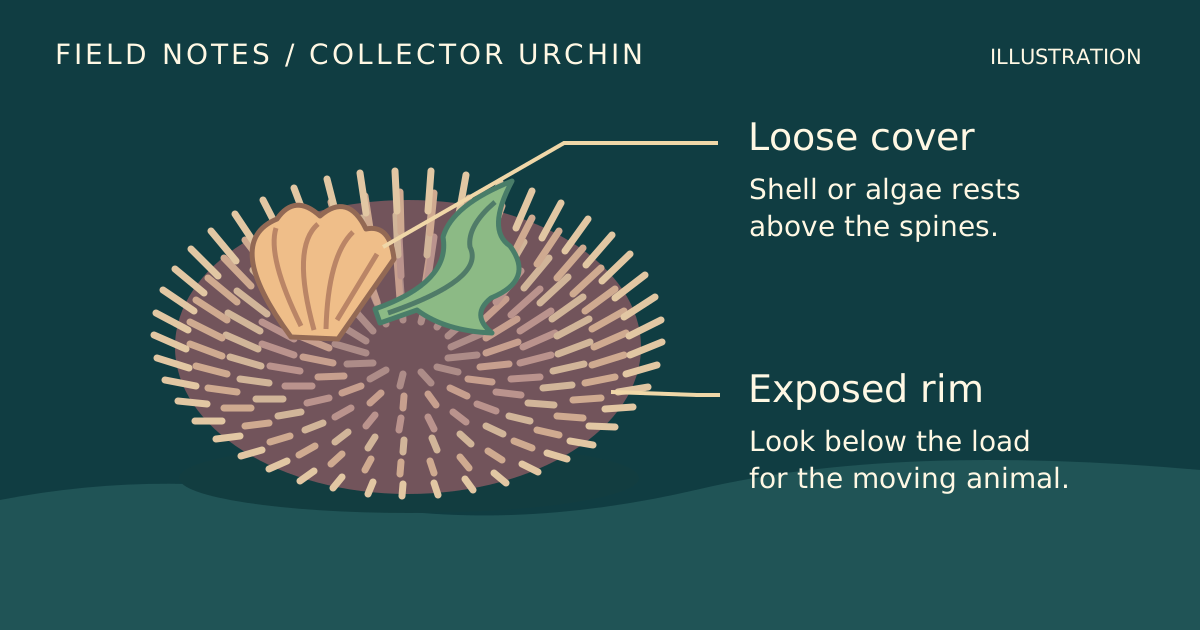
Follow the rim of the pile: the short spines belong to the urchin; the loose pieces above them do not. Original field diagram, not a photograph. 1 2
Graphic: SeaLifeWiki. Research basis · Original SeaLifeWiki graphic. Original conceptual field illustration. No photograph or research figure was traced. Color, scale and spine count are illustrative.
On a shallow Indo-Pacific reef, look for a shell fragment perched on a dome of short spines, with one edge creeping uphill. That movement gives away a collector urchin at work: the shell hasn’t grown there, and it hasn’t simply fallen into place.
The collector urchin, Tripneustes gratilla, grips loose pieces with its tube feet and moves them over its body with the help of its spines. A piece held overhead can do something it couldn’t do lying beside the urchin: block light from reaching the surface beneath it. Experiments on Moorea in French Polynesia found that these urchins covered more of themselves in bright conditions than in shade. The interesting part for a snorkeler is that you can watch the mechanics of making that shade, even when you can’t tell why a particular piece was picked up. 1 3
Follow one shell, not the whole pile
At first, the most conspicuous things in view may all belong to something else: a chip of coral skeleton, a piece of shell, a stray strip of weed. Look just below the lowest piece for the curve they’re resting on. The Australian Museum describes a typical pin-cushion urchin, another name for this species, as having short white spines, sometimes tipped orange. A glimpse through a gap in the cover is more useful than the color of whatever happens to be on top. Several species of urchin collect debris; a shell-covered dome alone won’t settle which one you’ve found. 1 2
If there’s movement, choose a fragment with a recognizable corner. Watch that corner against two references: a fixed point on the reef, and the rim of the urchin itself. If the whole dome travels and the corner keeps its place above the same patch of spines, the animal is carrying it. If the dome holds its position but the corner moves toward the crown, you’re watching the load change place on its carrier. A blade waving back and forth while its base stays put is a different sight again.
The best view of a pickup is often at the side. Researchers filming collector urchins in the Philippines recorded several flexible tube feet taking hold of a single piece of rubble. The feet pulled while spines underneath pushed; ahead of the piece, spines could lie down out of its way. In the close-ups you can distinguish a foot bending around an edge from a spine tipping under it. On the reef you might only see the result: a hard chip traveling up the side of a rounded animal without sliding back to the bottom. 1
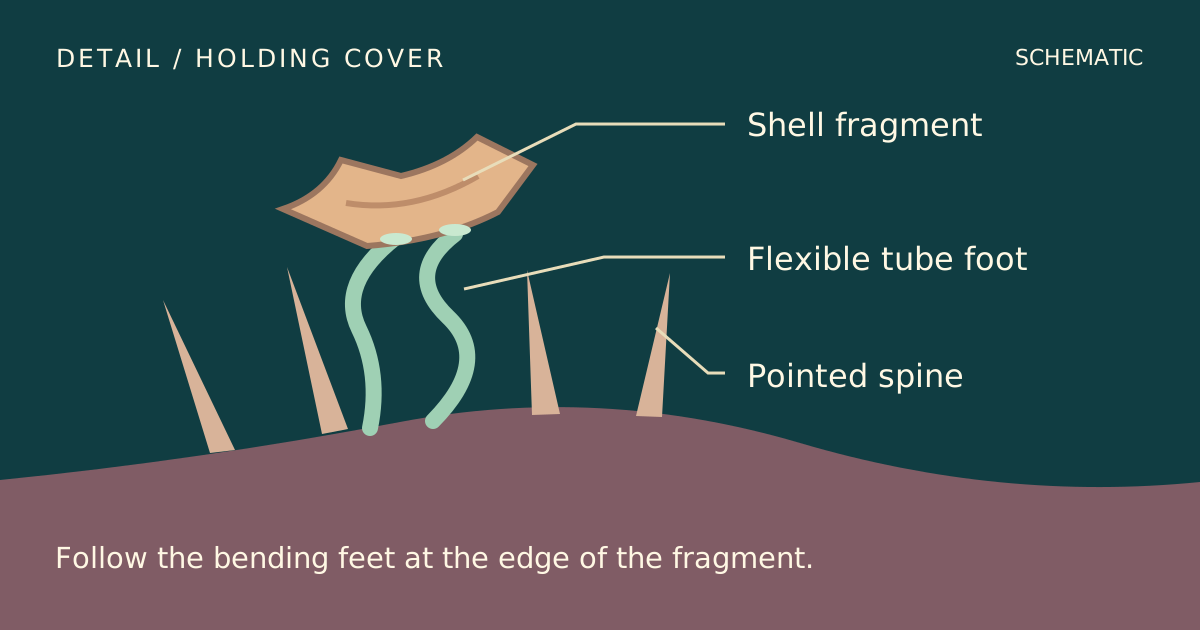
Look at the underside of the moving edge. The flexible feet can grip and pull; the spines can push the piece upward or tilt out of its path. Original explanatory diagram. 1
Graphic: SeaLifeWiki. Research basis · Original SeaLifeWiki graphic. Original conceptual detail of a shell fragment, tube feet and spines; not a micrograph or a measured reconstruction.
A patch of shade that travels with the urchin
A ledge makes a useful comparison. Its shadow stays with the rock; a shell’s shadow can stay with the animal. On Moorea, a researcher compared collector urchins only partway under rocks with ones completely underneath. The partly exposed animals carried more cover. It’s a pattern you can look for from open water if both kinds of shelter are visible. There’s no need to peer deep under a ledge or turn a rock over to find its most sheltered resident. 3
Out on the reef, two animals beside the same ledge may also have different loose material within reach. To distinguish the effect of light from the luck of finding a shell, the Moorea study offered the same ten urchins pieces of plastic under bright and shaded conditions. After half an hour, the animals with intact spines had covered about 55 percent of their upper surface in the bright treatment, against about 39 percent in the dim one. Those are averages at the end of the trial, not a target that a wild urchin must reach before it stops collecting. 3
The clear pieces are the revealing detail. An urchin could lift one and hold it overhead just as it could an opaque red piece, but the two wouldn’t cast the same shadow. Under bright conditions the opaque pieces occupied more of the animals’ surface than the clear ones did. In dim conditions the two took up equal areas on average. That’s good evidence that blocking light matters. It isn’t evidence that these urchins always want red objects, or that a white shell on one wild animal tells you which wavelengths of light it’s responding to. 3
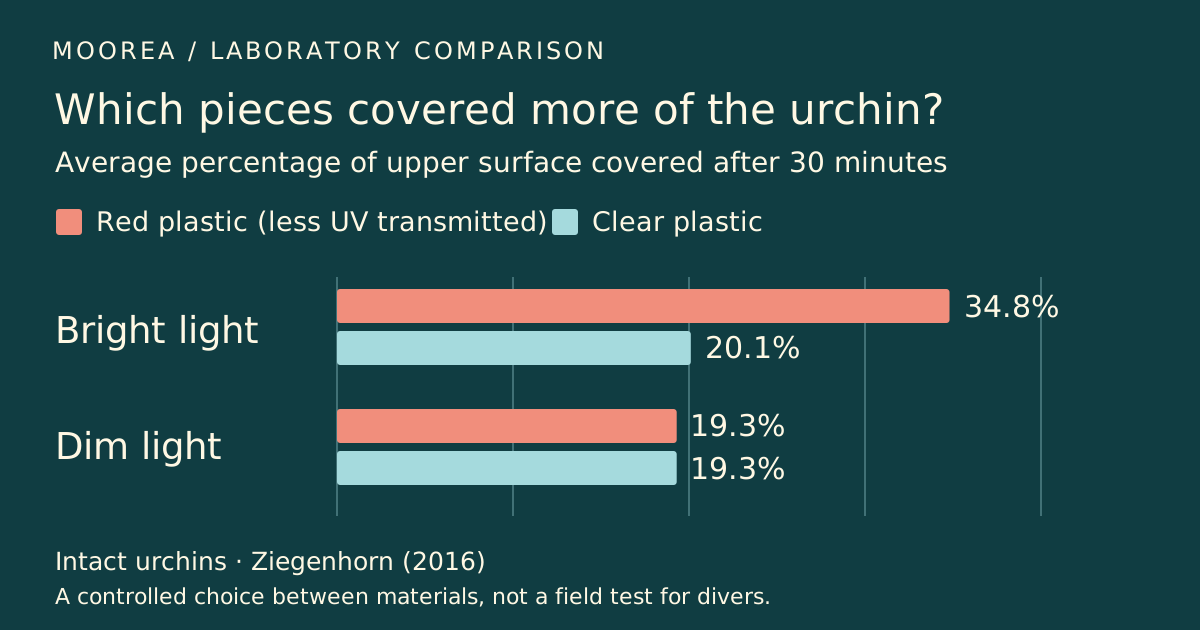
Read across each pair: the opaque pieces accounted for more covered area only in the bright treatment. Bars show area covered at 30 minutes, not the number of pieces picked up. Original chart of the intact-urchin trials. 3
Graphic: SeaLifeWiki. Research basis · Original SeaLifeWiki graphic. Original chart independently drawn from numerical results in the study text, not copied from its figures.
Seaweed on top isn’t a mouthful
A strip of seaweed makes the picture harder to interpret than a shell does. These urchins really do eat algae. In Hawaiʻi, the state raises native collector urchins to graze invasive seaweeds, including on reefs in Kāneʻohe Bay. Yet the side of the animal facing you from above is the opposite side from its mouth. A strip being drawn up that slope is evidence of transport. You haven’t just watched a bite, any more than a shell traveling the same route would be evidence that the urchin was eating shell. 1 4
Where there’s a choice of loose pieces, notice the materials as well as the route. Across six Philippine survey sites, researchers sorted the loads of four covering species. The material on Tripneustes gratilla and another species, Salmacis sphaeroides, included more plant material, especially seagrass, relative to the loads of the two other species, which favored hard fragments. That does not make a green covering a species label. In the researchers’ footage of Tripneustes itself, the piece going up the side is coral rubble. 1
Try looking away from the animal for a moment. Is the nearby bottom strewn with narrow blades, pale chips, or both? Then look back and see which outlines recur on the urchin. If every nearby patch of rubble is pale, a pale load is less surprising than it first appeared. If a single blade lies across several white chips, follow its base rather than its waving tip; you may be able to see which item the feet are actually holding. A note that says ‘blade held across the crown’ will be more useful later than one that says ‘feeding.’
Leave the cover where you found it
It’s tempting to lift a shell for a clean view of the spines, especially if the animal underneath is hard to identify. The shell is the thing worth seeing here. Remove it and any pickup you photograph next is a response to your intervention. Adding a shell, sliding an interesting object within reach, or moving the urchin out from under a rock changes the question in much the same way. Let an obstructed view stay obstructed; another part of the rim may already be visible from your route.
For a useful record, frame a little reef beside the animal rather than filling the entire screen with spines. A short, steady clip that includes the fragment, the rim and that fixed patch of reef can distinguish three events a still frame can’t: water moving a loose end, an urchin walking with its load, and the load itself traveling up the urchin. If nothing moves during your look, the arrangement of pieces and the amount of overhead shelter are still worth noting. There’s no need to wait for the animal to perform.
On your next pass over a rubble-strewn reef, start with the piece that seems least interesting: one chipped shell among many. Look at the space between it and the bottom. If a fringe of spines fills the gap, keep your eyes on one corner of the shell. The few millimeters it moves relative to those spines can tell you more than a perfect view of the whole animal.
Sources & further reading
- Barrett et al. (2019): Tool Use by Four Species of Indo-Pacific Sea Urchins — Field sampling in the Philippines, aquarium observations and Figure 7 footage of Tripneustes gratilla moving rubble with tube feet and spines. Material comparisons are between sampled species, not a universal ranking of preferred objects.
- Australian Museum: Pin-cushion Urchin, Tripneustes gratilla — Institutional species account for short spines, color variation and carrying shells, weeds and pebbles.
- Ziegenhorn (2016): Best Dressed Test: A Study of the Covering Behavior of the Collector Urchin Tripneustes gratilla — Primary Moorea field and experimental study. Article chart uses mean final percent cover in 30-minute light treatments before experimental spine removal, not counts or wild-site targets.
- Hawaiʻi Division of Aquatic Resources: Urchin Hatchery — The agency describes raising native collector urchins to graze invasive seaweeds and its reef work in Kāneʻohe Bay.
Read next
- Sea Star, Brittle Star, or Basket Star? Follow the Arms
Start where each arm meets the body: a broad arm blending into the center, a sharp joint, or repeated branching can separate three star-shaped animals before color misleads you.
- Monterey’s kelp forest puzzle: why sea otters leave some urchins uneaten
Otters hunt among the kelp beside an urchin-covered barren because a spiny shell on bare reef can contain very little worth eating.
- Seal or Sea Lion? Look at the Ears, Then the Flippers
When a sleek marine mammal passes underwater, look behind the eye for an ear flap and watch which pair of flippers drives the next stroke.