Destinations & habitats
Monterey’s kelp forest puzzle: why sea otters leave some urchins uneaten
A forest and an urchin barren can sit side by side. The explanation lies partly inside the urchins—and in the feeding choices of the otters above them.
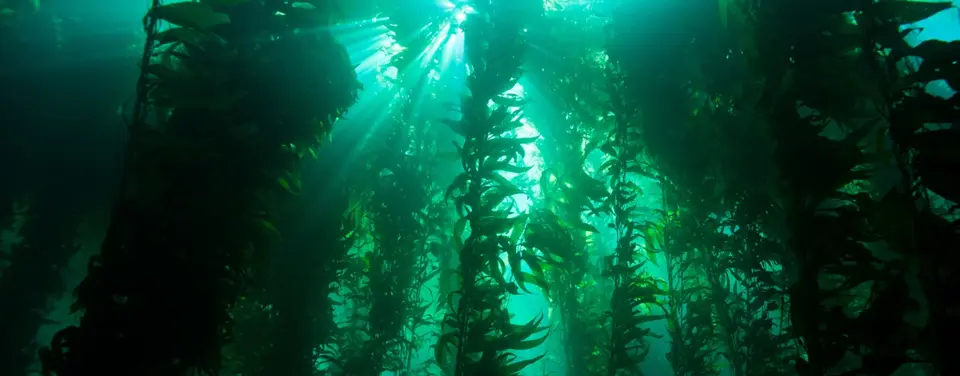
A wild kelp forest in Monterey Bay National Marine Sanctuary. The canopy creates habitat extending upward from the rocky bottom.
Photo: NOAA / National Marine Sanctuaries. Image source · Public domain (NOAA employee work; source marked Public Domain Mark 1.0). Resized and converted to WebP. Index thumbnails use a display crop. Image remains under the stated license.
.jpg)
The familiar story takes three steps: sea otters eat sea urchins, sea urchins eat kelp, and otters therefore protect kelp forests. But look beneath the surface around Monterey and the pattern can be less tidy. A surviving kelp patch may border rock covered in purple urchins, even though otters forage nearby.
The missing detail is that an urchin’s food value changes with its own diet. In a Monterey study, otters concentrated their urchin hunting in surviving kelp patches, where the prey had more nutritious tissue. Urchins in barrens could be numerous and exposed yet offer much less reward. The otters helped maintain the forest that remained without simply clearing the neighboring barrens. 1
A forest held in place by the seafloor
Giant kelp is a brown alga, not a tree. A holdfast anchors it to rock, while stems called stipes carry blades upward. Gas-filled floats help lift the blades toward light. The result is a habitat with a bottom, a water-column interior, and a surface canopy, each offering different opportunities for marine life. Kelp forests depend on enough light and suitable coastal conditions, including nutrients. 2
That vertical structure explains why a loss of kelp changes more than a view from shore. The same patch of seabed can lose its overhead cover and much of the living structure through which animals moved. Calling it a forest helps convey that architecture, even though its builder grows and reproduces very differently from a land plant.
A purple urchin belongs in this habitat. Its presence does not by itself diagnose a problem. The question is how many are exposed, what they are eating, and whether kelp continues to grow around them. A visitor who counts every urchin as damage will miss the difference between a grazer living within a forest and grazing that prevents a forest from returning.
When the food supply changes, the grazers change too
Urchins in kelp habitat can remain in cracks and feed on detached algae delivered to them. When food becomes scarce, more may emerge and graze attached growth. In central California, the changes beginning in 2014 coincided with climatic stress on kelp and the loss of sunflower sea stars to wasting disease. The sea stars were another urchin predator. Several pressures therefore acted together, rather than an isolated change in otter numbers. 3
The resulting pattern can reinforce itself. Fewer kelp plants mean less drifting food; exposed grazers can consume new growth; and scarce food leaves urchins in poorer condition. This is why the bare patch next to a forest deserves attention. Its appearance reflects both what happened earlier and the processes that continue there now.
The central California story should also remain distinct from the extensive bull-kelp losses farther north. Monterey’s giant-kelp forests, northern California’s bull-kelp systems, and their predator communities overlap in some mechanisms but differ in geography and history. A statewide headline does not describe every reef in the same way.
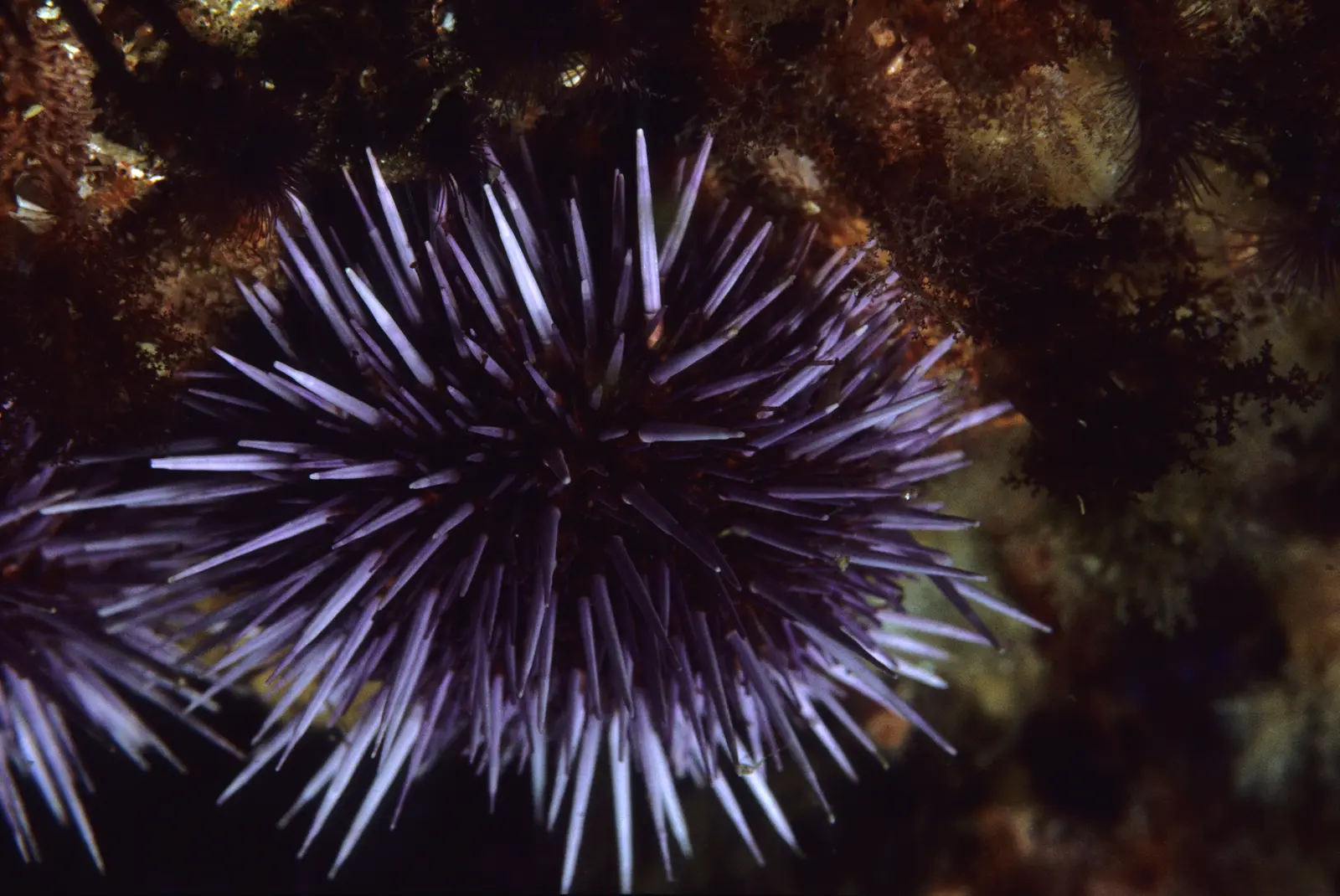
A purple sea urchin in the Monterey area. This close-up shows the grazer, not a documented urchin barren.
Photo: Dr. Dwayne Meadows, NOAA/NMFS/OPR. Image source · CC BY 2.0. Resized and converted to WebP. Index thumbnails use a display crop. Image remains under the stated license.

The valuable part is inside the shell
Sea otters have substantial daily food needs. They rely on dense fur and a high metabolic rate in cold water, and their prey includes several kinds of marine invertebrates. An otter has to acquire enough food while paying the costs of diving, handling prey, and staying warm. An easy-to-find item is not automatically a good meal. 4
In the Monterey work, Joshua Smith and colleagues combined underwater surveys with observations of otter foraging and long-term population information. They assessed the condition of urchins as well as their numbers. The gonads—reproductive tissues that store energy—provided a measure of how profitable an urchin could be to eat. 3
The university’s account of the research describes a marked increase in urchin consumption by otters after the outbreak, yet persistent barrens. The apparent contradiction disappears once you ask which urchins the otters were eating. Well-fed animals in forest patches offered more than their starved counterparts on bare reef. 1
An otter is not choosing a restoration project. It is obtaining food. The habitat benefit follows from those choices, and the benefit can be concentrated where the otter’s preferred prey occurs. That distinction keeps a useful ecological explanation from turning into a story about animals deliberately managing the coast for us.
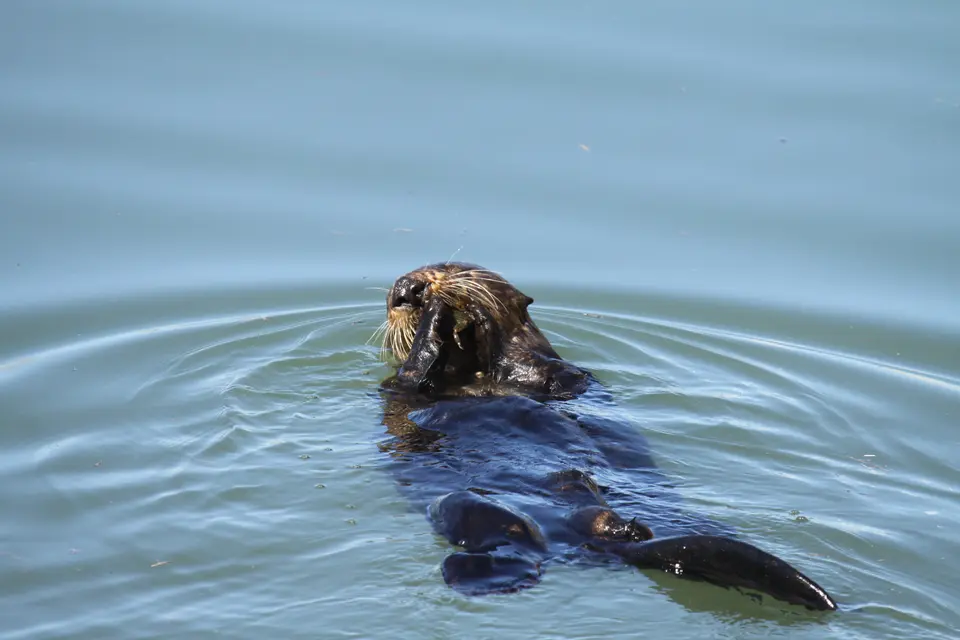
A sea otter eats a green crab at Moss Landing, California. Otters take a variety of prey; the animal pictured is not eating an urchin.
Photo: Lilian Carswell / U.S. Fish and Wildlife Service. Image source · CC BY 2.0. Resized and converted to WebP. Index thumbnails use a display crop. Image remains under the stated license.

Protection and recovery are different outcomes
Maintaining a patch of living kelp is valuable even if the adjacent barren persists. It preserves habitat now and leaves living kelp within the wider landscape. But the conditions that keep an existing forest intact need not be sufficient to restart one where grazing already dominates.
A separate study published in 2025 makes that point at a broader scale. Researchers compared three decades of community data from western Vancouver Island and San Nicolas Island in southern California. Kelp and urchin responses to otter recolonization followed different trajectories. Their modeling indicated that changing interactions among community members mattered, rather than a single constant effect of otters on urchins. This was not a new survey of the Monterey patches; it was evidence that the same predator can have different effects in different ecological settings. 5
For conservation, the implication is to ask what limits recovery at the particular place: grazing, kelp recruitment, environmental conditions, or some combination. Protecting otters remains important, but the word keystone does not mean that one species overrides all the other conditions affecting a forest.
How to read the scene at Monterey
From shore, look for the relationship between surface kelp and repeated otter dives. Binoculars let you watch without drawing closer. A series of dives in one area raises a useful question about the food below; it does not let you identify the prey unless you can actually see it.
Underwater, compare the canopy, the attached growth on the rocks, and the positions of urchins. Are they mostly tucked into crevices or spread across exposed surfaces? A single dive cannot reproduce a field study, but it can teach you which observations are relevant. Do not move or break urchins to investigate their condition, and give otters room to rest and feed.
Use the Monterey Bay map, sea otter profile, and purple sea urchin profile to connect the animals with the place. Then look again at the boundary between forest and bare rock. The puzzle is not whether otters matter. It is where their feeding makes a difference, and why.
Sources & further reading
- UC Santa Cruz (2021), Sea otters maintain remnants of healthy kelp forest amid sea urchin barrens — Research-team account of the Monterey findings.
- NOAA — What is a kelp forest? — Kelp habitat and environmental context.
- Smith and colleagues (2021), Behavioral responses across a mosaic of ecosystem states restructure a sea otter–urchin trophic cascade — PNAS 118, e2012493118; Monterey field study.
- U.S. Fish & Wildlife Service — Southern sea otter — Natural history, feeding, and conservation background.
- Langendorf and colleagues (2025), Dynamic and context-dependent keystone species effects in kelp forests — PNAS 122, e2413360122; comparison of Vancouver Island and San Nicolas Island.