Destinations & habitats
Bonaire’s reef begins in the mangroves: the hidden nurseries of Lac Bay
Some of the fish on Bonaire’s reefs spend their early lives among roots and seagrass. Following those connections changes what a reef destination looks like.
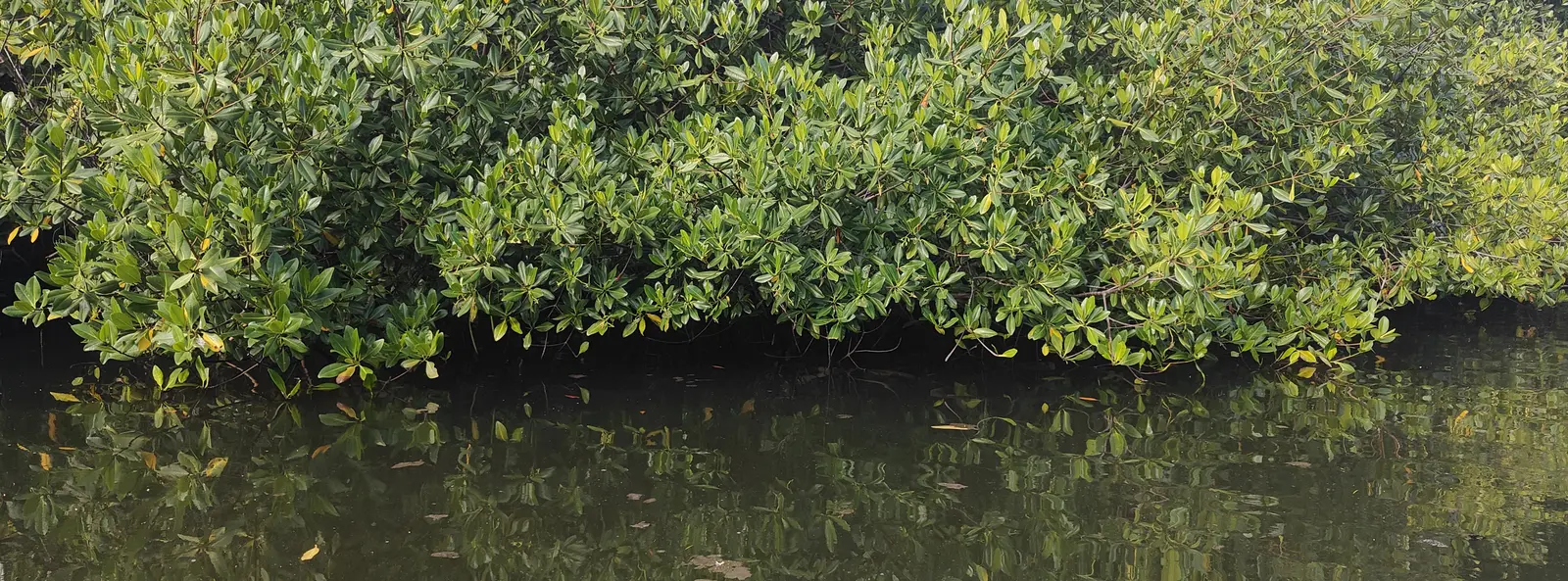
Lac Bay, Bonaire. The mangrove edge is part of a connected coastal habitat, rather than a separate attraction unrelated to the reef.
Photo: Adamboluu. Image source · CC BY-SA 4.0. Resized and converted to WebP. Index thumbnails use a display crop. Image remains under the stated license.

A reef fish has a history that its present location does not reveal. The snapper beside a coral head may have spent part of its early life in much shallower water. To understand why it is here now, you sometimes have to look toward the shore.
At Lac Bay on Bonaire’s southeast coast, mangroves and seagrass provide nursery habitat for several fish later associated with coral reefs. Yet there is no single route through childhood. Different species favor different places, and some juveniles use shallow reef habitat itself. The connection is real; the claim that all reef fish begin in mangroves is not. 1
What the roots provide beneath the surface
The submerged roots of red mangroves create spaces through which small fish can move. Organisms growing on the roots add food and structure. Nearby seagrass offers a different arrangement of leaves, sediment, small prey, and shelter. A habitat can matter because it supplies food, reduces some risks, or connects an animal to another useful place—not simply because it contains many fish. 2
A nursery is therefore more than a picturesque gathering of juveniles. The ecological question is whether a habitat helps young animals survive and contribute to later populations. Counting small fish is one line of evidence. Establishing where they subsequently move and how many survive requires additional work.
That distinction is useful for a visitor, too. A school resting among roots tells you the site is in use. It does not prove that every fish hatched there, lives there continuously, or will join the nearest reef. The interesting questions begin after you notice the school: which species, which size classes, and which neighboring habitats?
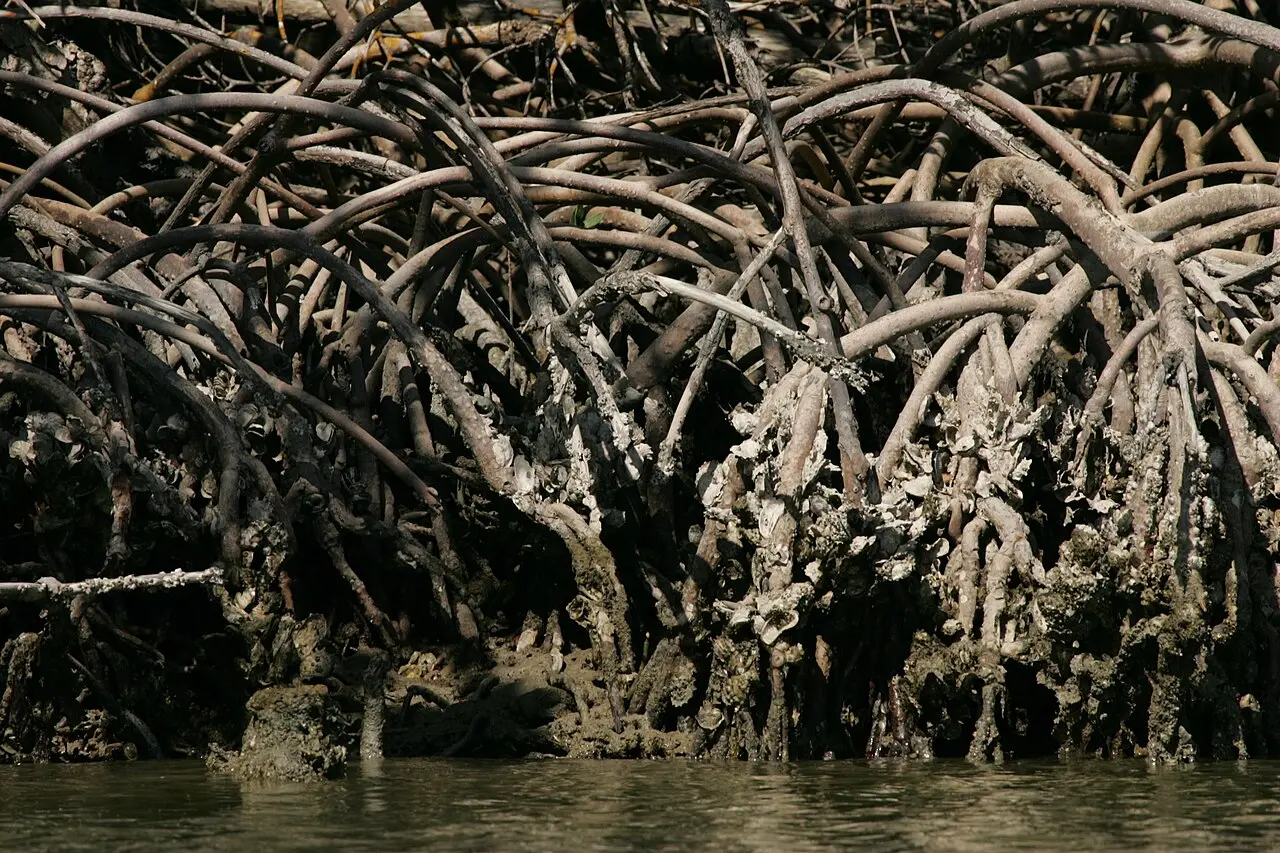
Red mangrove roots in Florida illustrate the root architecture discussed here. This comparison photograph was not taken at Lac Bay.
Photo: Steve Hillebrand / U.S. Fish and Wildlife Service. Image source · Public domain (photographer rights release / USFWS source). Resized and converted to WebP. Index thumbnails use a display crop. Image remains under the stated license.


A study that compared the places fish grow up
Ivan Nagelkerken and colleagues surveyed sixteen selected reef-fish species around Bonaire. They compared mangrove prop roots and turtle-grass beds in Lac Bay with four reef-depth zones, from the shallowest water down to twenty meters. By recording both fish lengths and abundance, they could distinguish where juveniles occurred from where larger fish occurred. 1
The results were species-specific. Juvenile schoolmaster snapper favored mangroves; yellowtail snapper and stoplight parrotfish favored seagrass in the comparisons; several other juveniles favored shallow reef. Young Atlantic blue tangs occurred in all six habitat categories. Much of the juvenile use concentrated in shallow habitats, with shifts toward reef habitat at later stages for many of the studied species.
This is a reason to examine the bay as a set of habitats rather than label the whole place nursery and move on. It is also a historical study, published in 2000. It identifies ecological relationships; it is not a current census of fish at a particular channel entrance.
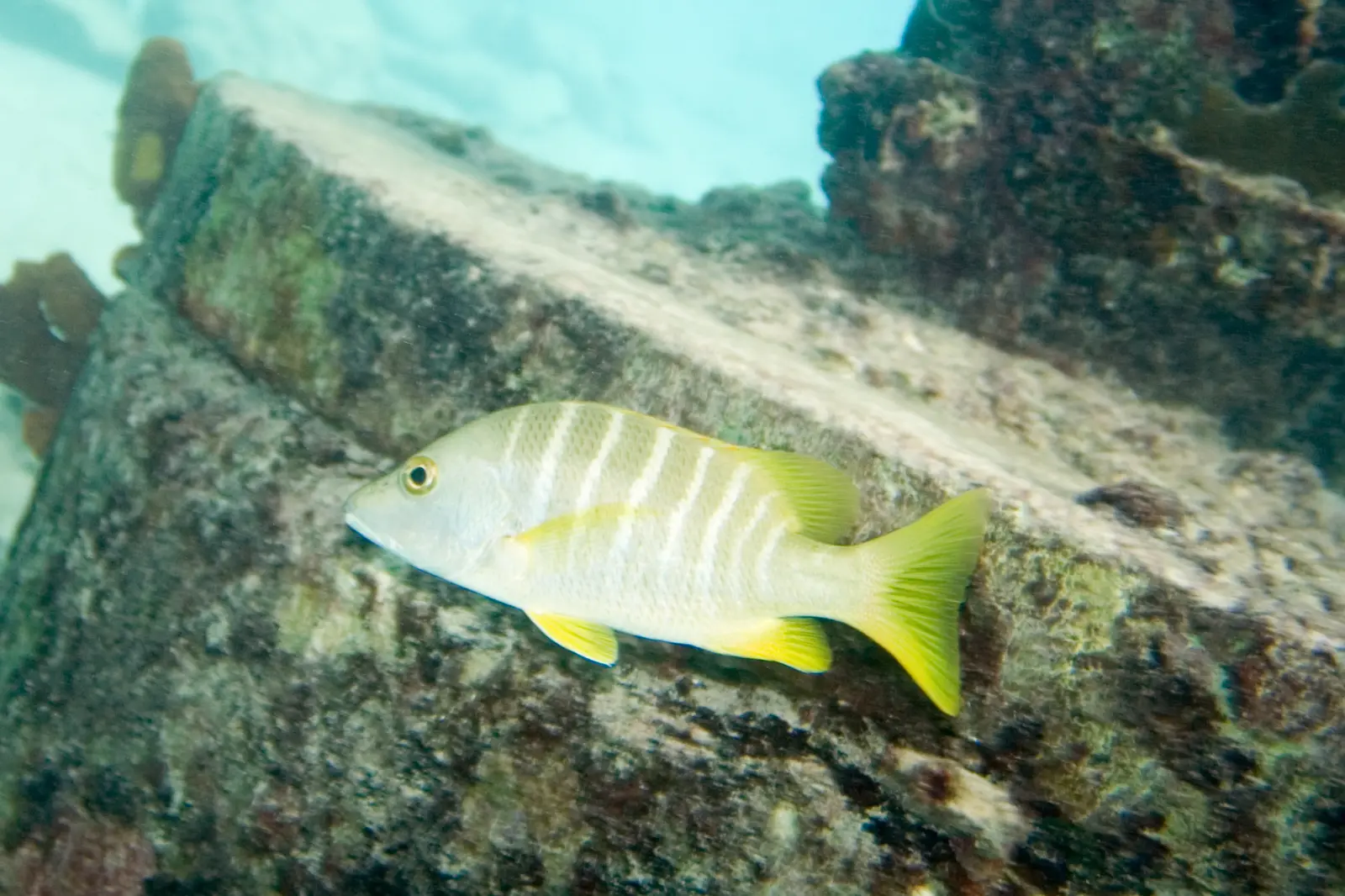
A juvenile schoolmaster snapper, Lutjanus apodus, photographed off western Bonaire. The photograph illustrates the species and life stage; it was not taken in Lac Bay.
Photo: Paul Asman and Jill Lenoble. Image source · CC BY 2.0. Resized and converted to WebP. Index thumbnails use a display crop. Image remains under the stated license.
.jpg)
The reef connection extends beyond the bay
A separate Caribbean study led by Peter Mumby found that mangrove connections were associated with substantial differences in fish communities on neighboring reefs. Several commercially important species had more than twice the biomass where adult habitat connected to mangroves. The work also highlighted a close dependence of rainbow parrotfish on mangrove habitat. Those findings came from that study’s Caribbean sites, not a measurement of today’s fish biomass at Lac Bay. 3
The implication is straightforward: protecting the place where an adult fish is seen may leave out a place that mattered earlier in its life. A line drawn around coral habitat can be ecologically incomplete if fish cross it as they grow or forage.
This also changes the meaning of a species map. A marker on a reef shows a documented occurrence. It cannot reconstruct the fish’s route from juvenile habitat to that point. Reading habitat alongside location helps you ask a better question: which nearby environments could support different parts of this species’ life?
A green meadow can change without disappearing
Seagrass is not one interchangeable green covering. Research in Lac Bay documented the expansion of the non-native Halophila stipulacea after its establishment there in 2010. The plant spread through clonal growth, and detached fragments could remain viable and root again. In the study, tethered fragments began producing roots and leaves within ten days. 4
A change in the plants composing a meadow can change its structure even if the bottom still looks green from above. The study discussed possible effects on sediment stability and ecological functions, while also noting that colonization of previously bare areas can add vegetation. Expansion of an introduced species and its precise consequences are related but separate research questions.
For an observer, the useful habit is to notice what makes up the meadow. Broad or narrow leaves, plant height, exposed sediment, and the animals using it provide more information than the label seagrass alone. Avoid pulling plants to inspect them; a photograph can preserve the detail without disturbing the bottom.
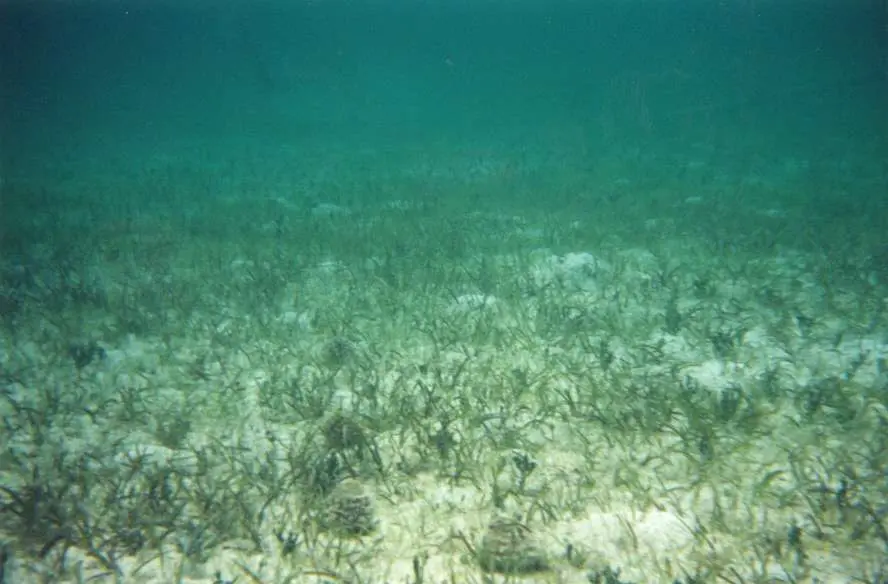
Turtle grass, Thalassia testudinum, at Grahams Harbour in the Bahamas. This comparison image shows a Caribbean seagrass habitat, not the Halophila invasion studied in Lac Bay.
Photo: Jstuby. Image source · Public domain (released by the photographer). Resized and converted to WebP. Index thumbnails use a display crop. Image remains under the stated license.


Why restoring water movement matters
Mangroves need functioning waterways as well as living trees. A 2025 research report on Bonaire describes poor circulation and high salinity in parts of Lac Bay’s backwaters, where mangrove losses had occurred. Restoring the forest therefore involves understanding water exchange and the conditions around the roots, rather than treating planting as the entire solution. 5
Local restoration work by Internos and the Mangrove Maniacs includes reopening channels and planting mangroves in selected areas. Their project account connects those activities with the goal of restoring water movement. Reports of progress deserve attention, but planted seedlings and cleared channels are measures of work completed; long-term survival and habitat function are measures of ecological recovery. 6
For the reef story, this is the connection worth carrying away: land-derived sediment, channel condition, tree health, juvenile fish habitat, and adult reef communities can form parts of the same coastal system. The reef does not end at the waterline in the way a postcard frame suggests.
What to look for at Lac Bay
Where access is permitted, compare the mangrove edge with adjacent open shallows. Look for changes in fish size, spacing, and use of cover. Then compare those observations with fish on a reef visit. Even without identifying every animal, you can begin to recognize that different parts of the coast serve different life stages.
Follow the marine park’s current access guidance, keep fins clear of the bottom, and leave roots and vegetation undisturbed. Shallow habitat can be damaged by standing or pushing through it. A route that is appropriate for a kayak is not automatically an invitation to enter every channel on foot or with snorkel gear.
Open the Bonaire map, then read about yellowtail snapper, stoplight parrotfish, or the Atlantic blue tang. Each offers a different way to follow the same question from the bay to the reef: where does this animal find what it needs as it grows?
Sources & further reading
- Nagelkerken and colleagues (2000), Importance of mangroves, seagrass beds and the shallow coral reef as a nursery for important coral reef fishes — Estuarine, Coastal and Shelf Science 51, 31–44; Bonaire visual censuses.
- Nagelkerken and colleagues (2008), The habitat function of mangroves for terrestrial and marine fauna: a review — Aquatic Botany 89, 155–185; habitat structure and connections.
- Mumby and colleagues (2004), Mangroves enhance the biomass of coral reef fish communities in the Caribbean — Nature 427, 533–536; wider Caribbean evidence, distinct from the Bonaire census.
- Expansion and fragment settlement of the non-native seagrass Halophila stipulacea in a Caribbean bay (2017) — Marine Biology Research; observations and experiments in Lac Bay.
- Conservation state of the mangrove forests of Bonaire, Caribbean Netherlands (2025) — Research report addressing mangrove condition and water circulation.
- Bonaire Naturalesa — Mangrove restoration at Lac Bay — Account of the local restoration project.
- STINAPA Bonaire — Marine park information and current visitor guidance.