Observation & identification
Green Turtle, Hawksbill, or Loggerhead? The Details That Give Them Away
Watch the head, then the shell’s trailing edge. Those two views often tell you more than the color that first caught your eye.
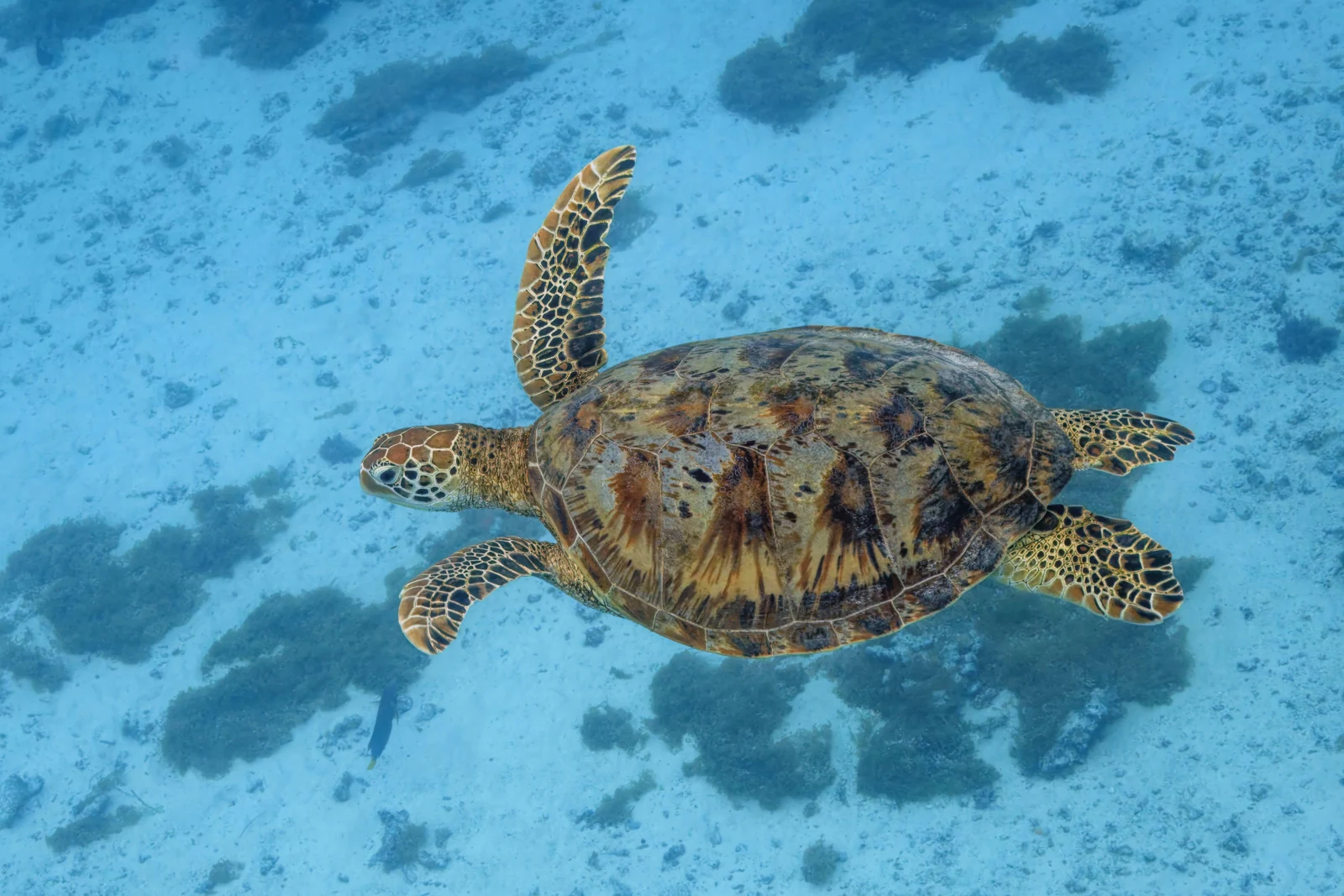
A green sea turtle near Moorea, French Polynesia. Start with the proportions of the head and shell; color alone can lead an identification astray.
Photo: Charles J. Sharp. Image source · CC BY-SA 4.0. Resized and converted to WebP. No cropping, color changes, or content edits.
_Moorea.jpg)
When a turtle passes on your next snorkel, look at the shape of its head before following the pattern on its shell. Then watch the rear edge as it swims away: a hooked beak, a broad jaw, or a saw-edged shell can turn an uncertain sighting into an identification.
The mistake is to start with green, brown, or yellow. A green turtle can wear a brown shell; a young green can carry a pattern that resembles a hawksbill’s. Water, shadows, and the angle of your view add another layer of confusion. Build the identification from several features that agree, and you can keep your distance while making better use of the few seconds the animal gives you. 1
Let the turtle show you the next angle
For the first pass, compare three features you may see without changing position: a hawksbill’s narrow hooked beak, a green’s smaller blunt head, or a loggerhead’s broad, heavy jaw. Then trace the rear shell edge. Save the scale count for a clear photograph or a natural top-of-head view; it is often too small a detail for a brief passing glimpse. 1 2 3
A turtle approaching diagonally offers a head profile. One crossing beneath a snorkeler may show its entire upper shell. One swimming away reveals the shell’s trailing edge but hides the face. Treat those as different pieces of evidence, rather than trying to force the same identification trick onto every view.
Stay where you can watch without intercepting it. If the turtle turns naturally, your second view may answer the question that the first left open. Swimming ahead to obtain a face-on photograph can put you in its route to the surface. The animal needs air; your identification can wait.
This guide compares three species that divers and snorkelers encounter in tropical and subtropical waters. It does not make every turtle one of the three. If the visible features disagree, retain the photograph and the location instead of choosing the nearest-looking name. Other sea turtles, unusual shell arrangements, and incomplete views all deserve room in the answer. 4 5
Green turtle: a small head ahead of a broad oval
Seen from above, a green turtle often presents a broad oval shell with a comparatively small head projecting from the front. The beak lacks the long, sharply hooked profile that gives a hawksbill its name. At the rear, the shell’s outline is generally smoother than a hawksbill’s toothed edge. Follow that outline before becoming absorbed in the streaks and patches on the scutes—the plates covering the shell. 1
If a clear photograph shows the top of the head, look immediately ahead of the eyes, toward the nose. A green turtle normally has one pair of prefrontal scales there: two principal scales side by side. Count that specific pair, rather than every scale around the eyes. Use the photograph you already have; there is no need to move into a turtle’s path to collect it.
Now return to what the animal is doing. An older green cropping seagrass or grazing algae offers a view of the beak working against vegetation. That fits its predominantly plant-based diet, but eating alone does not establish identity. A turtle merely resting in a seagrass bed has not shown you what it eats. The head and shell still do the identifying. 1
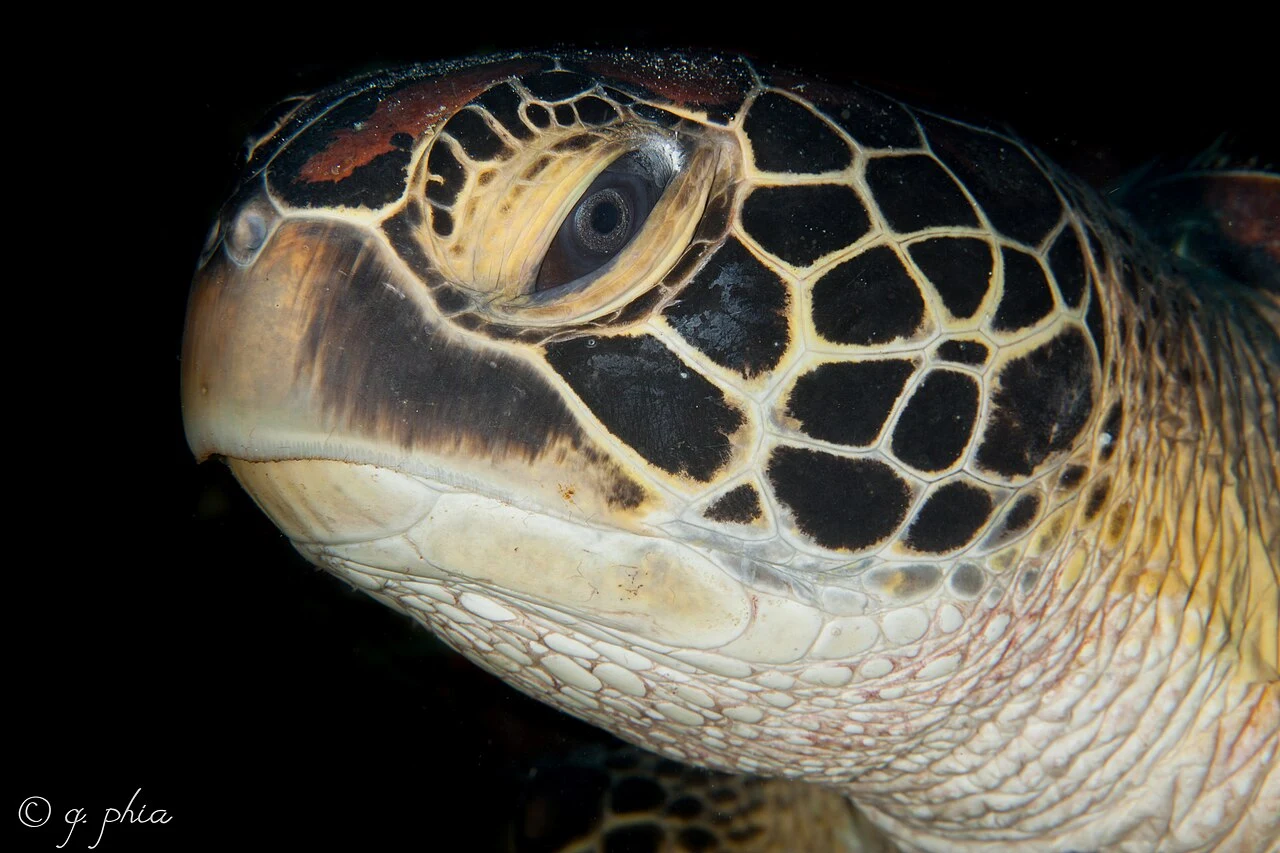
A green turtle at Fukui, near Siladen, Indonesia. Its rounded beak is visible in profile; this side view does not reveal every prefrontal scale.
Photo: q phia. Image source · CC BY 2.0. Resized and converted to WebP. No cropping, color changes, or content edits.
.jpg)
Hawksbill: the beak reaches into the reef
Watch a hawksbill turn sideways and the face becomes the clue: a narrow head ending in a projecting, hooked beak. Seen from behind, the shell can look toothed along its rear margin. Its plates often overlap like shingles. Those features make a stronger combination than the amber-and-brown shell pattern that attracts the camera first. 2
That narrow face also helps explain a familiar reef encounter. A hawksbill may put its head into a space between pieces of reef, reaching food a broader-headed turtle would approach differently. Sponges form a substantial part of the diet in many populations. If you cannot see what the beak removes, record the probing motion rather than naming an unseen meal.
A top-of-head photograph can supply another check: hawksbills normally have two pairs of prefrontal scales. That separates them from greens, but not by itself from loggerheads. Return to the hooked beak and shell edge before settling on the name. A head-scale count works best as corroboration of the animal you have already begun to recognize. 2 4
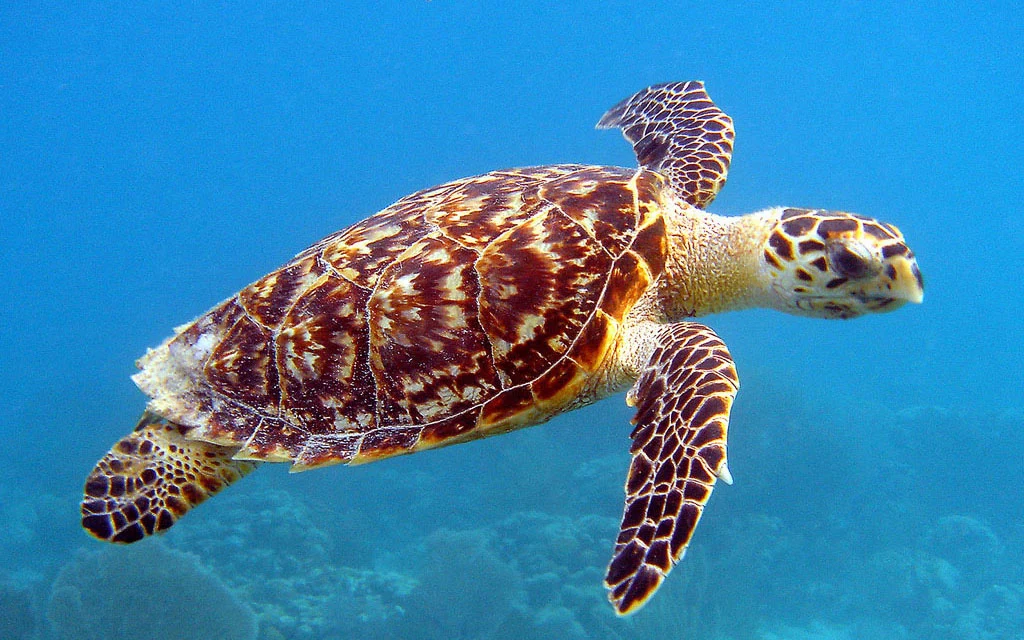
The hawksbill’s narrow, hooked beak and rear shell outline are useful clues. Its shell pattern is a supporting detail.
Photo: NOAA. Image source · Public domain. Resized and converted to WebP. No cropping, color changes, or content edits.

Loggerhead: notice how much of the front is head
A loggerhead can give the impression that someone enlarged the head without enlarging the rest of the turtle. Look for the broad, heavy jaw and substantial neck, particularly in a side or three-quarter view. The shell often looks more heart-shaped than a green’s oval, but head proportions usually make the stronger first impression. 3
The jaw has work to do. Loggerheads eat hard-shelled prey, including marine snails and other bottom-dwelling animals. If one is feeding over sand or rubble, the pause and repeated jaw movements may hold more interest than the transit between feeding spots. Stay back and let the sequence continue; an animal interrupted before it handles its food leaves you with less to interpret.
From above, a loggerhead normally has five large lateral scutes down each side of the shell. Greens and hawksbills normally have four. These are the plates beside the central row, not the small plates forming the rim. A slanting view can hide the first plate, so a count of four from an incomplete photograph cannot safely overrule the broad head. 3 4
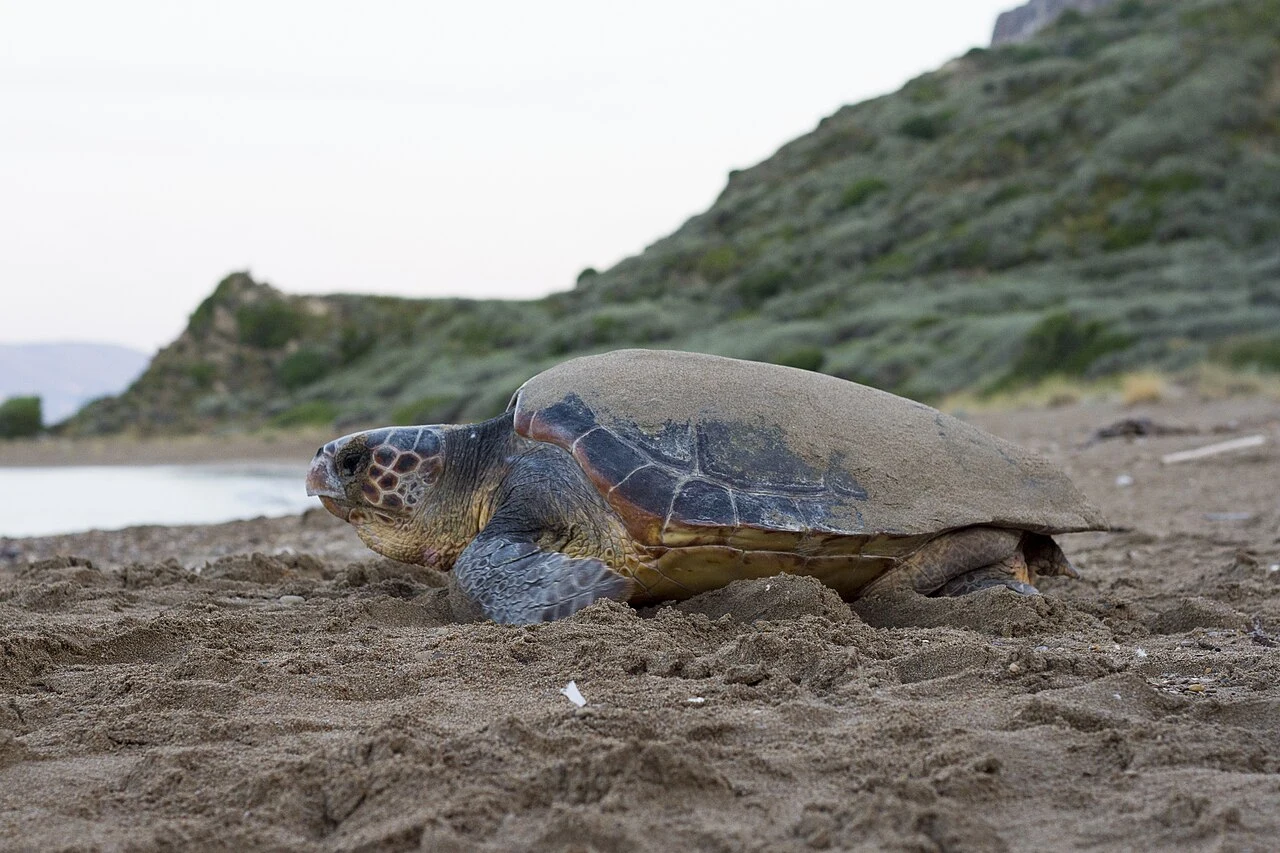
A loggerhead on a beach in Zakynthos, Greece. This clear side view shows the broad head and heavy jaw to look for underwater.
Photo: Dionysisa303. Image source · CC BY-SA 4.0. Resized and converted to WebP. No cropping, color changes, or content edits.

Three checks to make back on the boat
Review the photograph at full size before cropping it. First compare the head profile; then trace the rear shell edge; finally count any scales or scutes the image genuinely resolves. This order keeps a guessed plate boundary from becoming the foundation of the whole identification.
The comparison below describes typical features. Use a combination, especially with young turtles or animals photographed at an angle. A feature you cannot see belongs in the unknown column of your notes, not in the absent column.
| Look for | Green | Hawksbill | Loggerhead |
|---|---|---|---|
| Head and beak | Relatively small; short, blunt profile | Narrow head; projecting hooked beak | Large head; broad, heavy jaws |
| Rear shell outline | Generally smooth | Often strongly serrated | Usually less serrated than a hawksbill |
| Prefrontal scales | 1 pair | 2 pairs | 2 pairs |
| Lateral shell scutes per side | Usually 4 | Usually 4 | Usually 5 |
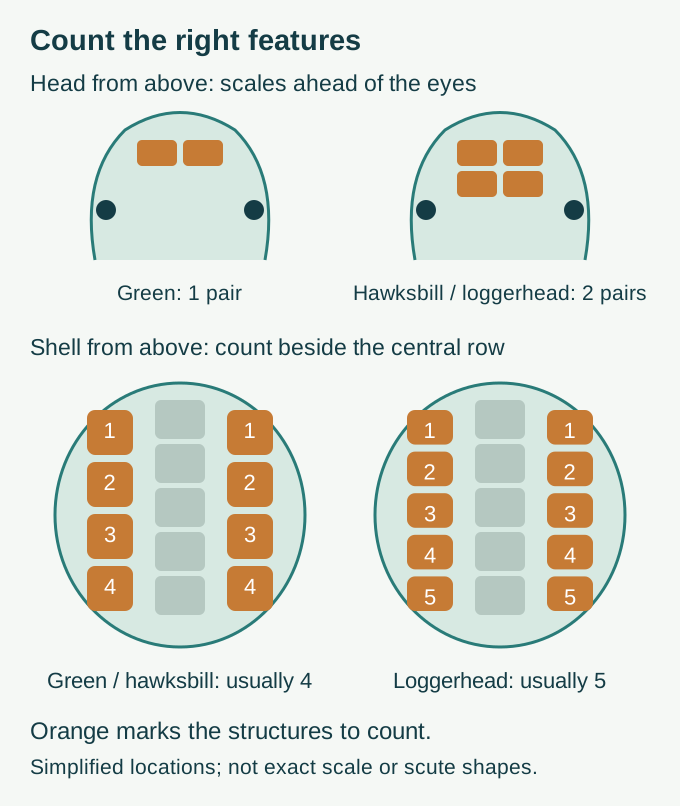
Count the correct structures: prefrontal scales lie ahead of the eyes; lateral scutes sit beside the central shell row. The diagram isolates the features rather than depicting complete turtle anatomy. 1 2 4
Graphic: SeaLifeWiki. Research basis · Original SeaLifeWiki graphic. Original explanatory graphic; see caption for scope.
The clues that most often mislead
A turtle that looks green in blue water is not necessarily a green turtle. Algae on the shell, a warm beam from a dive light, and a camera’s white-balance setting can all change the impression. Nor does a patterned shell automatically mean hawksbill: young greens can have conspicuous radiating markings. 1
Size is another tempting shortcut. A small turtle might be a young individual of a large species, and apparent size changes with distance through a mask. Barnacles and scars can conceal plate boundaries. Even a beautifully lit image can omit the feature you need if the flipper, neck, or another animal covers it.
Keep the scientific names with your identification: Chelonia mydas, Eretmochelys imbricata, and Caretta caretta. They make your notes useful when local common names vary. If the evidence supports only possible hawksbill, retain that qualification. A clear photograph labeled uncertain gives a later reviewer more to work with than an unqualified name attached to a guess.
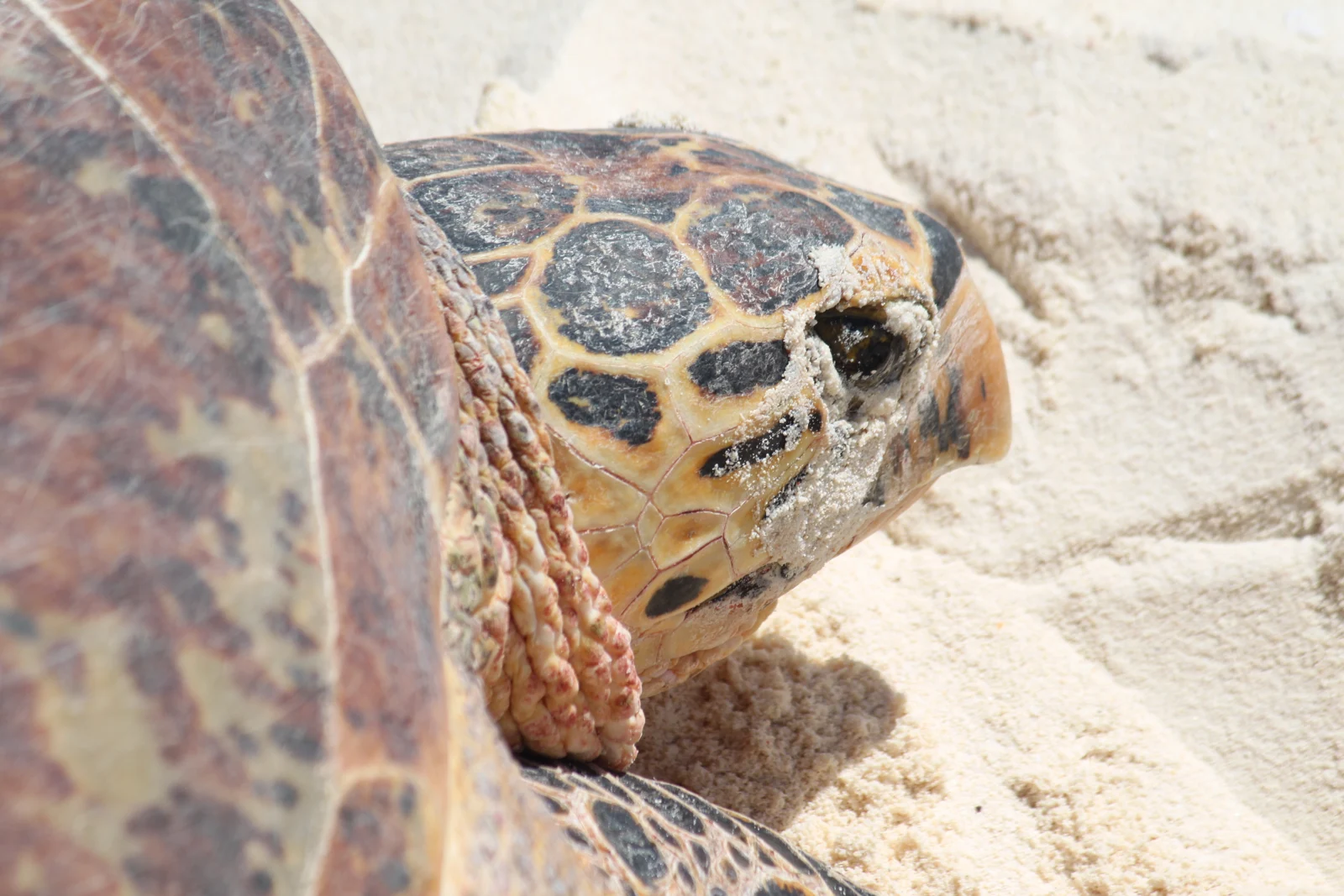
The hawksbill’s projecting beak in detail. Compare the profile with the green turtle portrait above, rather than relying on shell color.
Photo: Gerwin Sturm. Image source · CC BY-SA 2.0. Resized and converted to WebP. No cropping, color changes, or content edits.
.jpg)
Leave with an identification and an undisturbed turtle
Use the viewing distance and access guidance for the place you are visiting. Let a turtle feed, rest, and surface without pursuit or contact. If it changes direction to avoid you, the useful adjustment is yours to make. The next natural turn may provide a better view than a closer approach would. 5
Before your next trip, compare the green turtle profile with the Florida Keys, Bonaire, or Hawaiʻi map. Then put the names aside for the first few seconds of the encounter. Head, shell edge, visible scales: let the turtle supply the answer.
Sources & further reading
- NOAA Fisheries — Green turtle — Head scales, shell pattern, scutes, and diet.
- NOAA Fisheries — Hawksbill turtle — Beak, overlapping shell plates, prefrontal scales, and feeding.
- NOAA Fisheries — Loggerhead turtle — Head proportions, shell appearance, and hard-shelled prey.
- Massachusetts Division of Fisheries and Wildlife — Loggerhead sea turtle — Comparison of lateral scutes and prefrontal scales among these species.
- NOAA Fisheries — Marine life viewing guidelines and distances — Location-specific guidance for watching wildlife without disturbance.