Species & behavior
The Moray Eel’s Second Bite: How Hidden Jaws Pull Prey Down Its Throat
The front jaws pin the prey. A second set reaches forward inside the mouth, grips the meal, and hauls it into the throat—a hidden handoff behind the teeth you can see.
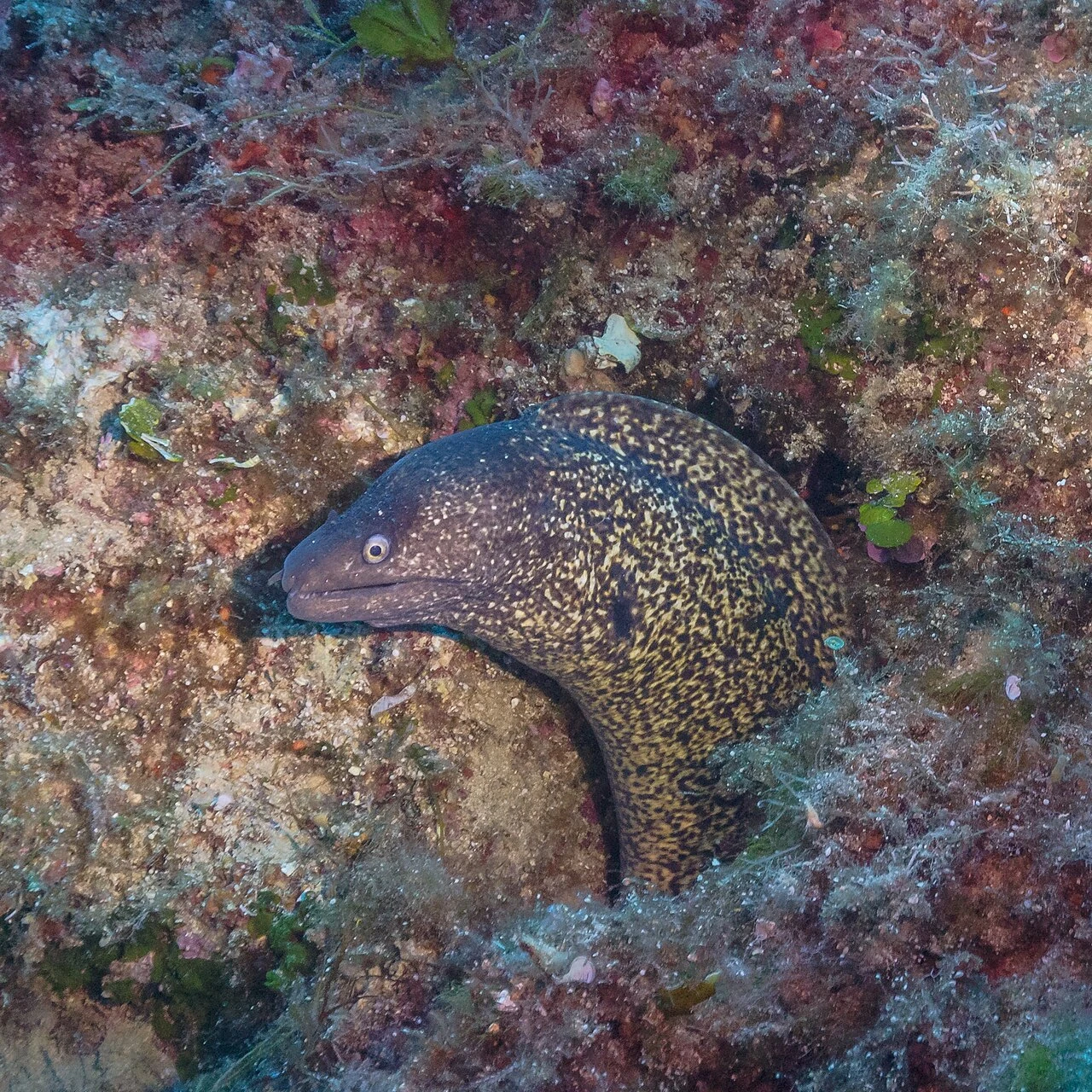
A Mediterranean moray, Muraena helena, at Gozo, Malta. The landmark feeding study used a different species, the reticulated moray, Muraena retifera.
Photo: Diego Delso, delso.photo. Image source · CC BY-SA 4.0. Resized and converted to WebP. No cropping, color changes, or content edits.
,_Regga,_Gozo,_Malta,_2021-08-23,_DD_09.jpg)
Watch a moray’s mouth from outside its reef crevice: open, close, open again, teeth exposed as it pumps water over its gills. If you witness a natural feeding strike, follow the captured prey after the first bite—the next grip comes from jaws hidden deeper in the head. 1 2
The outer jaws hold the meal while the throat jaws advance inside the mouth, seize it, and retract. As the food moves backward, the front jaws can release their grip. The moray has a way to transfer slippery, struggling prey toward its esophagus without relying on a strong inward flow of water to do the carrying. 2 3
First, separate breathing from biting
The open mouth makes an excellent photograph and a poor guide to the animal’s intentions. A resting green moray repeatedly moves water through the mouth and across its gills. The teeth become visible as part of that routine. An open mouth alone does not tell you that an attack is beginning. 1
Look beyond the face. Is the animal holding the same position in its shelter, or is its head moving toward something? Is there actually prey between the jaws? Following a whole sequence gives you more information than freezing the most dramatic-looking frame.
This is also why a close photograph of a gaping eel does not automatically show the famous second jaws. Teeth on the roof of the mouth and teeth lining the outer jaws are not all pharyngeal teeth. In a green moray, several visible rows belong to the ordinary mouth apparatus. The transport mechanism was established by watching jaws move, not by counting intimidating points in a portrait. 1
Watch the meal, not just the mouth
Picture a prey fish held crosswise between the outer teeth. To swallow it, the moray has to move it into the throat, yet opening the outer jaws could give a struggling meal its chance. Think of trying to pass a slippery object from one hand to another: a secure second grip makes the release possible.
In the feeding sequences studied by Rita Mehta and Peter Wainwright, the throat jaws advanced into the mouth and seized the prey. As they retracted, the outer jaws opened and the food moved backward. These are pharyngeal jaws—pharyngeal simply places them in the throat. Their unusual mobility, rather than their mere existence, is the key. 2
Watch the direction of the handoff in the diagram: the throat jaws reach the food inside the mouth, then carry it back. They do not extend beyond the snout to snatch prey outside the eel. The first visible bite has already caught the meal; the hidden jaws solve the next problem, getting it deeper without losing control of it.
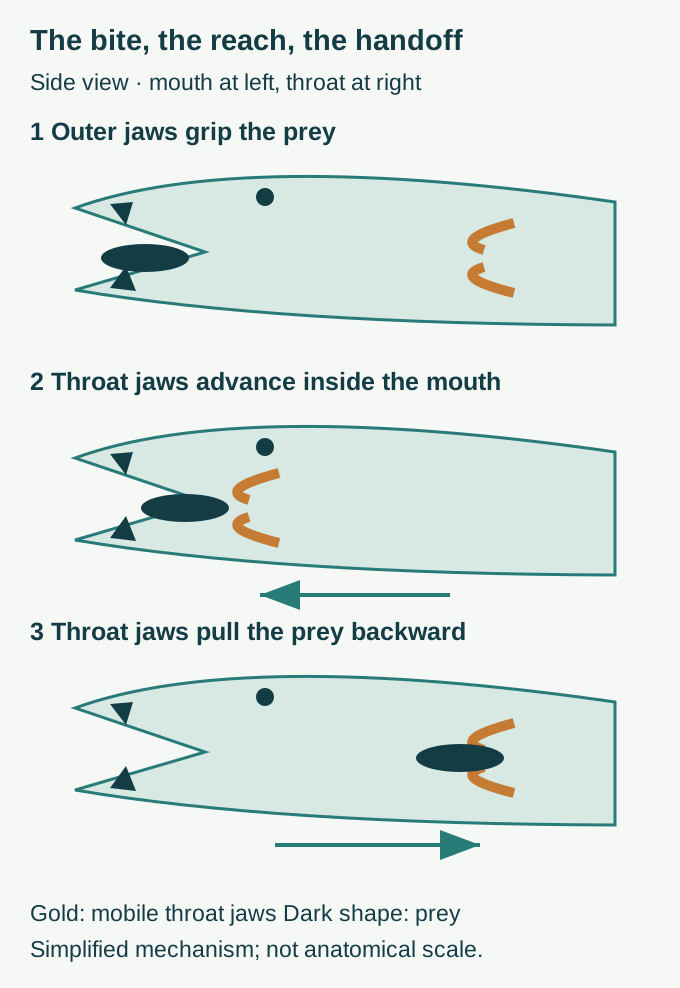
A handoff inside the mouth. Original schematic based on the filmed mechanism; simplified positions, not an anatomical X-ray or a scale drawing. 2
Graphic: SeaLifeWiki. Research basis · Original SeaLifeWiki graphic. Original explanatory graphic; see caption for scope.
Most fish have another solution: move the water
Watch a reef fish take a small item suspended in front of its mouth. The item can disappear with a quick expansion of the head and mouth cavity. Many fishes use that expansion to draw in water carrying food; water movement also helps move the meal through the mouth. A moray relies strongly on biting and mechanical transport instead. 3
Now look at the rock close around the eel’s head. The narrow space helps make sense of a fish that bites and transports food mechanically, rather than relying on a large expansion to draw water inward. Researchers proposed crevice life as a setting that favored this feeding arrangement. The jaw movement is filmed evidence; that evolutionary explanation remains a hypothesis. 3
You can use the distinction on an ordinary dive without seeing the hidden jaws. Notice the space an animal occupies before it feeds. A fish hovering over open reef and an eel reaching from a narrow hole face different physical circumstances. The rock is part of the feeding scene, not merely the background behind the animal.
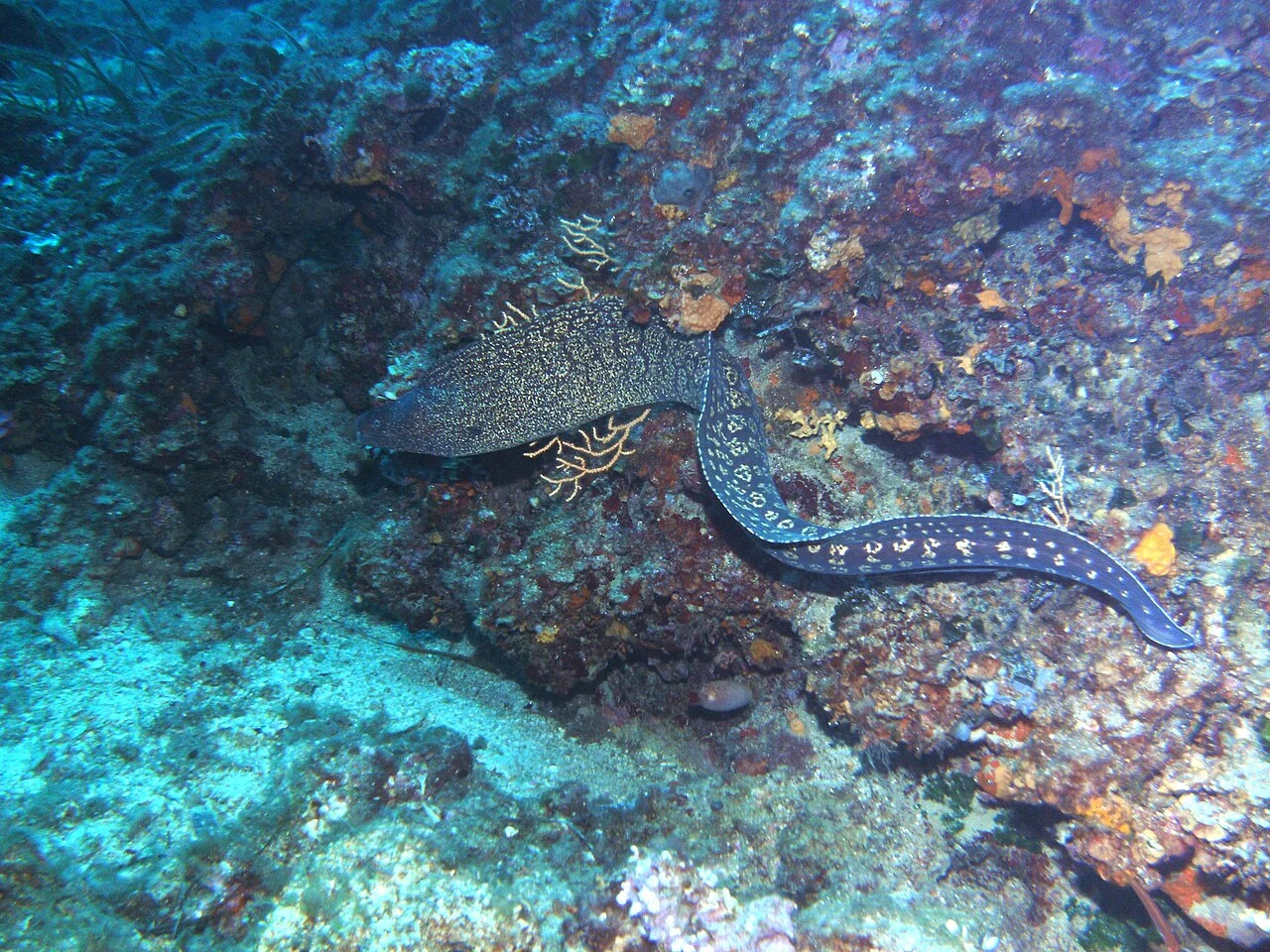
A Mediterranean moray in the open reveals the long body usually hidden behind the head. Habitat photographs show that body plan; they do not document the internal jaw movement.
Photo: steven van tendeoo. Image source · CC BY-SA 3.0. Resized and converted to WebP. No cropping, color changes, or content edits.

How researchers caught the hidden handoff
An ordinary feeding video gives you the outside of the story. To see what happened after the prey crossed the lips, Mehta and Wainwright combined high-speed filming with moving X-ray images, or video fluoroscopy. UC Davis’s veterinary facilities helped make the internal movement visible. Their 2007 work focused on the reticulated moray, Muraena retifera. 3
Imagine replaying the strike one frame at a time. First locate the food; then follow the outer jaws; then track the deeper jaws as they travel toward it. The X-ray view answers the question that an underwater portrait cannot: which structure is actually carrying the food when it moves through the head? That is why the discovery rests on a sequence, not a remarkable-looking still.
The idea had a longer history than the filming. Gareth Nelson’s dissections in 1967 had already suggested that the muscle arrangement could move large prey into a moray’s throat. Four decades later, moving images showed the action. In 2019, Smithsonian work revisited the muscles and corrected parts of earlier anatomical descriptions, including differences between moray subfamilies. 4
For the observer, keep following the food rather than trying to memorize every muscle. The filmed reach and retraction explain the handoff. Later anatomical work refines which muscles move which parts, and reveals differences among morays. The direction of the meal remains the thread connecting the footage, the diagram, and a feeding event glimpsed on a reef.
A second jaw is common; this much travel is not
The surprise is not that a fish can have teeth deeper in its head. Many fishes have throat jaws involved in handling food, including structures suited to crushing or processing it. Morays take that equipment much farther forward. The arrangement lets the throat jaws collect food from the mouth instead of waiting for water to deliver it. 4
A later experiment supplied an especially clear demonstration that the transport need not depend on surrounding water. In a 2021 study, snowflake morays, Echidna nebulosa, were trained to take food on a platform out of the water. They bit the food and swallowed it with pharyngeal transport. The researchers compared feeding movements on land and underwater; this was a controlled experiment with another moray species, not a report that every reef moray normally hunts ashore. 5
Think back to the slippery meal in the outer jaws. The platform experiment removes the current of water you might have imagined doing the carrying. A moving, toothed grip still works. You do not need to see an eel leave the sea to appreciate what that reveals about the bite you might witness underwater.
The better moray encounter is a patient one
Let the eel choose whether to emerge. Keep your hands out of the crevice and never offer food to provoke the mechanism. Florida Museum identifies feeding and contact as circumstances in which bites become more likely. A staged strike would also tell you less about how the animal normally searches and handles prey. 1
If you record a natural feeding event, keep the seconds before and after the bite. A short clip that includes the approach, capture, and disappearance of the meal can be more revealing than a tighter shot ending at the first snap. Back aboard, watch once for the prey and again for the head’s movement. Accept that the internal grip may remain invisible in your footage.
On a Florida Keys or Bonaire reef, a moray resting in its hole is already worth stopping for. Now the rhythmic gape has a meaning, and so does the instant when a captured meal slips out of sight. The reef has not acquired a stranger animal. You have learned to read more of the one that was there.
Sources & further reading
- Florida Museum — Green moray — Breathing, visible teeth, habitat, and observing without feeding or contact.
- Mehta & Wainwright (2007) — Raptorial jaws in the throat help moray eels swallow large prey — Original Nature study and feeding sequences in Muraena retifera.
- UC Davis — ‘Alien’ jaws help moray eels feed — Filming, fluoroscopy, suction-feeding comparison, and the crevice-life hypothesis.
- Smithsonian Ocean — Reexamining the curious jaw of the moray eel — Historical observations and later corrections to descriptions of the muscles.
- Mehta & Donohoe (2021) — Snowflake morays exhibit similar feeding kinematics in terrestrial and aquatic treatments — Experimental evidence for swallowing without surrounding water; a different species from the 2007 study.