Species & behavior
Why some parrotfish sleep inside a mucus bubble
The transparent covering around a resting parrotfish can be a defense against tiny nighttime parasites. Its story links reef behavior, chemistry, and an unusually revealing experiment.
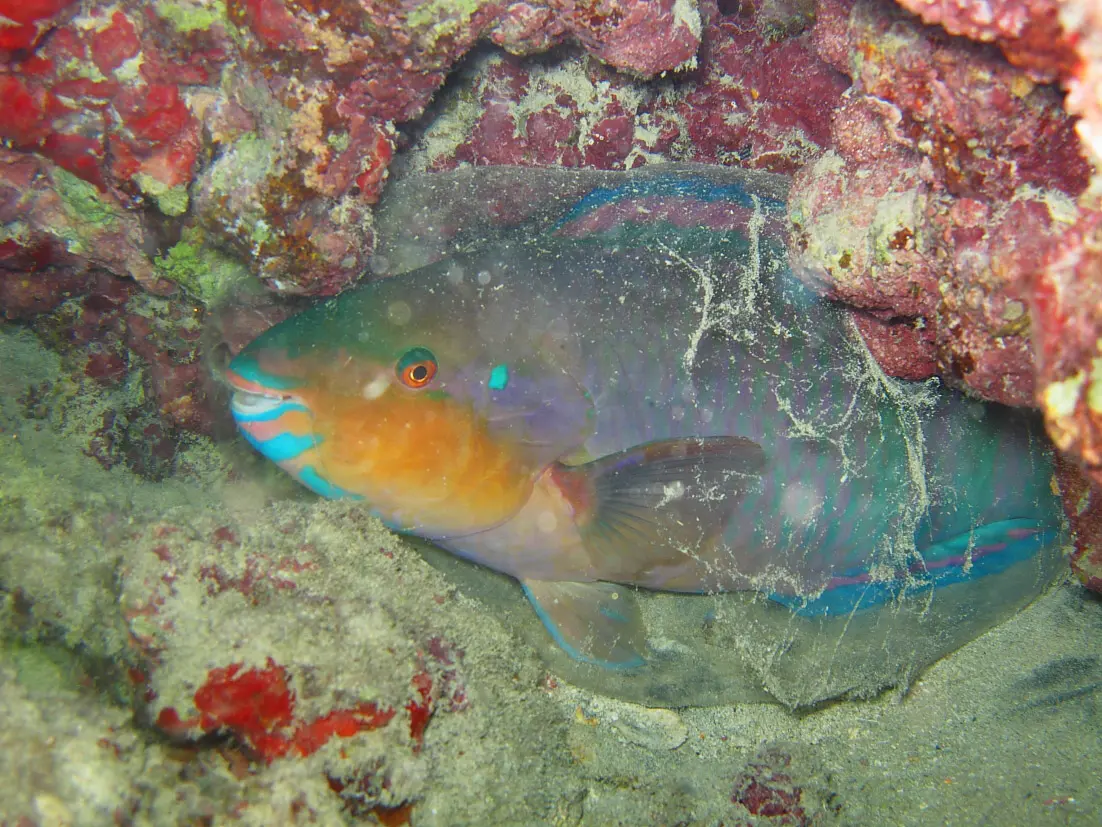
A Zelinda’s parrotfish, Scarus zelindae, inside a mucus cocoon at Abrolhos, Brazil. This is a different species from the Australian fish in the experiment.
Photo: Igor Cristino Silva Cruz. Image source · CC BY-SA 4.0. Resized and converted to WebP. Index thumbnails use a display crop. Image remains under the stated license.

A light passes over a resting parrotfish and catches a faint outline around its body. The covering can look like a loose transparent bag. It is mucus, arranged into a cocoon around the fish rather than merely coating its skin.
For some parrotfish, that covering offers protection from small parasitic crustaceans. An experiment found far fewer attacks when the cocoon remained intact. The familiar description of a nighttime sleeping bag is memorable, but the more revealing comparison is a mosquito net: a barrier between a resting animal and organisms seeking a meal. 1 4
The reef’s night shift has smaller hunters too
A night dive draws attention to conspicuous animals: a moray emerging, a hunting crustacean, or a fish tucked into a crevice. Gnathiid isopods are much easier to miss. Their parasitic juvenile stages attach to fish and feed, then detach again. They are crustaceans, not insects, and the comparison with mosquitoes concerns their way of taking a meal rather than close relatedness. 2
Alexandra Grutter’s feeding experiments showed how quickly that interaction can unfold. In trials using a wrasse host, more than 93 percent of larvae had engorged guts after thirty minutes. Feeding and detachment rates varied with larval stage. The results help explain why a fish might repeatedly seek cleaning: the parasites on its body are not necessarily a fixed group that remains there all day.
This is a different kind of nighttime risk from a predator swallowing the fish. A small parasite may leave its host alive, yet repeated feeding can impose a cost. Resting successfully therefore involves more than finding a crevice too narrow for a large hunter. It can also involve limiting access by animals small enough to be overlooked by a diver.
Daytime cleaning and nighttime covering
Cleaner fish can remove parasites from other fish. In a field experiment reported in Nature, Grutter found that the presence of the cleaner wrasse Labroides dimidiatus reduced parasite abundance on a client species, producing a 4.5-fold difference within twelve hours. It supplied experimental support for the benefit of cleaning, rather than relying only on the appealing sight of two species interacting. 3
That study involved a particular cleaner and client; it was not a direct trial of parrotfish cocoons. It nevertheless establishes an important part of the wider story: fish have ways to reduce parasite loads while active. A resting fish faces the same general problem under different conditions.
The cocoon makes protection part of the resting place itself. Smithsonian’s account illustrates a parrotfish enveloped in mucus, describing its role against parasites during sleep. Think of the difference between visiting a cleaner and maintaining a barrier: one removes organisms that have reached the body, while the other may reduce the chance that they reach it. 1
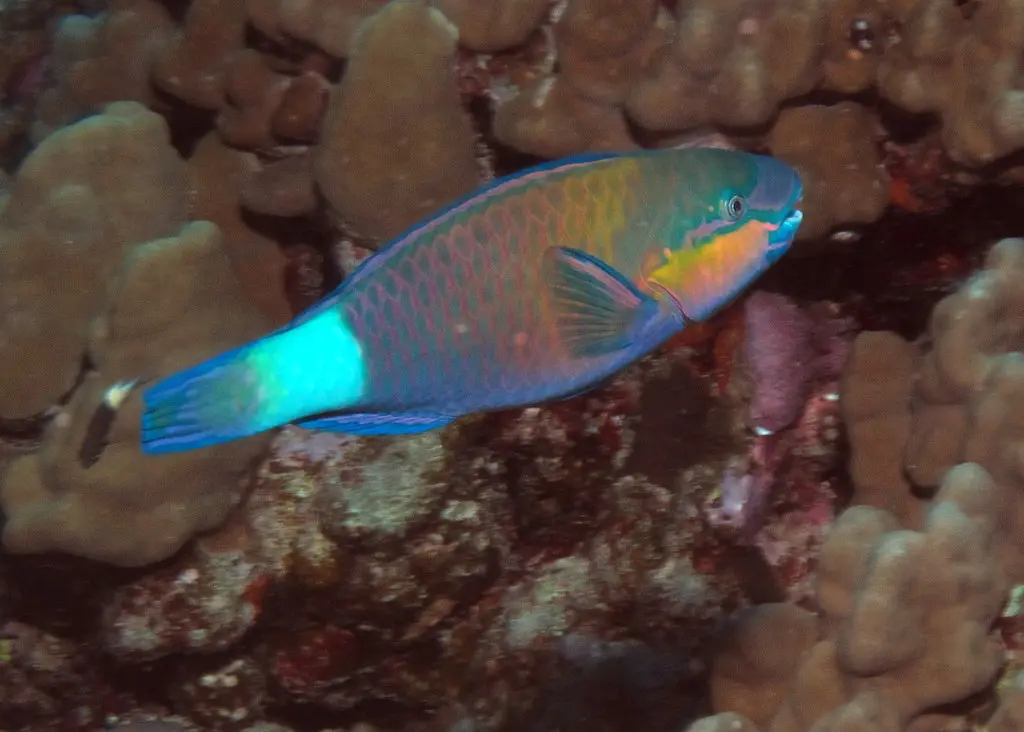
Chlorurus sordidus at Shelenyat Reef in the Red Sea, Egypt. Current Australian references use Chlorurus spilurus for the mainland Australian populations discussed in the older cocoon study.
Photo: Derek Keats. Image source · CC BY 2.0. Resized and converted to WebP. Index thumbnails use a display crop. Image remains under the stated license.
.jpg)
Taking away the cocoon tested the idea
Grutter and colleagues collected parrotfish at Lizard Island on Australia’s Great Barrier Reef. In the 2010 study, they allowed fish to form cocoons, removed the covering from some, and exposed both groups to unfed gnathiids for 4.5 hours. In the analyzed trials, parasites attacked 17 of 18 fish without cocoons, compared with 2 of 20 fish whose cocoons remained—about 94 percent versus 10 percent. 4
The authors also estimated cocoon energy content at roughly 2.5 percent of a daily energy budget. That estimate used another parrotfish species as the energy-budget proxy; it was not a complete measurement of production costs in the study fish.
The key experimental move was to change the covering, rather than simply compare a naturally protected species with an unrelated unprotected one. That made the result a much more direct test of whether the cocoon mattered. The outcome concerns parasite attacks under the trial conditions; it does not translate into a claim that a wild fish gains a particular percentage chance of surviving the night.
Mucus is a material, not just a texture
A separate study of queen parrotfish examined the cocoon’s chemistry. Researchers described a network of small glycoproteins—proteins bearing carbohydrate components—and found that prepared mucus samples and an isolated protein inhibited bacterial growth in laboratory tests. 5
That opens another way to think about the covering. Its physical form and its chemistry can both matter. A layer might interfere with contact, alter chemical cues, or affect organisms that encounter it. Those are different mechanisms, and demonstrating one biological effect does not automatically identify which mechanism produced it.
The antibacterial result also needs to stay attached to what was tested: prepared material in a laboratory assay. It does not establish that every intact cocoon sterilizes the water around a sleeping fish. What it does show is that the material deserves investigation in its own right, beyond its visible shape.
Ordinary fish mucus also has biological functions. A review by Kerry Shephard examines its roles in exchange with the surrounding water, defense, and movement. The large external cocoon is a specialized arrangement, but it builds on a material already central to life at a fish’s surface. 6
What about hiding from moray eels?
The idea that cocoons conceal a sleeping fish from predators has a long history. Howard Winn and John Bardach investigated moray feeding preferences in 1959 and proposed a possible protective role for parrotfish mucus envelopes. Their title itself treated that role as a possibility. Comparing the consumption of different fish species, however, leaves several explanations open, because the prey differ in more than their coverings. 7
The parasite experiment asks a narrower question more directly. A cocoon could conceivably serve several purposes, but those purposes need their own evidence. There is no need to discard the interesting observation—a fish surrounds itself with a transparent material—when a familiar explanation turns out to be less settled than expected.
Species names add one more detail. The Australian experiment called its fish Chlorurus sordidus. Current Australian references distinguish the mainland Australian populations as Chlorurus spilurus. Keeping the original study name beside that later treatment makes the research easier to follow. Our cocoon photograph shows Scarus zelindae, so it illustrates the behavior without posing as an image of the experimental animal. 8
How to observe a resting fish
If you notice a cocoon on a night dive, pause far enough away to avoid touching either fish or covering. Look for the outline and the space it encloses. A short observation can reveal the structure without requiring you to poke it, wake the fish, or keep a light fixed on it for an extended period.
A useful photograph records the whole animal, its resting position, and enough surroundings to place the behavior in context. Label the species only as confidently as the visible features allow. A cocoon is a behavioral clue, not a species-identification key.
Explore the Great Barrier Reef map for the region of the experiment, or continue with the Bonaire nursery story to see another side of parrotfish life. From feeding grounds to resting places, a reef animal’s day contains several different problems to solve—and some solutions are almost transparent.
Sources & further reading
- Smithsonian Ocean — Parrotfish in mucus cocoon — Description and illustration of the resting covering.
- Grutter (2003), Feeding ecology of the fish ectoparasite Gnathia sp. — Marine Ecology Progress Series 259, 295–302; feeding and detachment experiments.
- Grutter (1999), Cleaner fish really do clean — Nature 398, 672–673; experimental evidence for parasite removal.
- Grutter and colleagues (2010), Fish mucous cocoons: the ‘mosquito nets’ of the sea — Published online in 2010; Biology Letters 7, 292–294 (2011 issue). Cocoon-removal experiment and energy estimate.
- Videler, Geertjes & Videler (1999), Biochemical characteristics and antibiotic properties of the mucous envelope of the queen parrotfish — Journal of Fish Biology 54, 1124–1127.
- Shephard (1994), Functions for fish mucus — Reviews in Fish Biology and Fisheries 4, 401–429.
- Winn & Bardach (1959), Differential food selection by moray eels and a possible role of the mucous envelope of parrot fishes in reduction of predation — Ecology 40, 296–298; the earlier predator hypothesis.
- Fishes of Australia — Greenfin parrotfish, Chlorurus spilurus — Museum species account explaining the Australian taxonomic treatment.