Species & behavior
How a bluehead wrasse changes sex when its social world changes
A change in the reef’s social order can set off a transformation in behavior, appearance, and reproductive anatomy. Those changes do not all happen at once.
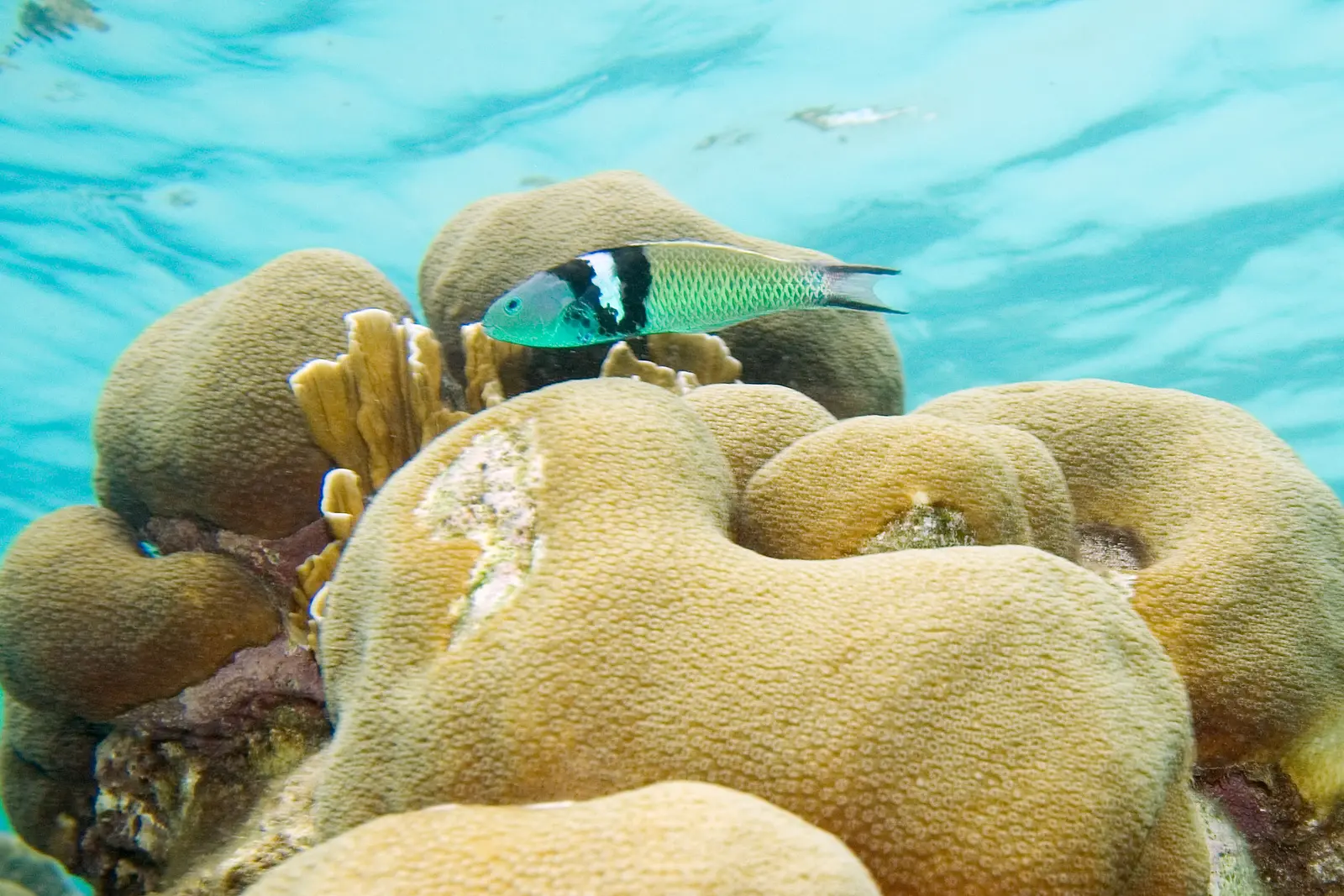
A terminal-phase bluehead wrasse photographed off Bonaire. Its blue head and contrasting bands differ from the appearance of initial-phase fish.
Photo: Paul Asman and Jill Lenoble. Image source · CC BY 2.0. Resized and converted to WebP. Index thumbnails use a display crop. Image remains under the stated license.
.jpg)
A blue-headed fish patrols above a Caribbean reef, passing smaller yellow-and-white fish. The colors seem to offer a simple way to sort them. Yet some of those smaller fish are female, some are male, and a female can later become a reproducing male.
In the bluehead wrasse, Thalassoma bifasciatum, a change in social opportunity can start that transformation. When a dominant male disappears, a large female may assume the male behavioral role before her ovaries have become testes. This is a sequence of changes, not an instantaneous switch of color and anatomy. 1 2
Two color phases, more than two life histories
The bluehead wrasse lives in the tropical western Atlantic, including Caribbean reefs. Initial-phase fish commonly have yellow and pale areas with a dark stripe along the side. Terminal-phase fish have the blue head and contrasting bands that make them easier to recognize. Initial phase and terminal phase describe appearance; they are not simply alternative words for female and male. 1
Some males mature as males while retaining an initial-phase appearance. Other males were previously females. Either route can lead to the terminal phase. Thus, seeing a blue-headed individual tells you more about its present appearance than its entire reproductive history.
Biologists use protogyny for a female-to-male reproductive sequence. The term is useful, but it does not mean every member of this species starts as a female, every female eventually changes, or every yellow fish is waiting for its turn. The reef’s social arrangement matters, as do the fish’s size and opportunity.
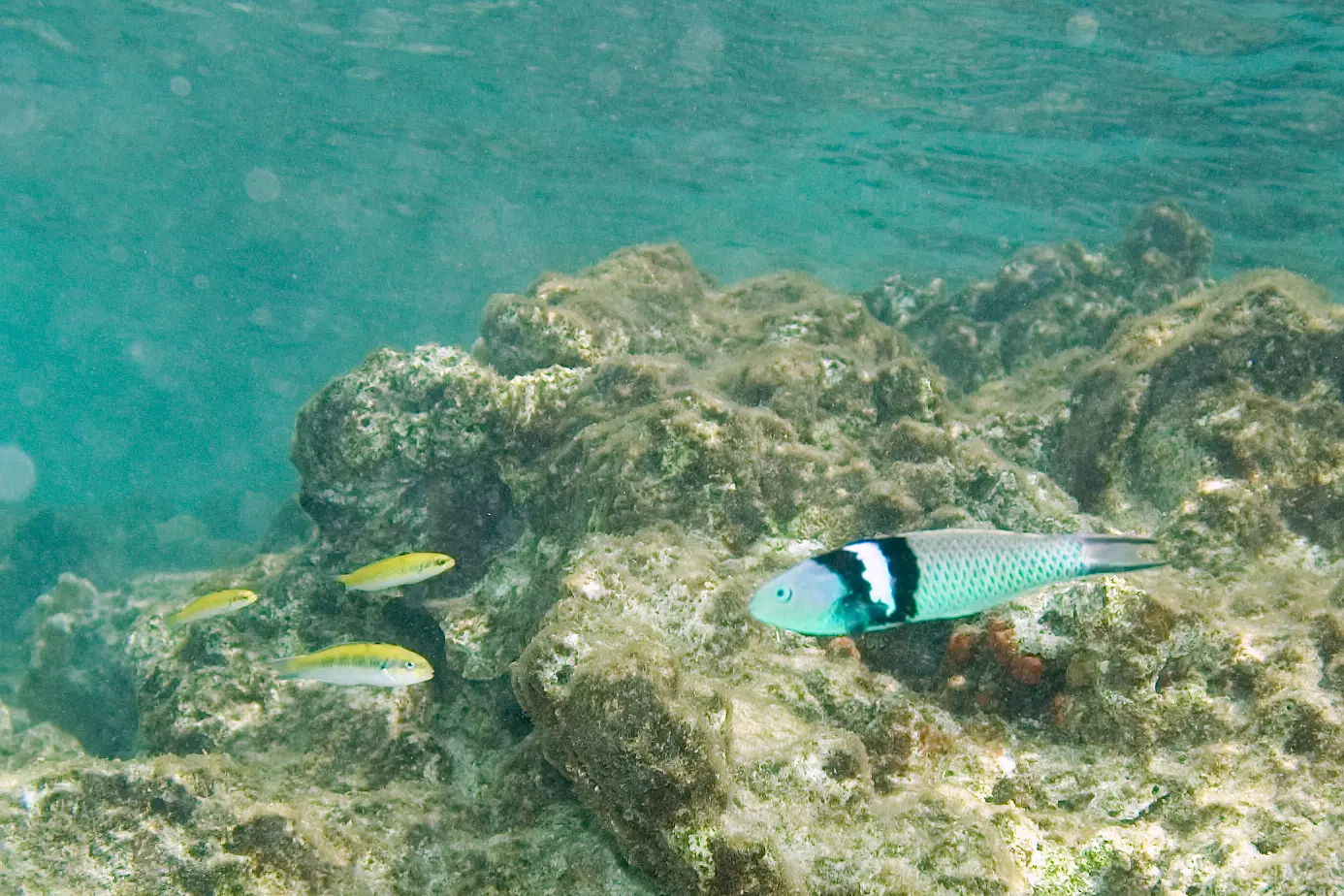
Bluehead wrasses of different color phases off Bonaire. The yellow initial-phase individuals cannot be assigned a sex from color alone.
Photo: Paul Asman and Jill Lenoble. Image source · CC BY 2.0. Resized and converted to WebP. Index thumbnails use a display crop. Image remains under the stated license.
.jpg)
What happens when the dominant male disappears?
Robert Warner and Stephen Swearer tested social control in the field. Removing large terminal-phase males triggered changes in the largest initial-phase females. Control groups, in which dominant males were handled and returned, did not show the same response. The design helped separate a change in social conditions from the disturbance caused by researchers handling fish. 2
The speed was revealing. Fish previously observed spawning as females began male-typical behavior within minutes after the removals. The researchers later examined reproductive tissue to verify actual sex change. Mature sperm could appear in as little as eight days. Acting in the male role on the first day therefore did not mean that a complete reproductive transformation had already occurred.
Imagine observing only one part of that sequence. A diver watching courtship might record a changed role. A photographer might record a changing pattern. A tissue sample might reveal a transitional organ. Each observation answers a different question, which is why the strongest account combines behavior and anatomy rather than treating one as a substitute for the other.
The loss of a male is a change in opportunity, not an instruction understood in human language. Researchers can identify a social trigger without claiming that the fish consciously decides to rebuild its body.
Behavior starts before the reproductive machinery is ready
A later experiment asked whether functioning reproductive organs were necessary for that early behavioral response. John Godwin and colleagues removed the gonads from females before changing their social status. The fish could still assume male-typical behavior after becoming dominant. The result showed that the early behavioral transition did not require a newly functioning testis. It did not mean the fish could reproduce without reproductive organs. 3
This distinction is central to the story. An animal’s behavior, hormone signaling, and reproductive tissue interact, but they need not change in lockstep. A rapid shift in courtship can precede the slower work of dismantling one tissue state and establishing another.
The neural signals also resist a one-hormone explanation. Research reviewed by Melissa Lamm and colleagues connects male-typical behavior with the signaling molecule arginine vasotocin and highlights estrogen synthesis in the brain and gonads. These findings point to a coordinated system, with several possible links between a social event and a bodily response. 4
How an ovary becomes a testis
In 2019, Erica Todd and colleagues investigated wild bluehead wrasses undergoing sex change off Florida. They compared gene activity and DNA methylation—a form of chemical marking involved in gene regulation—across stages of the transition. Activity associated with maintaining ovarian function declined, while male-associated pathways became active. The aromatase gene, involved in making estrogens, was an early part of that shift. 5
Their results supported a period of extensive tissue reorganization, rather than merely increasing the proportion of an already working male organ. The study also identified changes in the regulatory machinery controlling gene expression. This is a change in how genetic information is used, not evidence that the fish replaces its genome.
A timeline summarized in the paper separates the stages: behavior changes within hours; ovarian degeneration follows; testicular tissue develops over the next several days; and sperm production can occur around days eight to ten. Full terminal coloration can take roughly twenty days. The timing is a research-based sequence, not a stopwatch that every fish follows exactly.
A useful experiment—and a limit to the explanation
Another field study tested estrogen more directly. Large females with estradiol implants did not undergo the same behavioral changes as control females after researchers removed more dominant fish. The effect occurred in fish with and without ovaries. That intervention provides evidence that estrogen signaling can influence the behavioral transition, rather than merely changing alongside it. 6
It still does not supply a complete wiring diagram from seeing a rival disappear to producing sperm. The 2019 study proposed involvement of stress-related signaling, but a proposed pathway is not proof that ordinary stress of any kind will make a wrasse change sex. The social context and the species’ biology are essential parts of the explanation.
The practical lesson is to keep three questions separate: what the fish does, what it looks like, and what its reproductive organs can do. The research becomes more interesting when those answers differ for a while.
What you can observe without changing the experiment
On a Caribbean reef, look for the relative sizes of nearby wrasses, the places a terminal-phase fish revisits, and how other fish respond when it approaches. Record an interaction as a chase or a display before assigning it a motive. An observation becomes more useful when it distinguishes what you saw from what you infer.
Leave the social group intact. Trying to drive away a dominant fish would change the very behavior you want to understand. Repeated, undisturbed observations and clearly labeled photographs are more informative than an encounter engineered for a dramatic moment.
Visit the bluehead wrasse profile and explore the Florida Keys or Grand Cayman. A common small reef fish can offer a close view of a biological process that runs from social behavior down to the regulation of genes.
Sources & further reading
- Florida Museum — Bluehead, Thalassoma bifasciatum — Range, identification, and reproductive natural history.
- Warner & Swearer (1991), Social control of sex change in the bluehead wrasse — Biological Bulletin 181, 199–204; field manipulation and tissue confirmation.
- Godwin, Crews & Warner (1996), Behavioural sex change in the absence of gonads in a coral reef fish — Proceedings of the Royal Society B 263, 1683–1688.
- Lamm and colleagues (2015), The need for speed: neuroendocrine regulation of socially-controlled sex change — Integrative and Comparative Biology 55, 307–322; synthesis of neuroendocrine evidence.
- Todd and colleagues (2019), Stress, novel sex genes, and epigenetic reprogramming orchestrate socially controlled sex change — Science Advances 5, eaaw7006; gene regulation and the transition timeline.
- Marsh-Hunkin and colleagues (2013), Estrogenic control of behavioral sex change in the bluehead wrasse — Experiments testing estradiol’s influence on behavioral change.