Species & behavior
Why young blue tangs are yellow—and adults raid other fish’s gardens
The Atlantic blue tang changes more than its color as it grows. Its life reveals a reef divided into feeding grounds, defended borders, and opportunities to join a crowd.
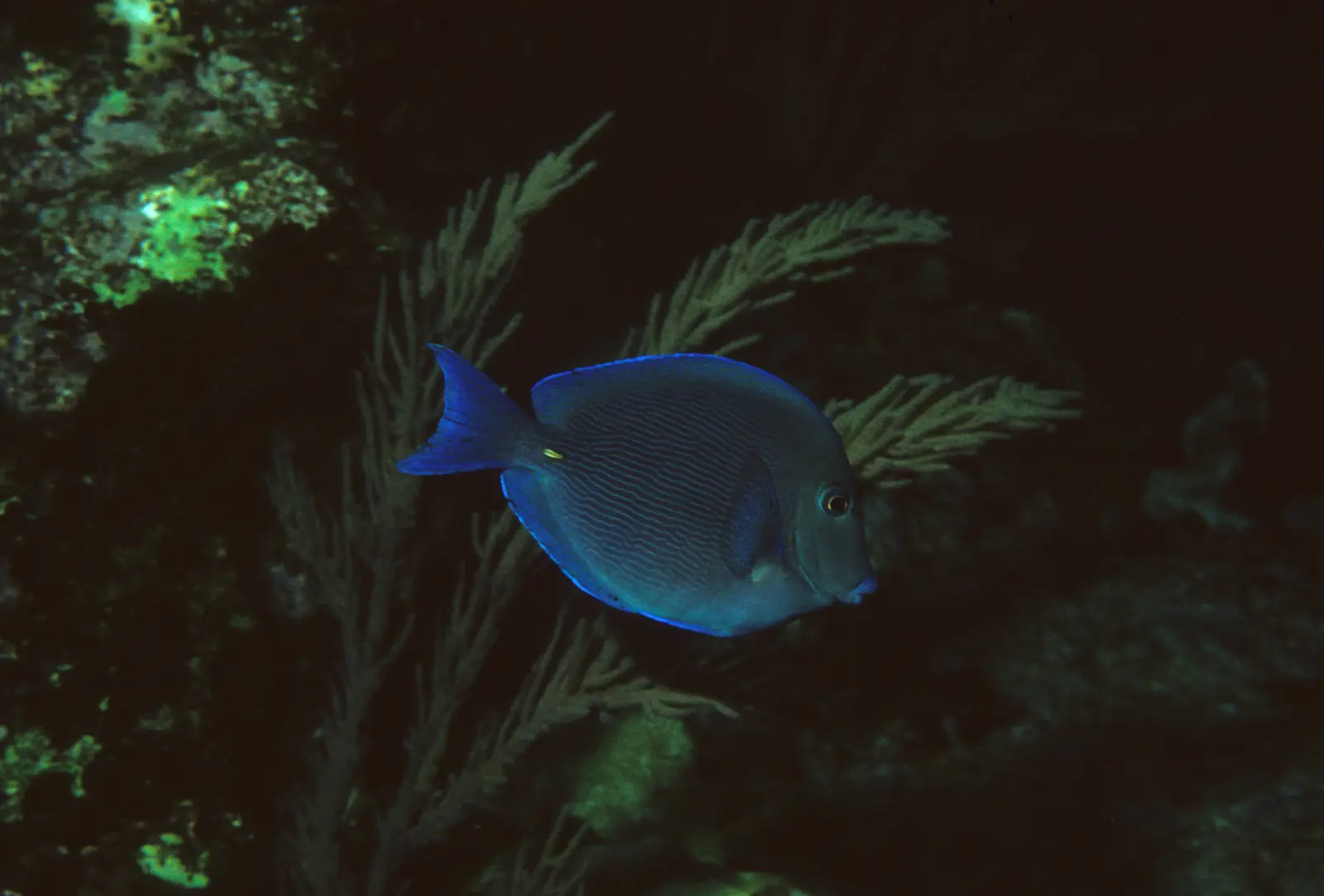
An adult Atlantic blue tang, Acanthurus coeruleus, photographed in the Caribbean Sea. Its juvenile phase is yellow.
Photo: Dr. Dwayne Meadows, NOAA/NMFS/OPR. Image source · CC BY 2.0. Resized and converted to WebP. Index thumbnails use a display crop. Image remains under the stated license.

A small yellow fish picks at a patch of reef. Nearby, a group of blue fish moves past, stopping to graze before continuing together. It is easy to give the yellow fish one name and the blue fish another. In the Caribbean, both may be Atlantic blue tangs at different stages of life.
The yellow juvenile becomes blue as it develops. Meanwhile, access to food helps explain why some tangs defend small areas and others travel in feeding groups. Those groups can gain entry to algae patches that a solitary fish struggles to use. To understand the animal, watch where it feeds and which fish interrupt it—not just its color. 1 3
First, make sure you have the right blue tang
The Atlantic blue tang, Acanthurus coeruleus, has a deep, flattened body and a small mouth. Juveniles are yellow; intermediate fish can combine blue and yellow; adults become blue to purplish. The yellow mark at the tail base draws attention to a spine on each side. Each spine rests in a groove and can serve in defense. This is the anatomical feature behind the name surgeonfish. 1
This Atlantic species differs from the Indo-Pacific palette surgeonfish, Paracanthurus hepatus, familiar from Finding Nemo and Finding Dory. A shared common name does not make the two interchangeable. When reading about blue tang behavior, checking the scientific name prevents an account of one ocean’s fish from becoming a story about another.
Yellow-to-blue development is well documented. A more ambitious claim—exactly why evolution favored yellow juveniles—needs separate evidence. Color might invite an explanation involving camouflage or communication, but a photograph alone cannot establish either. The useful first answer for a snorkeler is that yellow can identify a life stage, rather than a different species or a sick adult.
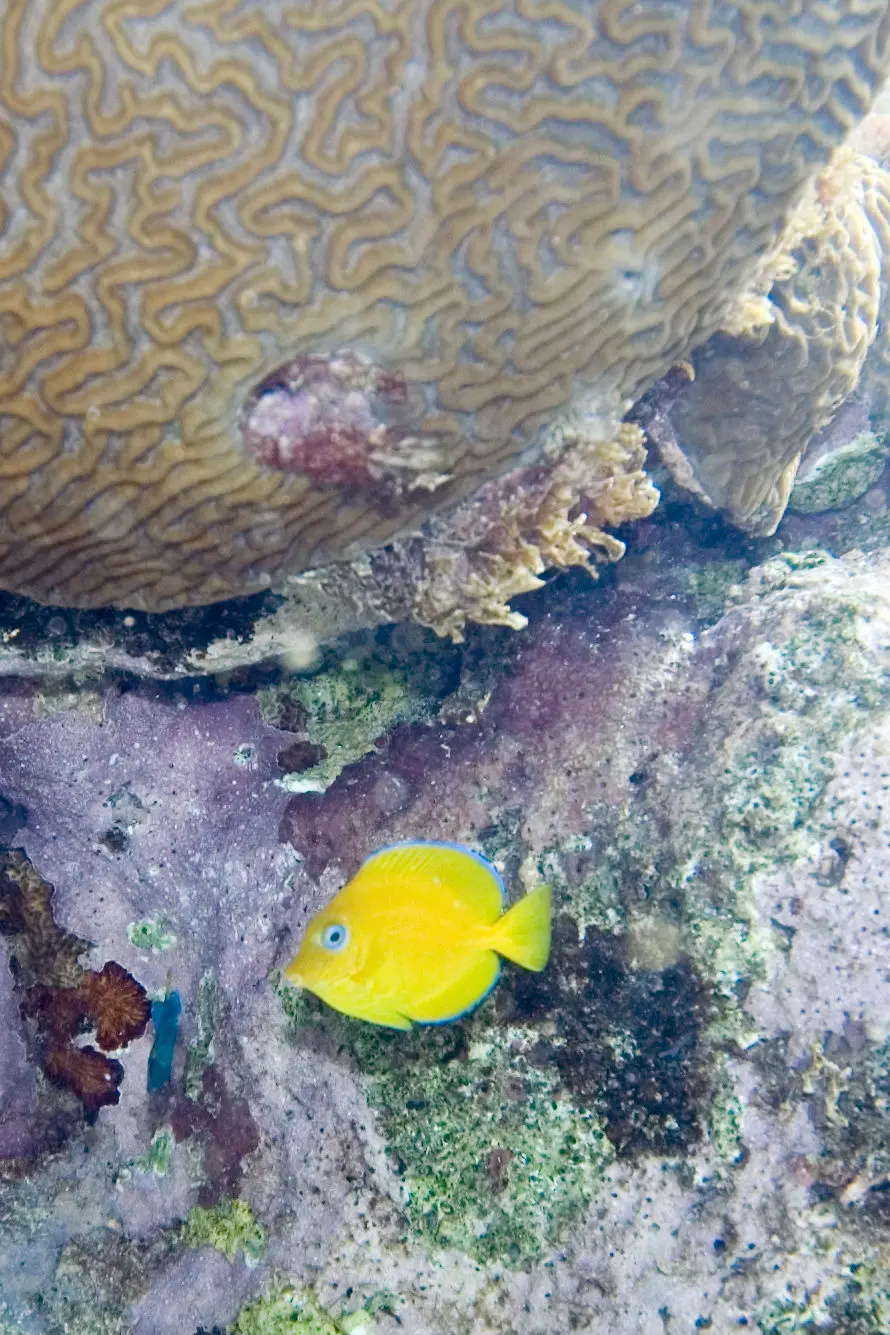
The juvenile phase. Look beyond the yellow color to the body shape and small grazing mouth when comparing it with an adult.
Photo: Paul Asman and Jill Lenoble. Image source · CC BY 2.5. Resized and converted to WebP. Index thumbnails use a display crop. Image remains under the stated license.

A young fish’s world can be smaller than your beach towel
On a fringing reef in Barbados, Thomas Bell and Donald Kramer studied yellow juveniles that lived alone in stable home ranges. The median home range measured 0.85 square meters. Larger juveniles used larger areas, and the fish occupied some reef zones much more often than others. Those measurements describe that study reef, rather than a fixed territory size for every juvenile tang. 2
That finding changes how you might watch one. Instead of following it until it disappears, remain still and see whether it returns to the same few feeding surfaces. Does it cross the sand, turn back at a coral edge, or chase a similar-sized neighbor? A repeated route can reveal more than a single close-up.
A home range and a territory are also different ideas. A home range describes the area an animal uses; a territory involves defending access. The Barbados juveniles showed territorial behavior within their small worlds. For a growing grazer, even a patch that looks unremarkable to a diver can contain food worth defending.
The garden already has an owner
Algae do not all grow on unclaimed ground. Some damselfish defend patches of reef against other grazers. In Susan Foster’s work on group foraging, solitary blue tangs were largely excluded from algal mats defended by dusky damselfish. Feeding in a group changed their access to those resources. 3
Think of the encounter as a problem of divided attention. A defender can chase one intruder, but several arrivals create more opportunities to take bites while the defender deals with another fish. Calling this a raid describes the outcome; it does not require the tangs to plan an attack or assign roles.
The distinction matters because a feeding school can look coordinated without proving human-like cooperation. What we can observe is who approaches, who gets chased, and who succeeds in feeding. Those are enough to show that the number of fish arriving together can change the value of a food patch.
Blue tangs primarily graze algae, including fine filamentous growth. Their feeding mouth repeatedly contacts the substrate, so a reef surface that looks bare from several meters away may still provide food. Watching the bites at a respectful distance is more informative than assuming the fish must be searching for something large enough for us to see. 5
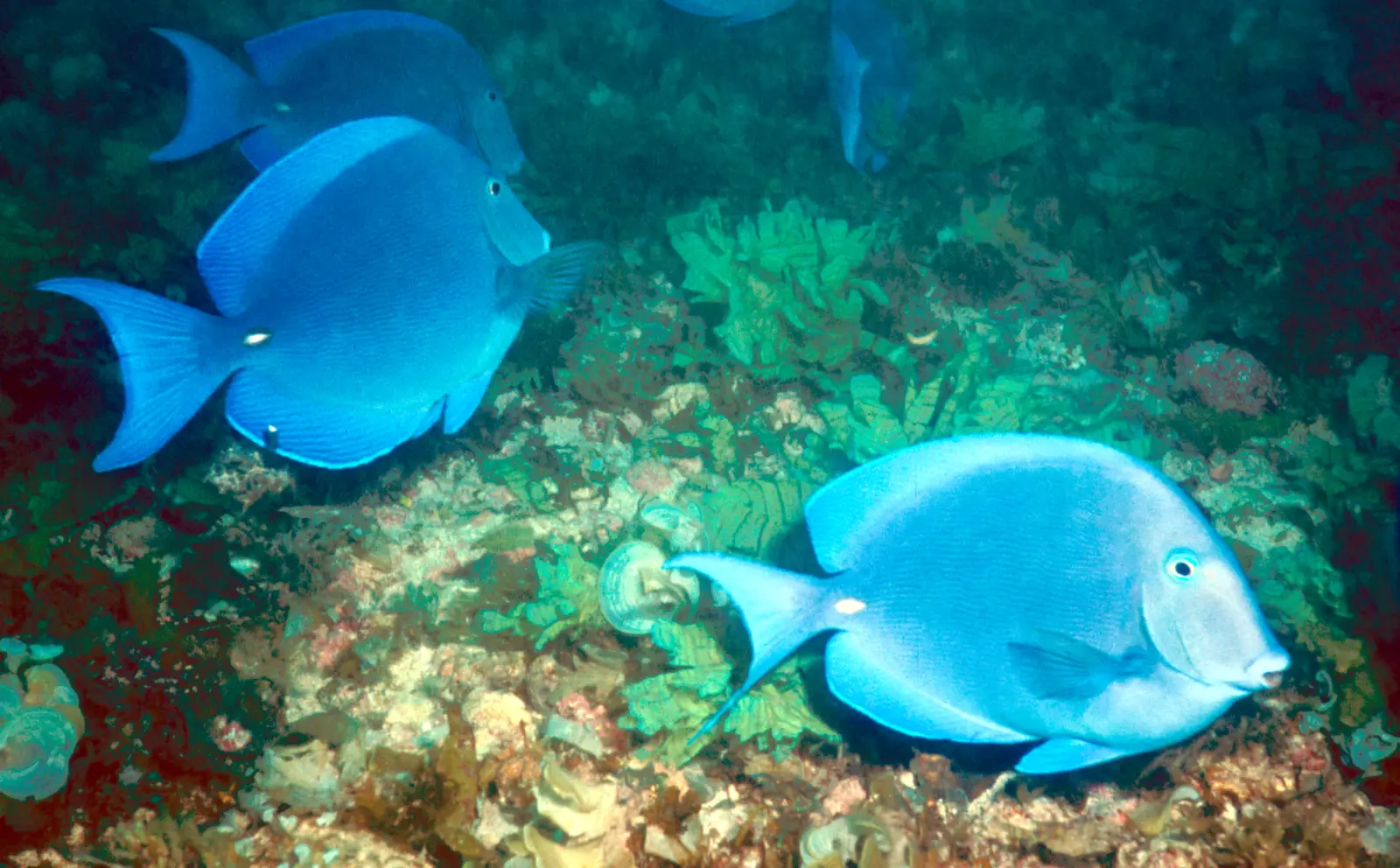
Grouping can change access to defended food. This photograph shows a school; it does not by itself establish that the fish were raiding a damselfish territory.
Photo: Marinha do Brasil. Image source · CC BY-SA 2.0. Resized and converted to WebP. Index thumbnails use a display crop. Image remains under the stated license.
_(52504659720).jpg)
Adults do not all live the same way
In another Barbados study, Ingrid Morgan and Donald Kramer distinguished territorial, schooling, and wandering behavior in adult blue tangs. Territorial fish stayed within smaller areas, chased other tangs, and fed more frequently. Schooling fish covered more ground, while wandering fish moved without a close association and visited cleaning stations more often. Tagged fish and repeated observations helped the researchers distinguish patterns from momentary impressions. 4
These are descriptions of behavior, not three separate types of blue tang with permanent labels. A lone fish passing you might be traveling between resources. A fish repeatedly circling the same patch may be doing something quite different. The difference emerges over time.
Blue tangs also appear in observations of reef fish feeding on material attached to sea turtles. Researchers in the southwestern Atlantic documented tangs grazing a hawksbill’s shell and picking around its neck and flippers. Such encounters show how a grazer can use a living surface as well as a reef surface. They do not mean that every tang regularly cleans turtles, or that every peck targets a parasite. 6
What to look for on your next reef visit
Choose one question before you start watching: is this fish staying, traveling, or feeding with others? Then note its size, color phase, nearby grazers, and any repeated chases. If a group passes, look for the fish that remain behind and defend the same spot. The defender can be as revealing as the visitors.
Avoid swimming into a school or offering food to produce a closer encounter. Both change the behavior you came to understand. A stationary observation gives you a better chance of seeing an undisturbed feeding sequence, including the pauses and unsuccessful approaches that a photograph leaves out.
Explore the Atlantic blue tang profile alongside the Florida Keys or Bonaire map. The next yellow juvenile you notice may occupy only a tiny patch of that map, yet the patch can contain a complete story about food, growth, and competition.
Sources & further reading
- Florida Museum — Blue tang, Acanthurus coeruleus — Identification, color phases, and tail-spine anatomy.
- Bell & Kramer (2000), Territoriality and habitat use by juvenile blue tangs — Environmental Biology of Fishes 58, 401–409; Barbados field observations.
- Foster (1985), Group foraging by a coral reef fish — Animal Behaviour 33, 782–792; access to defended algal resources.
- Morgan & Kramer (2004), The social organization of adult blue tangs — Environmental Biology of Fishes 71, 261–273; territorial, schooling, and wandering behavior.
- Animal Diversity Web — Acanthurus coeruleus — Diet and biological background.
- Sazima and colleagues — Turtle cleaners: reef fishes foraging on epibionts of sea turtles — Field observations from the tropical southwestern Atlantic.