Species & behavior
Why Reef Fish Visit Cleaning Stations—and Sometimes Jolt Away
A reef fish holds still for a tiny cleaner wrasse, then jolts or gives chase—a brief exchange that reveals both the benefit of cleaning and the conflict over what gets eaten.
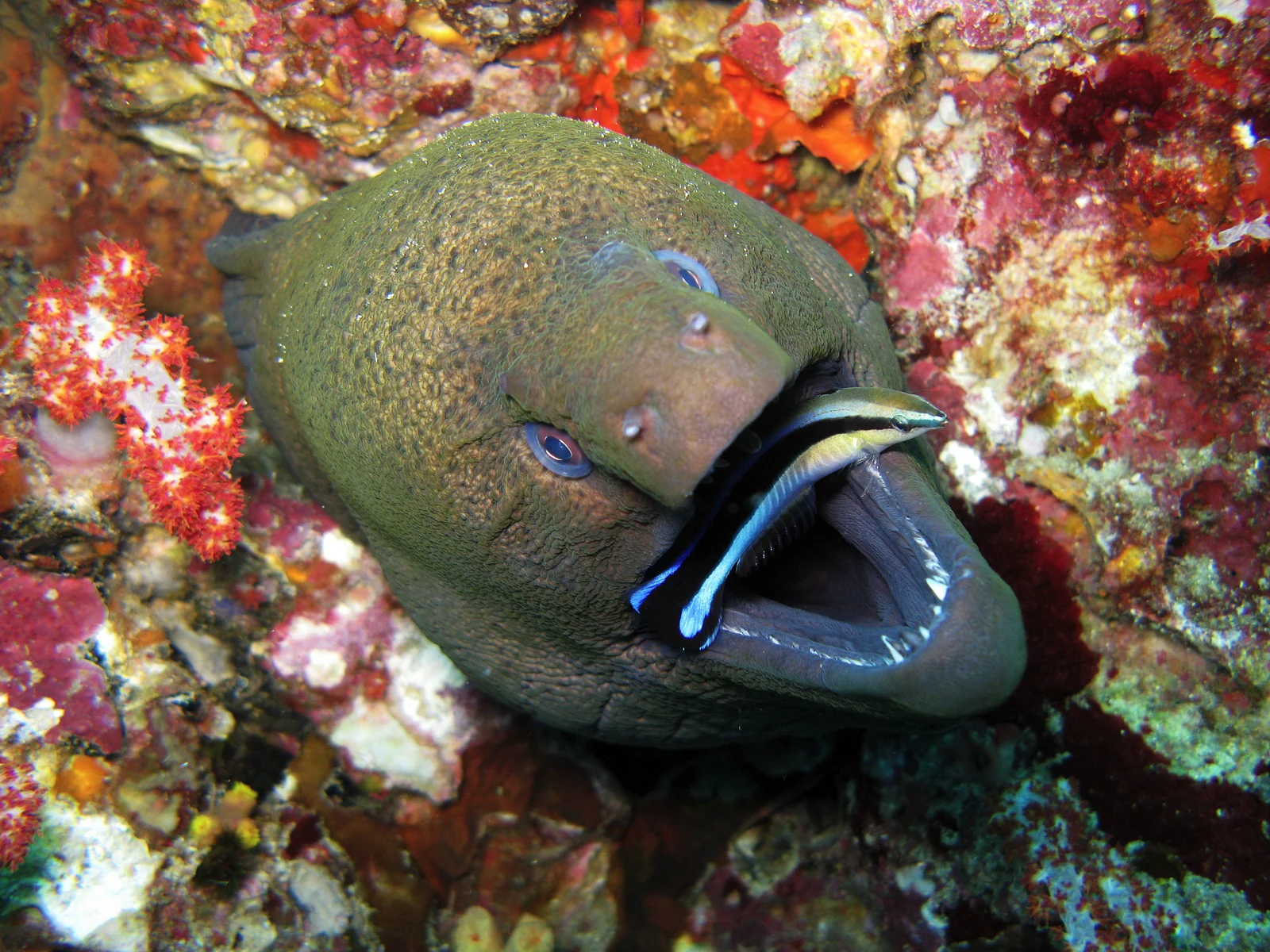
A bluestreak cleaner wrasse, Labroides dimidiatus, at the open mouth of a giant moray, Gymnothorax javanicus, in Thailand’s Andaman Sea. Look for the small striped fish before focusing on the teeth; its position reveals a cleaning visit rather than a captured meal.
Photo: Silke Baron. Image source · CC BY 2.0 Generic. Resized and converted to WebP; full frame retained in the article. Index thumbnails use a display crop. Photograph remains under the stated license.

On your next Indo-Pacific reef dive, look for a fish holding still while a smaller, black-striped wrasse moves along its body. That pause can be a cleaning visit: the larger fish gets parasites removed, while the wrasse finds a meal—and a sudden jolt may reveal where their interests diverge. 1 2 3
Start with the fish that seems to have stopped doing anything. Instead of grazing or traveling, it holds a position as the cleaner approaches. Watch through the first few contacts. Does the client stay, turn to present another surface, or pull away? The event becomes more interesting when you follow both animals, because a visit that benefits each of them still leaves room for disagreement.
The fish holding still is your first clue
A cleaning station need not look different from the surrounding reef. Look for a repeated interaction around a coral outcrop: a larger fish pauses, a smaller one approaches its surface, and another visitor may arrive after the first leaves. The location becomes recognizable through those exchanges. A cluster of fish alone does not identify a station; the close inspection gives you the missing evidence. 1
The bluestreak cleaner wrasse, Labroides dimidiatus, has a broad black stripe along its side, with pale areas toward the head and blue toward the rear. Juveniles look different: predominantly dark, with a bright blue stripe. Keep that name with the observation. This article follows research on this Indo-Pacific cleaner, rather than treating every small fish picking at another animal as the same species. 1
Once you find a likely cleaner, follow its mouth rather than its speed. Does it repeatedly approach the client's flank? Does the client keep that surface available? A fish passing close to another gives you proximity; repeated inspection and a client that holds position give you a sequence. If the cleaner disappears behind a gill cover or the far side of the body, wait for it to reappear instead of circling the client to keep it in view.
The food can be too small for your mask or camera to resolve. Among the cleaner's prey are gnathiid isopods, crustaceans whose juvenile stages take meals from fish. Alexandra Grutter tested whether cleaning actually reduced parasites on the client wrasse Hemigymnus melapterus. Access to cleaners produced a 4.5-fold difference in parasite abundance within twelve hours in that experiment. Those counts establish a benefit that an underwater photograph cannot measure. 2
Look back at the client holding its flank within reach. What appeared to be inactivity makes a feeding surface available to another fish, and the resulting meal can remove unwanted passengers. You do not have to see each parasite to recognize the interaction. Record the cleaner's contacts and the client's posture; leave the size of the parasite load to the methods that can actually count it.
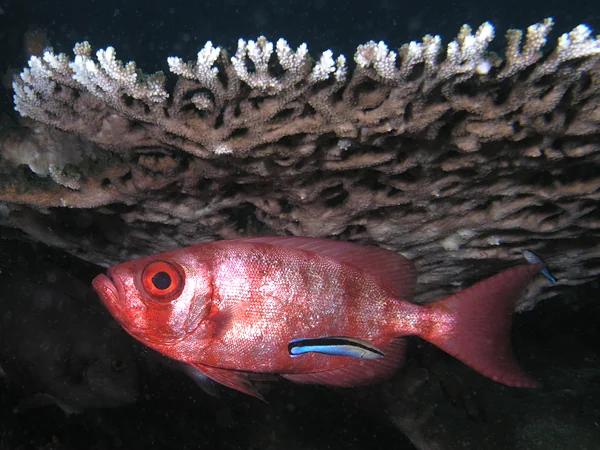
A cleaner beside Priacanthus hamrur beneath coral in Komodo National Park, Indonesia. Look for the dark stripe on the smaller fish and its position along the client’s flank; the food itself is too small to identify here.
Photo: Nick Hobgood. Image source · CC BY-SA 3.0 Unported. Resized and converted to WebP; full frame retained in the article. Index thumbnails use a display crop. Photograph remains under the stated license.

Stay for the jolt—and watch what follows
A client may interrupt the stillness with a quick body jolt. The useful detail is its timing: did it follow contact by the cleaner, and did the client then leave or chase? Researchers use contact-linked jolts as an indicator of an unwelcome bite. A twitch by itself does not identify what entered the cleaner's mouth, especially if your own approach disturbed the fish. 3 4
The conflict lies on the same surface as the food. A cleaner can eat parasites, but it can also take the client's mucus. In a feeding-choice experiment, Grutter and Redouan Bshary offered cleaners mucus, two kinds of parasites, and a control material on plates. The fish ate more mucus and parasitic flatworms than gnathiid isopods. The result shows why the most useful meal for the client need not be the cleaner's preferred choice. It does not mean that cleaners prefer mucus to every parasite. 3
Now the departure matters. When a client leaves, the cleaner loses access to its feeding surface. When a client chases, the next few seconds contain a cost as well as a meal. Follow the direction of that exchange: which fish breaks away, and which follows? A client pursuing a cleaner after a jolt is a different scene from a cleaner approaching a new arrival.
Bshary and Grutter tested whether consequences could alter the cleaner's choices using plates carrying preferred prawn pieces and less-preferred fish flakes. Taking prawn made a plate retreat or chase the cleaner; taking flakes did not. Cleaners exposed to those responses subsequently reduced their preference for the food that triggered them. These were artificial feeding tasks, but they tested how losing access or facing pursuit could favor more cooperative feeding. 4
Back at the outcrop, keep watching after the interruption. Does the client return to position? Does the cleaner approach again? You need not call either fish angry, apologetic, or dishonest to find the exchange worth recording. The visible chain—contact, jolt, departure or chase—gives the research a place in the encounter. A clip that ends at the first contact would miss most of it.
Sometimes the fins do the work
There is another contact to look for, and it involves the cleaner's fins. A wrasse can position itself against the upper part of a client and touch it with its pectoral and pelvic fins while pointing its head away from the client's body. In that posture, the mouth is not picking at the skin. If your view resolves the fins, you can distinguish touching from feeding. 5
Bshary and Manuela Würth documented this tactile stimulation during 112 hours of observations on twelve cleaners. Their results suggested that fin contact helped keep clients at an inspection and sometimes followed a jolt and conflict. Predatory clients received it more often than nonpredatory ones. The researchers proposed a role in managing those interactions; a still photograph alone cannot establish that a particular touch repaired a disagreement. 5
To test a benefit of touch separately from parasite removal, Marta Soares and colleagues gave surgeonfish access to cleaner-shaped models. Some models moved and provided physical stimulation; the comparison models stayed stationary. Fish exposed to the moving models had lower levels of the stress hormone cortisol. Because models were doing the touching, the experiment separated physical contact from a live cleaner's feeding. 6
That result gives you a second reason to watch a client remain in place. Not every useful moment at a cleaning station has to involve a parasite entering a mouth. The contact itself can matter. It does not let you read a wild fish's hormone level through its posture, but it does make the difference between a peck and a fin stroke worth noticing.
On a video, replay a clear contact once with attention on the cleaner's head, then again on its fins. Can you see which part touches the client? If the image is too distant, keep the observation at 'close contact.' A wider frame that preserves both fish is often more useful than a tight crop that hides the posture you need to interpret the exchange.
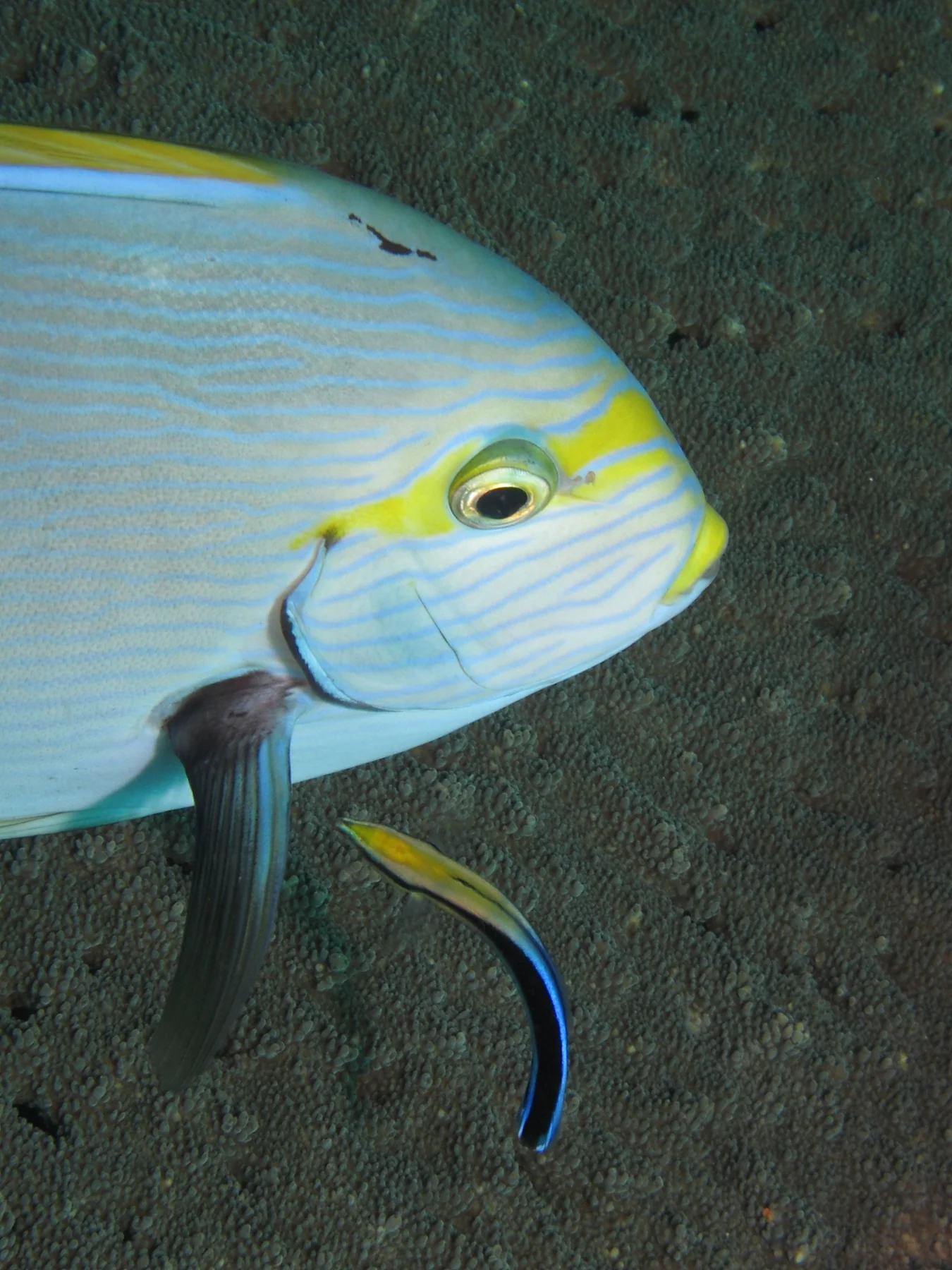
A cleaner approaches an elongate surgeonfish, Acanthurus mata, near Cannibal Rock, Komodo, Indonesia. Its head points toward the client’s surface. Compare that posture with the head-away fin contact described above; this photograph does not document tactile stimulation.
Photo: Alexander Vasenin. Image source · CC BY-SA 3.0 Unported. Resized and converted to WebP; full frame retained in the article. Index thumbnails use a display crop. Photograph remains under the stated license.

Give the next visitor room to arrive
Choose a viewing position that leaves the outcrop and the water around it open. Hover clear of the reef, with your fins and equipment away from coral, and follow your guide's positioning instructions. If a current prevents you from holding that position without grabbing the reef, pass the station rather than turning the observation into a struggle to stay beside it.
Watch one complete visit before looking for another subject. Begin when the client approaches, note the surface the cleaner inspects, and stay with the departure. That simple sequence lets you distinguish a fish waiting near an outcrop from one actually receiving attention. If several clients appear, follow one at a time instead of treating the gathering as proof that each fish received the same service.
Do not offer food, reach toward a cleaner, or present your hand to invite contact. Those actions would replace the exchange you came to watch with one you created. Keep an exit open for the client, and withdraw if your approach changes its behavior. The clearest record comes from letting the animals control how close they come to one another.
Before an Indo-Pacific trip, compare the bluestreak cleaner wrasse profile with the Great Barrier Reef regional guide and map. For another response to small parasites, read how parrotfish use mucus cocoons at night. That story follows a covering around a resting fish; this one follows a visitor working over its surface.
On the next dive, give the apparently motionless fish a second look. Find the smaller animal beside it, then watch the next contact and the response. A pause, a peck, a jolt, or a brush of fins can turn a few seconds beside an ordinary coral outcrop into an encounter you can read.
Sources & further reading
- Fishes of Australia — Common Cleanerfish, Labroides dimidiatus — Museums Victoria species account: appearance, distribution, feeding, and cleaning stations.
- Grutter (1999), Cleaner fish really do clean — Nature 398, 672–673. Experiment on cleaner access and parasite abundance in Hemigymnus melapterus.
- Grutter & Bshary (2003), Cleaner wrasse prefer client mucus: support for partner control mechanisms in cleaning interactions — Proceedings of the Royal Society B 270, S242–S244. DOI: 10.1098/rsbl.2003.0077. Distinguishes mucus, monogenean flatworms, and gnathiid isopods in feeding choices.
- Bshary & Grutter (2005), Punishment and partner switching cause cooperative behaviour in a cleaning mutualism — Biology Letters 1, 396–399. DOI: 10.1098/rsbl.2005.0344. Moving feeding plates model consequences of client responses.
- Bshary & Würth (2001), Cleaner fish Labroides dimidiatus manipulate client reef fish by providing tactile stimulation — Proceedings of the Royal Society B 268, 1495–1501. DOI: 10.1098/rspb.2001.1495. Field observations of fin contact, client behavior, and conflict.
- Soares and colleagues (2011), Tactile stimulation lowers stress in fish — Nature Communications 2, 534. DOI: 10.1038/ncomms1547. Moving-model experiment separates physical stimulation from live cleaning.