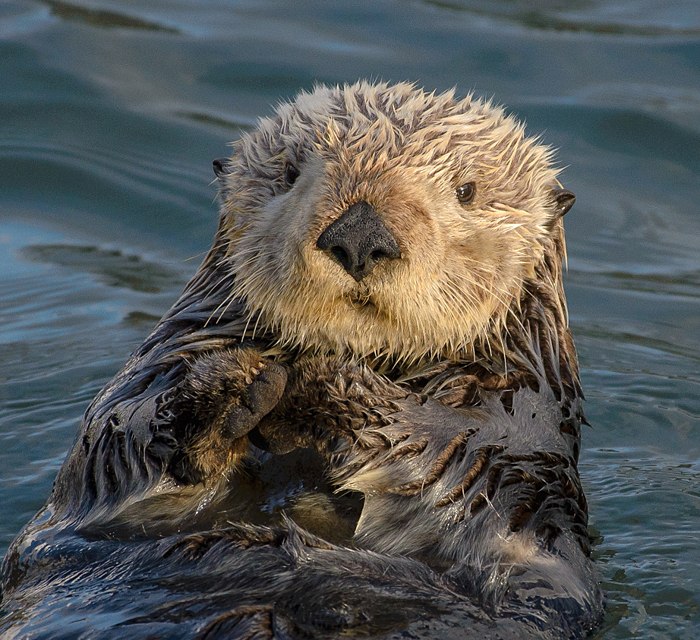
Photo: Marshal Hedin · CC BY-SA 2.0 · Source and license. Displayed as a resized crop. Photograph illustrates the species.
Habitat
Kelp forests, rocky coasts, and sheltered estuaries
Viewing zone
Surface; forages below
Viewing activities
Offshore · Beach / tidepool
What to look for
Look for a rounded, whiskered face, short forelimbs and broad, webbed hind feet. Sea otters often rest or handle food while floating on their backs.
What it eats
They eat marine animals, including invertebrate prey from coastal foraging grounds. Food choice varies; the presence of otters does not mean every nearby urchin will be eaten.
Life and behavior
Frequent grooming maintains the air-trapping fur that provides insulation. Groups resting at the surface are often called rafts; watch without interrupting resting or feeding.
Field context
Temperate coastal waters, often kelp forests over rocky or soft bottoms; commonly prefers water up to 30 m deep.
Observing responsibly
Beach/tidepool refers to observation from shore. Keep enough distance that resting or feeding behavior does not change.
When to look
The available records do not establish a reliable local viewing season. Use the map’s month filter to inspect dated observations; it does not predict an encounter.
These destination links use the same area and date cutoff as the map: 40 km circles, except for the four named regional rectangles. Checked 2026-09-19. Counts describe source records, not individual animals or sighting odds.
No matching destination records appear in the current bounded index. This may reflect incomplete coverage or naming differences; it does not establish absence.