
Destinations & habitats
Fiordland’s White Black Corals: Reading the Dark Water Above
Look for pale branching corals beneath Fiordland’s tea-colored surface water—their position reveals a habitat shaped by both shade and salt.
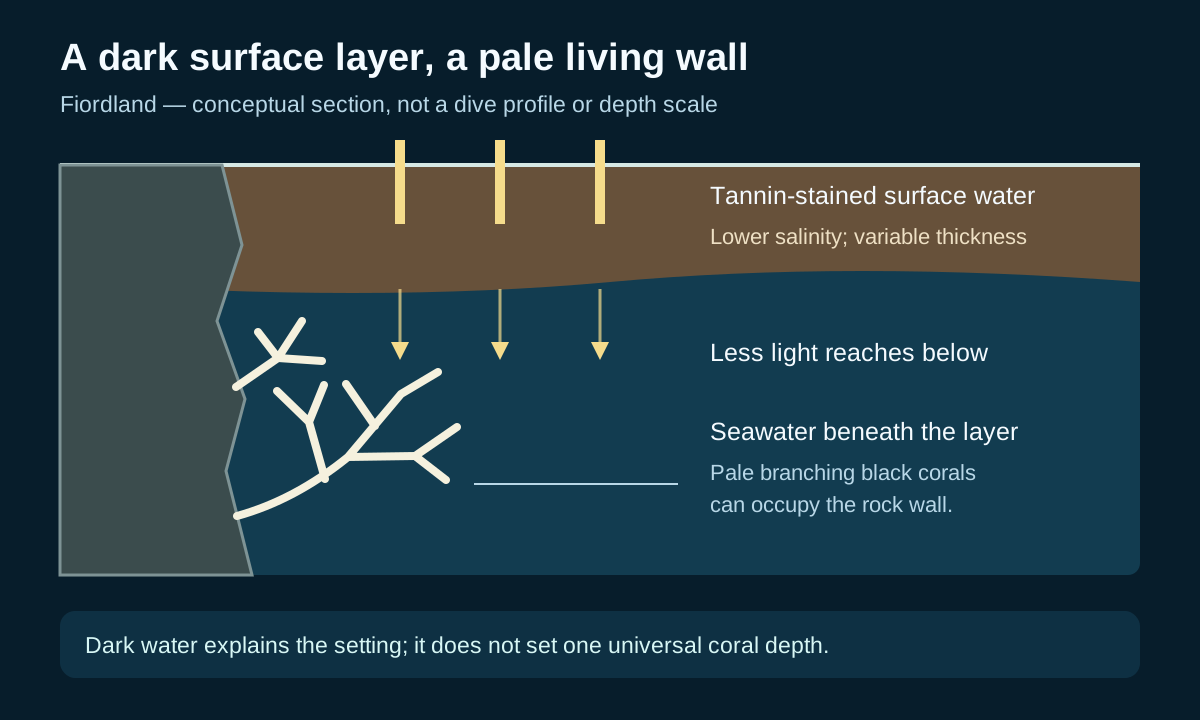
Two properties of the surface layer matter: tannins reduce incoming light, while low salinity can limit how high black corals survive on the wall. Original explanatory diagram, not a measured profile or a dive-depth recommendation. 1 3
Graphic: SeaLifeWiki. Research basis · Original SeaLifeWiki graphic. Original independently designed conceptual wall section, not traced from a photograph or source figure. Layer thickness, light rays, colony size and depth are illustrative and not to scale.
On a Fiordland wall, look for pale, tree-shaped corals below the tea-colored surface water. Their color and position matter: a living black coral need not look black, and the dark water above it is more than a filter on the sunlight.
The pale covering is living tissue over a dark skeleton. Overhead, tannin-stained runoff reduces the light reaching the seawater, helping create shallow habitats with animals often associated with deeper water; but freshwater also imposes a salinity limit. Reading the scene means separating the coral’s appearance, the light around it and the water it can tolerate. 1 2 3
The white tree is not necessarily a bleached reef coral
Begin with the whole colony rather than its color alone. The Fiordland black coral Antipathella fiordensis forms a branching tree whose pale living surface can stand out against the darker wall behind it. Its name refers to the supporting skeleton, not the color a diver should expect to see. The Department of Conservation describes that skeleton as proteinaceous: it is not the same material as the familiar limestone framework of a tropical stony coral. 2
The NIWA identification guide describes small polyps with six simple tentacles across the black-coral group. That is a useful anatomical distinction in a clear close-up photograph, not an instruction to move a mask within centimetres of a branch. From a normal observation position, the branching outline and pale surface may be all that can be resolved. Keep the identification at that level until a photograph or experienced local guide supplies better evidence. 4
White tissue therefore does not carry the same meaning here as loss of color in a symbiotic tropical reef coral. Nor does a dark patch establish its cause from a distance. First ask what animal you are looking at and which part of it is visible. Our coral scar and bleaching guide explains another case where color needs to be read alongside tissue and structure, rather than used as a diagnosis by itself.
Size offers another tempting shortcut. A February 2026 Earth Sciences New Zealand report describes ages and growth rates obtained by analysing collected skeletons, including radiocarbon and uranium-thorium methods. Its results differ among the sampled black-coral groups and locations. The relevant lesson beside a large colony is not to turn its height into a birthday: dating requires evidence that the silhouette cannot supply. 5
For your own record, separate what the image shows from what you infer. ‘Pale branching colony on a steep wall’ is an observation. A species identification needs diagnostic features; an age needs a different kind of study. A wide photograph that retains the attachment point and surrounding wall can be more useful than an isolated crop of white branch tips.
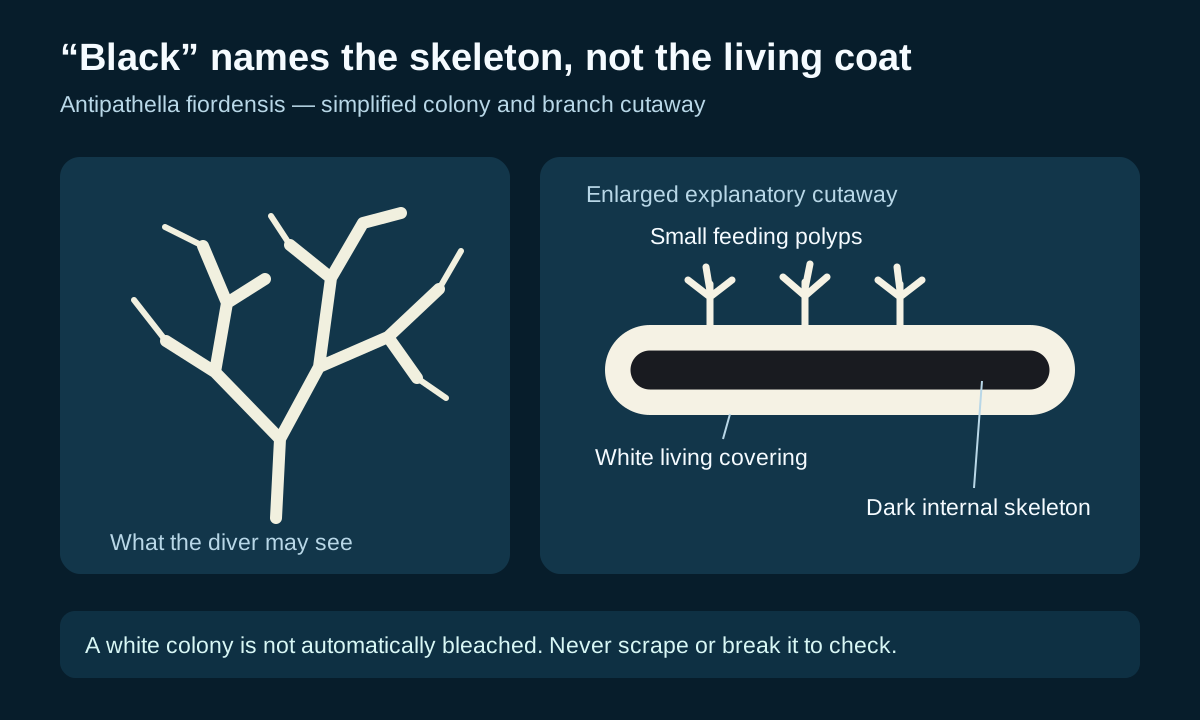
The name belongs to the skeleton; the pale outside is living tissue. This simplified cutaway explains the color contrast without depicting a sampled colony, a species diagnosis or bleaching. 2 4
Graphic: SeaLifeWiki. Research basis · Original SeaLifeWiki graphic. Original conceptual colony and enlarged branch cutaway. Not traced from an anatomical plate, research figure or photograph. Polyp spacing, branch proportions and cutaway thickness are illustrative.
The forest changes the light on the wall
Look up from the colony toward the surface, without losing your depth or position. Rainwater running off the forested slopes carries tannins into the fiords. The resulting surface layer can resemble diluted tea, reducing the light that reaches the saltier water beneath it. DOC records a very variable layer thickness, from centimetres to more than ten metres; there is no single depth at which every dive crosses into the same conditions. 1
Now compare the wall itself. NIWA describes an inner-fiord community that includes black and red corals, sea pens, lampshells and glass sponges in these dim, relatively shallow settings. This is often called deep-water emergence: the familiar depth range of an animal is not a fixed recipe for the habitat it needs. Here the water and landscape can create some low-light conditions without an equally long descent. 6
That does not make the entire fiord a single underwater room. Toward its outer reaches, ocean waves mix the surface water more strongly and seaweeds become prominent. NIWA’s guide introduction contrasts the large brown, fine red and coralline algae of these outer communities with the animal-rich inner walls. If two dives show different coverings on the rock, the difference may reflect where they sit along the fiord, not simply the depth on your computer. 6
Moana Uta, in Wet Jacket Arm, makes the local variation especially clear. DOC describes steep shaded walls and unusually dense black coral there, but also kelp beds in some areas and tidal-flow-exposed walls near Oke Island rich in lampshells and other suspension feeders. Those habitats share a named reserve without sharing exactly the same conditions. Keep the location and the wall’s surroundings in a sighting note, not just ‘Fiordland.’ 7
These comparisons help you read a dive rather than prescribe one. A pale colony against dark water is worth noticing; it is not a promise that the next dark wall holds the same animal. Nor does a low-light appearance tell you how deep you are. Use your instruments and agreed dive plan for depth, and use the scenery to ask better questions about the habitat.
Shade helps explain the setting; salt sets another boundary
Follow the wall above a colony with your eyes. If the upper rock lacks the same branching corals, it is easy to decide that the animals merely prefer the darkest place. A study of the Doubtful Sound system tested that explanation against another property of the water: salinity.
Kregting and Gibbs surveyed paired sites in 1999–2000, comparing brighter and more shaded sides as well as locations with different salinity conditions. The mean shallowest colonies occurred at about 4.4 metres at the higher-salinity entrance sites and 8.9 metres farther inside at lower-salinity sites. Despite the light contrast, the two sides did not differ significantly in their upper coral limit. An accompanying in-water experiment supported salinity stress as a constraint. The authors concluded that salinity, rather than light, dominated the extreme upper limit in their study. 3
Those numbers belong to that survey, not to a modern sighting forecast or a recommended depth. The useful field distinction is between two questions: why this fiord supports a shallow low-light community, and why a particular coral population stops higher up its wall. One explanation does not automatically answer both.
A diver’s view alone cannot measure salinity. Treat the arrangement of colonies as a reason to investigate the water conditions, not a substitute for instruments or repeated surveys. Equally, a gap in the branches is not proof of freshwater damage; an unoccupied patch could have a history that one visit cannot reveal. Record the pattern before naming its cause.
The diagram separates these ideas deliberately. Its light panel shows how the stained surface water dims the habitat; its salinity panel shows another property that changes down the water column. Neither panel draws a fixed coral line around every fiord. Keeping the two effects separate prevents an attractive landscape story from becoming a universal rule.
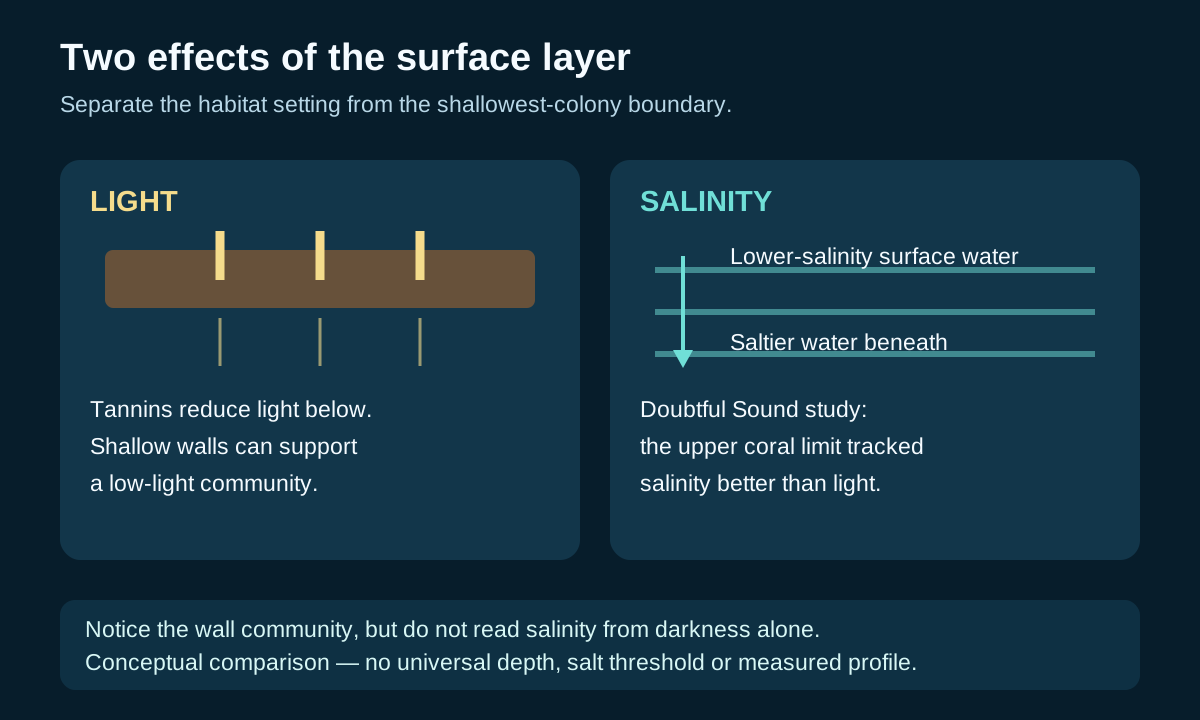
A habitat explanation and an upper-depth-limit test answer different questions. The historical study compared sites and measured water conditions; one dark wall or absent colony cannot reproduce that test. Original conceptual graphic, not a plot of measurements. 3 6
Graphic: SeaLifeWiki. Research basis · Original SeaLifeWiki graphic. Original qualitative comparison, not a reproduction of published results, map or measured salinity profile. No numeric threshold or universal depth boundary is shown.
Look for a second animal without reaching into the branches
Before moving on, see whether any narrow arms wind around the branches. NIWA records the snake star Astrobrachion constrictum living on Antipathella fiordensis. Its review describes the star collecting passing food or material on the coral surface; the association can help keep the colony clear. A visible coil, however, establishes the star’s position, not that it is feeding at that moment. Follow an arm in a photograph before mistaking it for another coral branch. 8
Leave that relationship intact. DOC advises divers not to touch colonies or remove the organisms among their branches, and specifically warns about damage from fins, cylinders and hoses. Secure loose equipment before entering the scene and leave enough clearance for your whole body, not only the camera. If the view requires bracing against the wall, threading through branches or asking a buddy to hold the colony, it is the wrong view. 2
Plan the visit with current local conditions and guidance, rather than treating shallow coral as easy access. The official Fiordland reserve maps and boundaries identify the protected areas; DOC also flags specific no-anchoring zones. A marine reserve boundary and a suitable dive plan are different things. Check both before entering the water. 1
Use the Fabulous Fiordland identification guide for the coral and its associated animals. SeaLifeWiki’s destination directory provides other regional reading, while the sea-star and brittle-star guide helps separate an arm from the structure it clings to. For another easily misread living substrate, compare Scotland’s pink maerl beds.
On the next suitable wall dive, carry three observations away: the color and branching of the colony, the surrounding cover on the rock, and any separate animal wrapped around it. Look up long enough to place those details beneath the surface water, then return to your buddy and instruments. The striking white tree is only the beginning; the useful discovery is how carefully you can read its setting without changing it.
Sources & further reading
- Department of Conservation: Fiordland marine reserves and maps — Checked November 3, 2026. Institutional description of tannin-stained runoff, variable surface layer and protected-area guidance. No universal diving depth, current access or encounter guarantee is inferred.
- Department of Conservation: Protected coral species — Checked November 3, 2026. Supports dark proteinaceous skeleton, pale living tissue, polyp covering and non-contact observation guidance. Uses the older Antipathes fiordensis combination; NIWA’s guide supplies Antipathella fiordensis.
- Kregting and Gibbs (2006): Salinity controls the upper depth limit of black corals in Doubtful Sound, New Zealand — Primary paper, New Zealand Journal of Marine and Freshwater Research 40:43–52; full text reviewed via the Coastal Restoration Trust repository. Surveys 1999–2000 compared sites, shade and salinity; mean shallowest-colony depths 4.4 m and 8.9 m are historical study results, not universal limits. In-water experiment took place in Milford Sound; its manipulation is not visitor guidance.
- NIWA and partners (2021): Fabulous Fiordland identification guide — Institutional guide and indexed black-coral section checked November 3, 2026. Supports current species combination, pale tree form and six unbranched tentacles in black-coral polyps. Linked documentary images are not reproduced here.
- Earth Sciences New Zealand (2026): Study deepens understanding of black coral age and growth rates — February 16, 2026 institutional account of skeletal radiocarbon/U-Th analysis. Used only to distinguish analytical age estimates from visual height; species-specific ages and radial-growth rates are not assigned to an observed colony.
- NIWA (2021): Fabulous Fiordland showcased in new e-Guide — October 5, 2021 institutional account supports inner-to-outer gradients in light, waves and community cover; emergence does not mean every deep-water species occurs shallowly.
- Department of Conservation: Moana Uta (Wet Jacket Arm) Marine Reserve — Checked November 3, 2026. Local habitat account distinguishes shaded black-coral walls, kelp areas and tidal-flow-associated suspension feeders near Oke Island. Not a dive itinerary or abundance census.
- NIWA (2019): The state of knowledge of deep-sea corals in the New Zealand region, Science and Technology Series 84 — Page 27 describes Astrobrachion constrictum on Antipathella fiordensis and reported feeding/cleaning association. A still photograph is not treated as evidence of feeding, and benefits from other coral-star pairs are not transferred as measured effects for this pair.
Read next
- Scotland’s Maerl Beds: Why the Pink “Gravel” Is Alive
Look for pink branches among pale seabed fragments in western Scotland: the living surface and the gaps beneath it make a habitat worth keeping clear of your fins.
- Sea Star, Brittle Star, or Basket Star? Follow the Arms
Start where each arm meets the body: a broad arm blending into the center, a sharp joint, or repeated branching can separate three star-shaped animals before color misleads you.
- The Sponge-Covered Boulder Beneath an Antarctic Ice Shelf
At 1,233 metres, a borehole camera found stalked animals clinging to one dark rock beneath 872 metres of Antarctic ice—where the current made their food supply the real puzzle.