
Ocean discoveries
Tubeworms at 9,533 Metres: Reading a Trench Cold Seep
Beside a submersible camera, a thicket of tubes over dark trench mud points to a food supply that leaves no trail of bubbles.
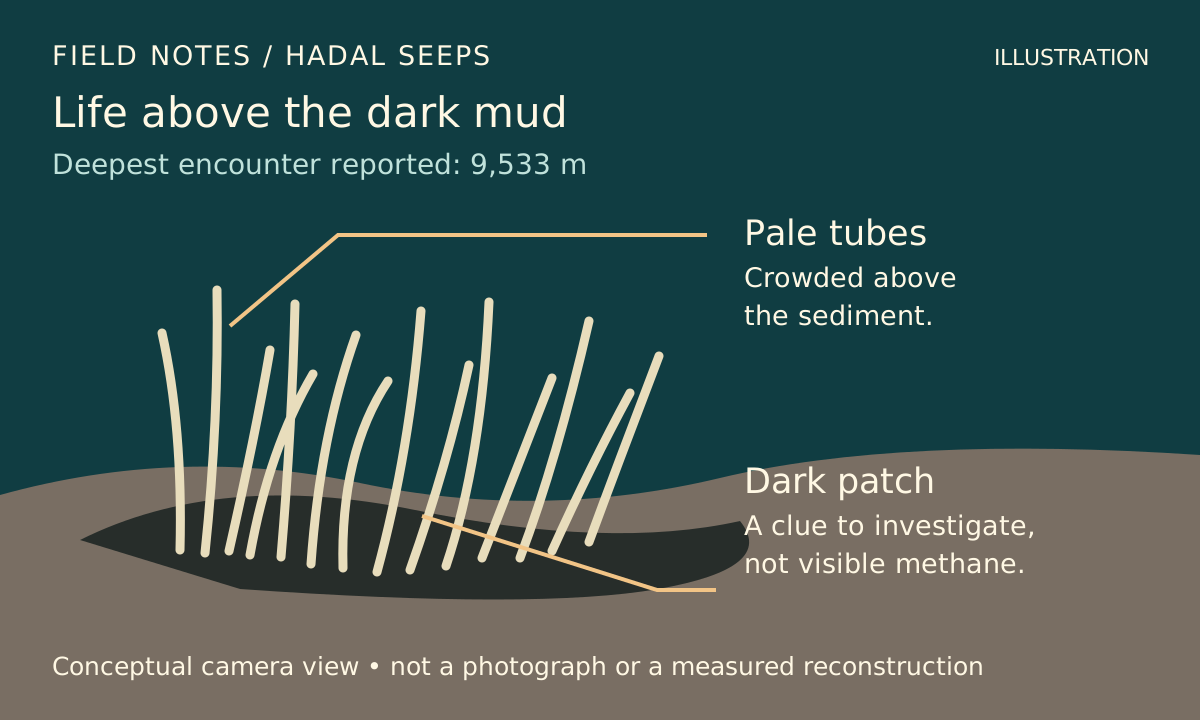
The first clue is the contrast between a dense patch of tubes and the mud around it. Original conceptual illustration, not a reconstruction of a particular camera frame. 1
Graphic: SeaLifeWiki. Research basis · Original SeaLifeWiki graphic. Original conceptual trench-seep illustration. No research figure or photograph was traced. The composition is not a reconstruction of one dive frame; number, spacing and scale of tubes are illustrative.
Beside Fendouzhe’s camera at 9,533 metres in the Kuril–Kamchatka Trench, look for a thicket of slender tubes rising out of black mud. The concentration of animals is the clue: a patch that looks like an underwater field has a food supply the camera cannot show directly.
The tubes belong to worms living at a cold seep, where chemical-rich fluids move through the sediment. Microbial partners turn chemical energy into food, supporting animals far below sunlight. This scene comes from a crewed submersible expedition in 2024, reported in Nature in July 2025—not a new sighting on a recreational dive. The useful puzzle in the footage is why life gathers so thickly in one part of the mud while the surrounding bottom looks different. 1 2
A field of tubes, with smaller traffic between them
Start at the edge of the patch rather than at its busiest centre. A close view can fill the screen with pale lines until it becomes difficult to tell what is attached to the bottom and what is passing through. Following one tube down to the mud separates an upright resident’s shelter from a free-moving animal. The frame’s edge also keeps a little surrounding sediment in view, so the density of the colony remains a visible comparison rather than just an impressive close-up.
The research team identified the dominant worms in the deepest community as frenulate siboglinids. The name is less useful on screen than the body arrangement: most of the worm stays inside a narrow tube, while tentacles can extend at its upper end. In photographs from the wider expedition, red tentacles stand out above the tubes, their colour associated with haemoglobin. Those pictures come from several sites and depths. They should not be assembled in your mind into one continuous view at 9,533 metres. 1
Among the tubes, another pale shape may move sideways across the picture. The study’s images distinguish free-moving worms from the tube-dwellers, and show small snails perched on tubes. That matters when reading the crowd. A passing animal is using the same patch, but its presence does not establish that it obtains food in the same way as its host. The field contains both fixed structures and traffic through them. A short sequence, rather than a single still, is what lets those roles separate. 1
A red tip disappearing behind a tube can also be a viewing problem. The animal may have changed position, the camera may have moved, or another tube may now obstruct the opening. Keeping the tube’s base and its top in the same view helps retain the connection. There is no need to turn a momentary disappearance into a story about fear or feeding. The first reliable note remains simple: a particular opening had a visible tentacle, and then the view changed.
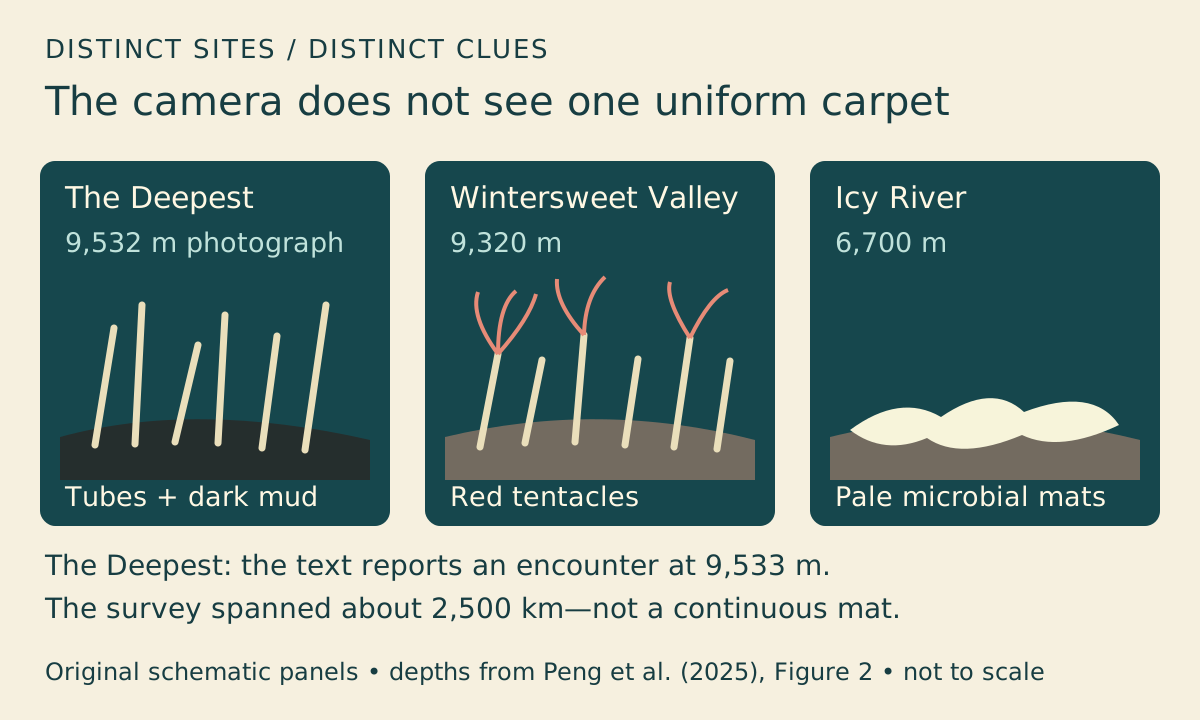
The expedition found different-looking patches at separate sites. The 2,500-kilometre survey span is not a continuous carpet of worms. Original explanatory graphic. 1
Graphic: SeaLifeWiki. Research basis · Original SeaLifeWiki graphic. Three independently drawn schematic panels based on the paper's stated observations. Not a copied map or figure, not to scale, and not one continuous or simultaneous camera view.
The seep need not announce itself with bubbles
A bright plume would make the explanation easy to picture: something rises from the bottom and animals gather around it. These trench seeps offered a less theatrical clue. The researchers reported no bubbling or associated gas phase during their dives. Their modelling placed methane under these conditions in dissolved form and potentially as hydrate, rather than as rising gas. The absence of a bubble trail therefore did not remove methane from the explanation. 1
That distinction changes the way to watch the mud. A dark patch can guide the camera toward a place worth investigating, but it is not a chemical reading. Neither the black colour nor a pale coating tells you the concentration of methane or sulfide. Sediment samples and measurements supply that part of the story. On screen, the honest connection is between an unusual bottom, the organisms clustered there, and the samples taken from that place—not between a colour and an invisible molecule.
Cold seep also does not mean a miniature version of the hot, shimmering flow in the archive’s hydrothermal-vent story. The practical visual question is whether a fluid source must be obvious before the community becomes understandable. Here it did not. Chemical energy can be available where the surface appears quiet. A camera can record the animals occupying that surface; explaining their food supply takes another kind of evidence beside the footage.
The university’s account describes symbiotic microorganisms as the food-making partners. That gives the tubes a second meaning: they are not simply a way to hold an ordinary feeding mouth above the bottom. Yet a screenful of tentacles cannot reveal the work of those microscopic partners inside an animal. Keeping the two scales together makes the scene clearer. The large, visible gathering is the encounter; the partnership explains how such a gathering can be supported there. 3
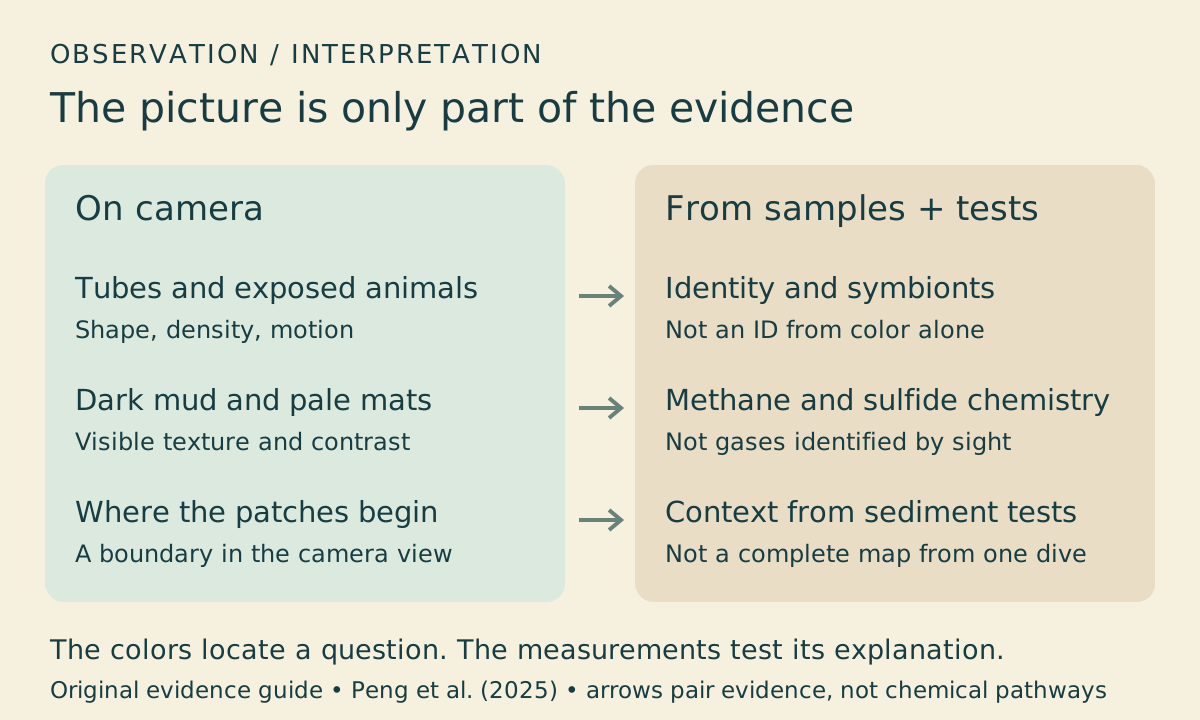
A camera records the patch; samples test its chemistry. Neither dark mud nor an absent bubble trail measures methane by itself. Original explanatory graphic. 1
Graphic: SeaLifeWiki. Research basis · Original SeaLifeWiki graphic. Original two-column evidence guide, not a copied research figure. Arrows pair observations with complementary tests; they do not encode causal or chemical pathways.
One patch is not the whole trench
The expedition ranged along the Kuril–Kamchatka and western Aleutian trenches, encountering seep communities during 19 of 23 dives. The reported sites span about 2,500 kilometres. On a map that is a long connection; underwater it is not a single field stretching beyond the camera’s lights. Each observation still belongs to a particular dive, depth and position. The evidence is repeated discoveries across a region, not proof that every intervening metre carries the same habitat. 1
The differences are visible. Some expedition images are dominated by slender tubes, others by clams partly embedded in sediment or pale microbial mats. Those arrangements give a reason to retain wide views along with close-ups. A frame filled with one clam cannot show whether it sits alone, in a small cluster, or among many neighbours. A mat’s edge, a change in sediment, and the distance to the next group of tubes provide context that disappears when every shot is cropped tightly. 1
The same care applies to depth labels. A photograph taken at one station does not automatically illustrate the record-depth encounter. The paper reports the initial deepest community at 9,533 metres, while its representative fauna panels carry their own depths. Keeping those labels attached avoids creating an imaginary mixed community assembled from the whole expedition. A tube patch in one panel and a clam bed in another can support a comparison without ever having shared the same camera frame.
For a diver watching the film at home, that is the useful map-reading habit: the place name and depth travel with the observation. The archive’s Mariana snailfish footage supplies a different trench encounter, not an interchangeable view of this seep. Both lie far beyond recreational access, but the landscape, animal and question differ. A trench is a setting, not a single habitat repeated wherever the bottom becomes deep enough.
The undisturbed edge is part of the evidence
A submersible’s sampling arm changes the scene it reaches. Before a tube or sediment sample leaves the bottom, footage of its original position preserves information that the recovered object cannot carry by itself: its neighbours, the surface around it and the way it stood in the patch. A view taken after sampling should remain distinct from that first look. Moving sediment can hide a small animal or obscure an opening without telling us what the animal would otherwise have done.
This is not a site for a dive itinerary, and watching the research footage does not require imitating its sampling. There is a familiar observation skill to take back to shallow water, though. A close-up becomes more useful when a little surrounding habitat remains in the record. On the next dive, a tube opening beside bare sediment, a sponge on one rock, or a grazing patch beneath kelp can be photographed without turning, lifting or clearing it for a better view.
The next time a film of the trench fills the screen with worms, the edge of the field may be the most informative part. There is the tube, there is the mud, and there is the space where the density changes. No bubbles need pass through the picture for that boundary to matter. It is a visible place to begin a question about the food supply below the frame.
Sources & further reading
- Peng and colleagues (2025): Flourishing chemosynthetic life at the greatest depths of hadal trenches — Nature primary study, published online July 30, 2025, from the 2024 Fendouzhe expedition. Discovery depth, community distributions, camera panels, sediment chemistry and methane-phase modelling are distinct evidence. No NC-ND research figure is reproduced.
- National Natural Science Foundation of China: deepest chemosynthetic ecosystem and methane reservoir — Institutional September 2025 account confirms the crewed vehicle, publication date and chemical-energy context; not a new November 2026 expedition.
- University of Southern Denmark: Completely New Ecosystem Discovered at 9,500 Meters Depth — Research-team institutional explanation, August 20, 2025, including direct observation, microbial partnerships and the scope of the expedition.
Read next
- How Mariana Snailfish Swim at 6,670 Metres in the Trench
At 6,670 metres in the Mariana Trench, a pale snailfish cruises head-down over the sediment—a visible path that a 2026 study turned into the first three-dimensional measurements of its swimming.
- The Animals Hidden Beneath a Deep-Sea Hydrothermal Vent
At 2,515 metres on the East Pacific Rise, watch ROV SuBastian lift a lava shelf: tubeworms, limpets and bristle worms occupy the warm cavity beneath what looked like solid seafloor.
- The Tiny Galápagos Blue Octopus Behind a New Species
At 1,773 metres near Darwin Island, follow a tiny blue octopus's squat body and short arms—the visible clues began an eleven-year journey from ROV footage to a species name.