
Ocean discoveries
The Animals Hidden Beneath a Deep-Sea Hydrothermal Vent
At 2,515 metres on the East Pacific Rise, watch ROV SuBastian lift a lava shelf: tubeworms, limpets and bristle worms occupy the warm cavity beneath what looked like solid seafloor.
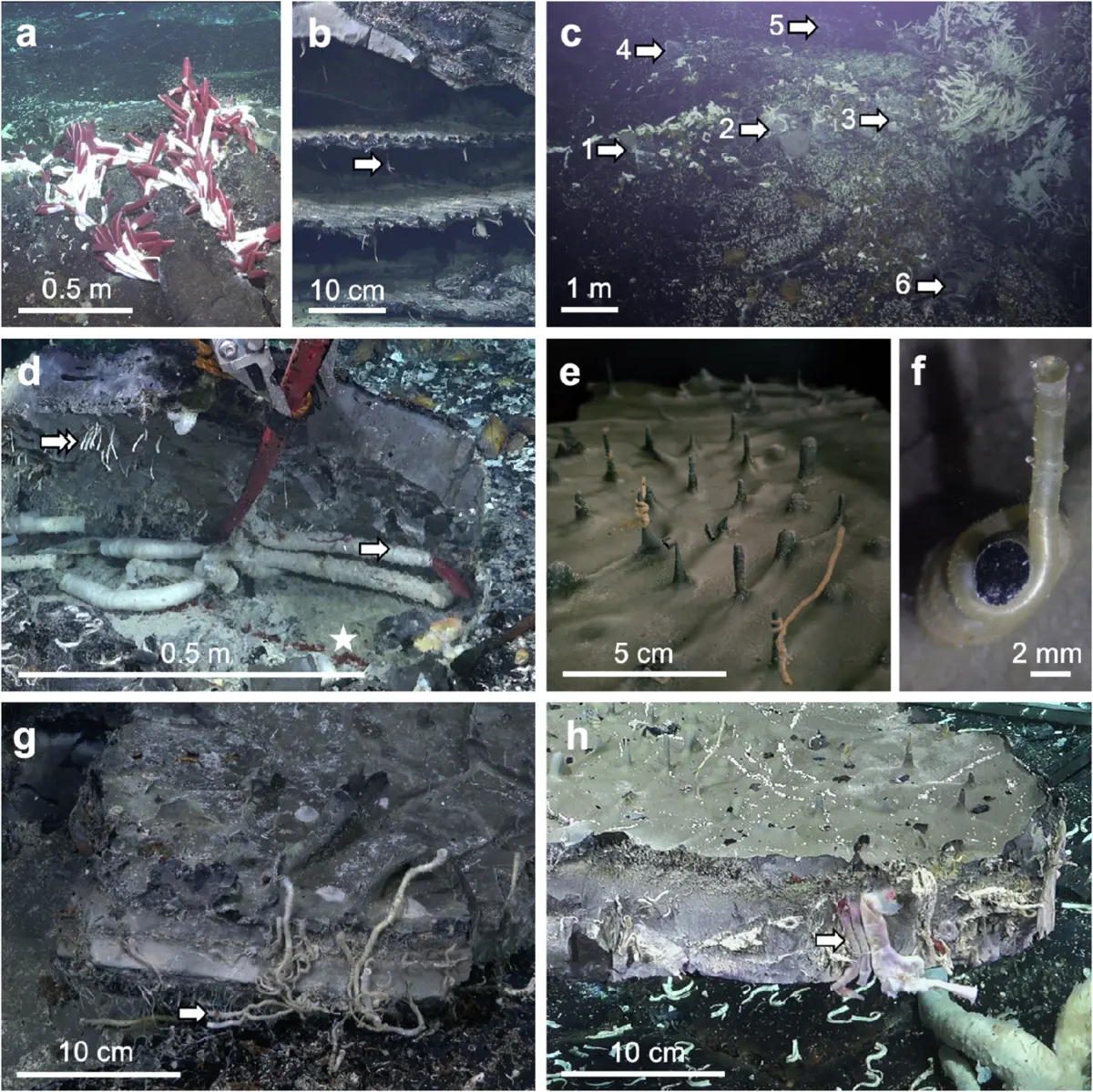
Read the panels from surface to underside: tubeworm clumps mark cracks in lobate lava, while lifted shelves reveal roughly 10-centimetre-high cavities and worms growing from the roof or through the cracks. These are complete research frames, not a reconstruction.
Photo: Monika Bright et al. / Nature Communications (2024), Figure 2. Image source · CC BY 4.0 International. Complete published Figure 2 resized from the publisher PNG to 1200 pixels wide and converted to WebP; no crop. All panels, labels, arrows and scale bars are shown in the article; the archive thumbnail uses a display crop.
At 2,515 metres on the East Pacific Rise, watch ROV SuBastian ease up a thin shelf of lava and look into the gap beneath it. Tubeworms, limpets and bristle worms inside that warm, fluid-filled cavity matter because they extend the visible vent community below the surface we had treated as its floor. 1
The early answer is direct but narrow: a 2023 expedition found adult vent animals in shallow cavities under lobate lava, and the peer-reviewed study reported the discovery in 2024. The animals show that seafloor and shallow-subseafloor habitats connect. They do not, by themselves, prove the researchers' further proposal that tubeworm larvae ride through the crust before settling. 1
Lift the shelf, and the habitat continues
Before the lift, the ROV camera showed a fairly flat field of lobate lava: overlapping sheets made when molten rock spread and cooled, with small clumps of tubeworms or mussels above visible cracks. That surface clue guided the experiment. The team chose six patches about 50 centimetres across within a 20-by-20-metre area at Fava Flow Suburbs, then worked through existing cracks rather than assuming every dark seam hid the same habitat. 1
SuBastian first widened a crack to a hole about 2 centimetres across. Through it, the team lowered a temperature probe about 20 centimetres below the seafloor and sampled cavity fluid before using a long pry bar to lift and flip the shelf. The sequence matters when you watch the footage: the temperature reading belongs to the sealed gap, while the animals become visible only after the roof has been turned over. A cloud or colour change at the opening is not a thermometer. 1
Five of the six opened spaces were about 10 centimetres high and held animals large enough to see on video. The sixth was only about 5 centimetres high and appeared empty, although three mussels lived on the surface above it. Across the five inhabited cavities, the maximum temperatures averaged 18.1 degrees Celsius, with substantial variation; ambient water beside the vents was about 2 degrees. Those measurements describe these six openings, not a universal temperature for hidden vent habitat. 1
The flipped rock also changes how to read the scene. What now appears on top in the ROV image had been the cavity ceiling. Lava drips point into the former gap, and pale tubeworm tubes wrap around them or pass through cracks toward the visible seafloor. The shelf itself was roughly 10 to 15 centimetres thick. Those dimensions turn a black line beneath a lava plate into a plausible room for animals, but they do not reveal how far the connected cavities continue sideways or downward. 1
Read the ceiling, the crack and the floor
Start at the roof. The smaller tubeworm Oasisia alvinae grew from all five inhabited cavity ceilings, sometimes curling around lava drips; some tubes reached 20 centimetres. Living giant tubeworms, Riftia pachyptila, shared two cavities with Oasisia. Four recovered Riftia measuring 30 to 41 centimetres in body length had mature reproductive tissue, so the camera was not merely catching newly settled larvae tucked into cracks. 1
Now follow the tubes through the rock. Oasisia could grow downward from the ceiling into the cavity or upward through a crack. Riftia in this study grew upward through cracks, often reaching the plume above the surface. That orientation is a visible bridge between the two habitats: a tube may occupy the hidden room, the crack and the open vent at once. It is not evidence that the adult worm crawled there; these tubeworms are fixed in place. 1
The cavity floor supplies a different clue. In one opening, white microbial mat covered the bottom beneath several large Riftia, and roughly 30 Paralvinella bristle worms were visible on the mat and tubes. Other cavities held mobile or partly mobile vent animals, including Nereis sandersi and Archinome rosacea bristle worms, Lepetodrilus limpets and the Galápagos rift limpet Neomphalus fretterae. Their presence shows more than a single tubeworm refuge: grazers, deposit feeders and predators or scavengers occurred below the lava. 1
Absence is a clue too, if kept local. Bathymodiolus thermophilus mussels sat on the surface above four inhabited cavities, yet none was visible inside the opened spaces. That contrast does not mean mussels never occupy any subseafloor cavity; it means the six excavations did not show them there. Likewise, the team collected smaller animals and microbes that still awaited detailed analysis, so a wide ROV frame cannot be treated as a complete species inventory. 1
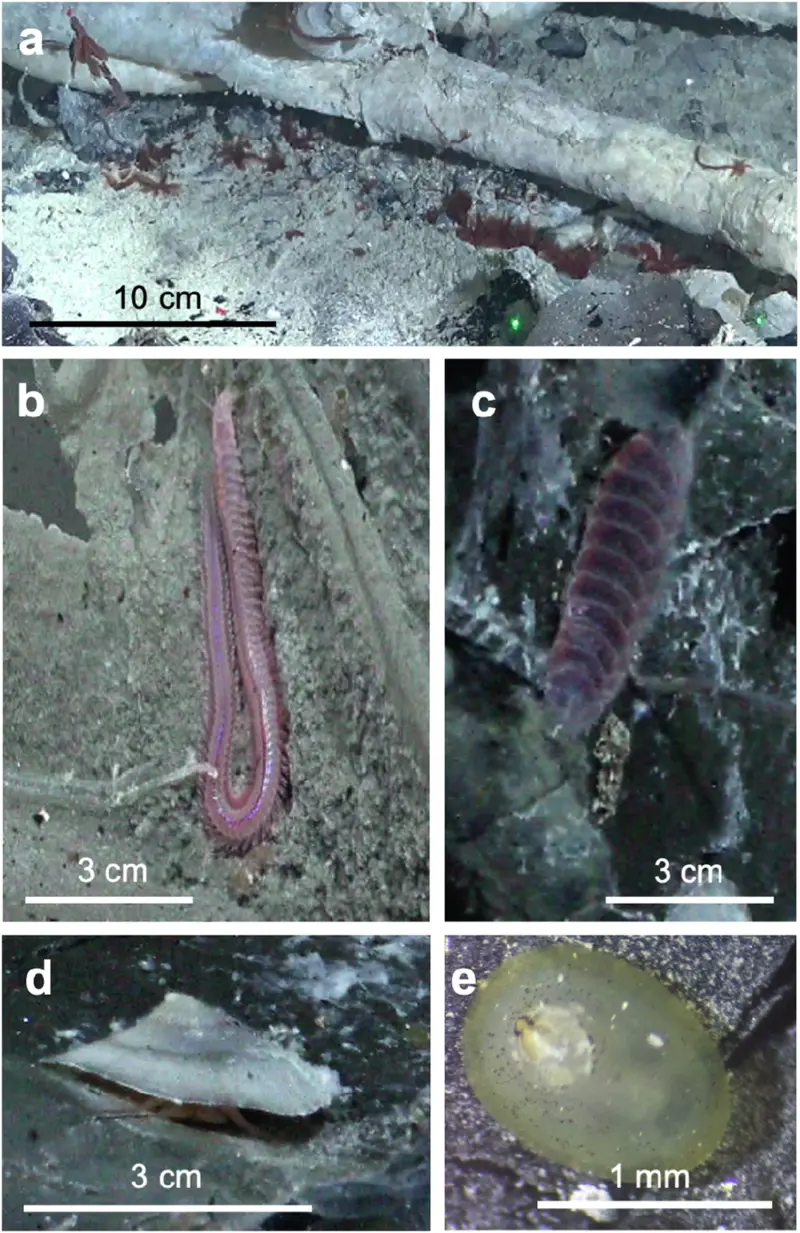
The cavity community was not one anonymous mass of worms. Complete research panels show Paralvinella on tubes and the cavity floor, mobile bristle worms on the roof, and two kinds of limpet; green laser points in panel a are 10 centimetres apart.
Photo: Monika Bright et al. / Nature Communications (2024), Figure 6. Image source · CC BY 4.0 International. Complete published Figure 6 resized from the publisher PNG to 800 pixels wide and converted to WebP; no crop. All panels, labels and scale bars retained.
What the adults prove—and what larvae still do not
The strongest conclusion is the one the camera can check: typical vent animals live both above and just below the visible seafloor. Five inhabited cavities contained sessile tubeworms, and four contained mobile or semi-mobile worms and snails. At least some mobile animals can crawl through lava cracks; the researchers observed that route into and out of the cavities. Together, the roof, crack and floor form connected habitat rather than two unrelated lists of species. 1
The larval story is more tentative. Riftia, Oasisia and related tubeworms release eggs that develop into tiny larvae, yet larvae have not been detected drifting in the water column at these vents. The researchers propose that cold seawater entering porous lava may carry larvae into the shallow crust, where it mixes with warmer vent fluid; larvae could settle in cavities or emerge with flow through discharge cracks. A cavity holding many similarly sized Oasisia supports that possibility, but the expedition did not film a larva travelling the route from intake to settlement. 1
When you look at the model, separate arrows from animals. The layered shelves, shallow gaps and adult worms came from direct observations and samples. The arrow carrying larvae down through a recharge crack and back toward a vent is an interpretation designed to explain those observations. The animals' presence is evidence consistent with the route, not a tracer experiment that identifies every step. 1
The same restraint applies to scale. Hollow lobate lava is known from fast- and intermediate-spreading ridges, and several shelves can stack above one another. But this study opened six cavities in one small vent area. It did not measure the three-dimensional volume of the habitat, map a continuous underground ecosystem across the ridge, or show how deep animals extend before heat sets a limit. In the next ROV image, a crack should prompt a question about continuity—not a claim that every plate hides a crowded cave. 1
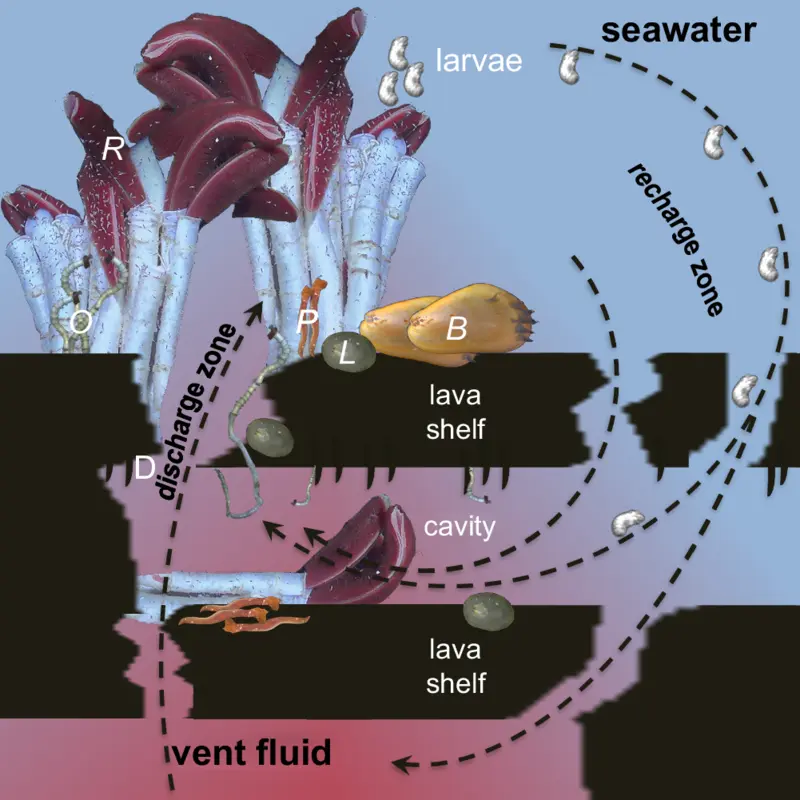
This complete published diagram is a proposed connectivity model, not an ROV view. Solid observations include layered lava, cracks, cavities and adult animals; the illustrated larval route through the recharge zone remains a hypothesis.
Graphic: Monika Bright et al. / Nature Communications (2024), Figure 5. Research basis · CC BY 4.0 International. Complete published Figure 5 resized from the publisher PNG to 800 pixels wide and converted to WebP; no crop. All labels, arrows and figure elements retained.
Watch the footage; leave the floor closed
This is an ROV discovery, not a recreational dive-site technique. The shelf was opened during a permitted research expedition with temperature probes, fluid samplers, suction equipment and a manipulator-guided pry bar; the procedure was filmed and some rock was recovered for measurement. Turning over lava without that design would destroy the very roof, flow path and animal positions needed to interpret the cavity. 1 2
For a careful replay, pause before and after the lift. On the intact surface, mark the tubeworm clump, mussels and crack. After the flip, locate the former ceiling, then look for tubes wrapped around lava drips, live worms rising through cracks, white mat on the floor and the 10-centimetre laser scale. That comparison distinguishes an animal truly inside the gap from one that had lived on top and was merely moved with the shelf.
The study site lies at 9 degrees 50 minutes north on the East Pacific Rise, not at a public dive destination. The paper's site figure provides the relevant research map. SeaLifeWiki's Galápagos regional map is separate eastern Pacific context near the ridge system and the place where hydrothermal vents were first scientifically observed in 1977; it is not Fava Flow Suburbs and does not promise a view of this cavity community. 1 3
For species context, the World Register of Marine Species record for Riftia pachyptila anchors the giant tubeworm's accepted name. Compare this shallow hidden habitat with the Octopus Garden, where ROVs linked warmer water to visible brooding females, or with a mushroom coral's measured movement, a laboratory discovery at diver scale. The methods differ, so the clues do too.
On the next dive, do not pry at a ledge to imitate SuBastian. Notice instead where water, animals or microbial film emerge from an intact crack, keep your hands and fins clear, and ask whether the habitat you can see may continue beyond the opening. At Fava Flow Suburbs, lifting one thin lava shelf turned that question into a view of animals living beneath the apparent floor.
Sources & further reading
- Bright and colleagues (2024), Animal life in the shallow subseafloor crust at deep-sea hydrothermal vents — Nature Communications 15, 8466; DOI 10.1038/s41467-024-52631-9. Primary 2024 paper reporting six 2023 ROV excavations, cavity conditions, observed fauna and the proposed seafloor–subseafloor connectivity model. Open access under CC BY 4.0.
- Schmidt Ocean Institute — Scientists Discover New Ecosystem Underneath Hydrothermal Vents — Expedition institution's August 8, 2023 account identifying R/V Falkor (too), ROV SuBastian, the international team and the experimental context. The later peer-reviewed paper governs quantitative and interpretive claims.
- NOAA Ocean Service — What is a hydrothermal vent? — NOAA institutional overview supporting the history of the 1977 Galápagos discovery and the basic relationship between seawater, ocean crust, magma and hydrothermal vents. It is not evidence for the 2023 cavity observations.