Destinations & habitats
Little Cayman’s Grouper Moon: Why Thousands of Fish Gather to Spawn
A grouper beneath a ledge is only the beginning. At Little Cayman’s winter gathering, barred fish turn dark and pale, then surge upward to spawn above the shelf edge.
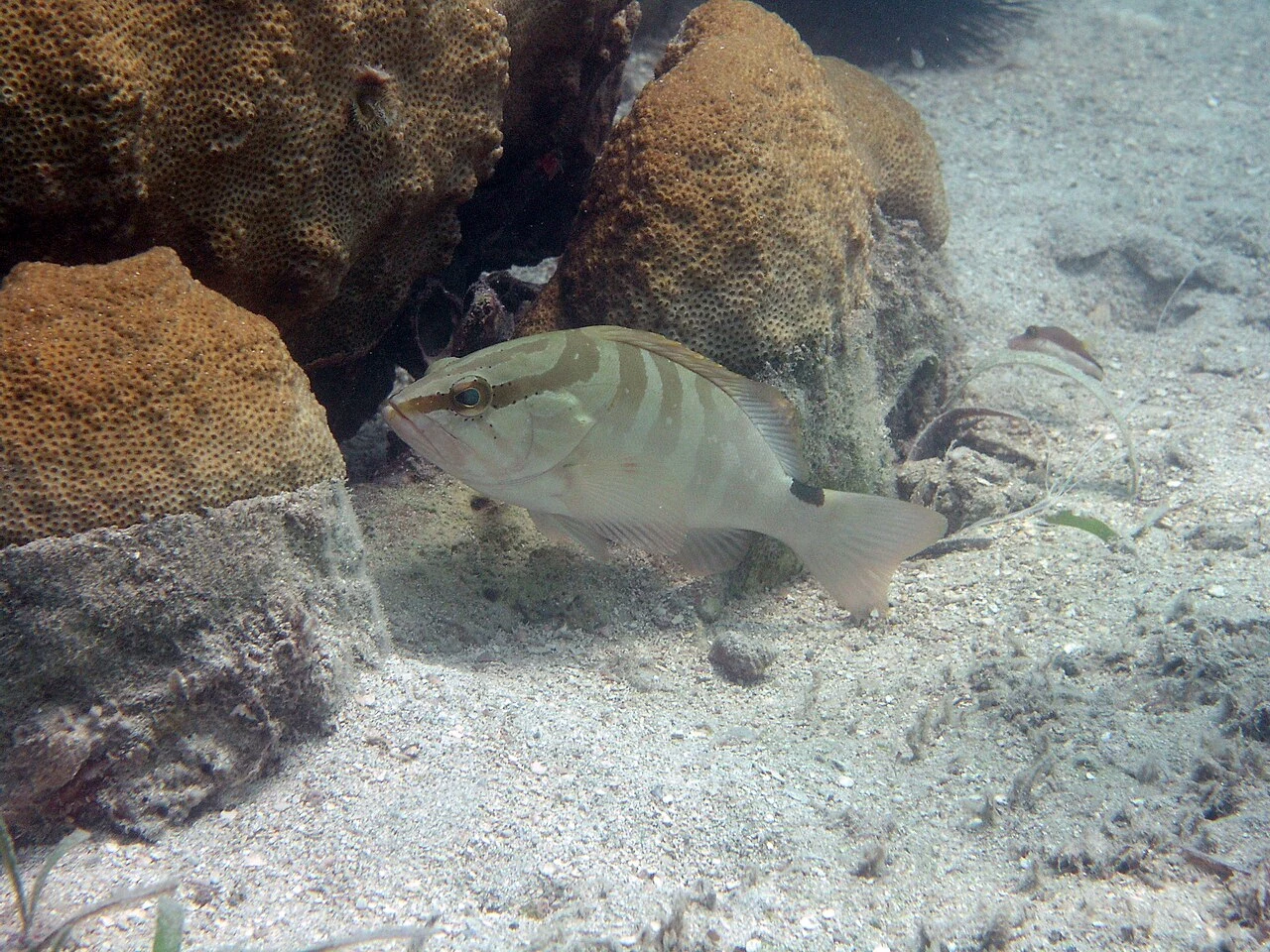
A Nassau grouper at St. John, U.S. Virgin Islands. The barred body and dark mark at the tail base help identify the species; this photograph does not show the Little Cayman aggregation.
Photo: NOAA CCMA Biogeography Team / NOAA Photo Library. Image source · CC BY 2.0. Resized and converted to WebP. No cropping, color changes, or content edits.

On your next Cayman reef dive, learn the bars and dark tail-base saddle of a Nassau grouper holding beside a ledge. Then watch Grouper Moon footage: at Little Cayman’s winter gathering, thousands crowd the shelf edge, changing color before short spawning rushes carry fish up into open water. 1 2
The contrast is startling. A species you may meet one fish at a time fills the view with bodies, while familiar bars give way on some individuals to dark backs and pale bellies. As evening approaches, the gathering builds toward brief releases of eggs and sperm. Its intensity is also its vulnerability: adults from a much wider area have concentrated at one predictable place. 4 6
Recognize the loner before looking for the crowd
A Nassau grouper often looks as though it belongs to the ledge beside it: a substantial fish, large eyes, and a body capable of a quick departure into shelter. Look for five uneven dark bars and a dark saddle at the upper base of the tail. A mark across the top of the head resembles a tuning fork. These help distinguish Epinephelus striatus from other groupers before its colors start changing. 1
Hold your position and watch where the fish returns after a short excursion. That ordinary relationship with shelter gives the winter story its scale. Spawning requires a fish associated with a home area to leave it and converge with others. The busy gathering is a temporary departure from the spacing that usually makes a grouper sighting feel like meeting one resident.
Do not use the presence of several groupers on an ordinary dive as proof of spawning. Start with what you can record: species, numbers visible at once, movement, and location. A feeding opportunity, a shared shelter, and a reproductive gathering are different scenes, even if all put more than one fish in your frame.
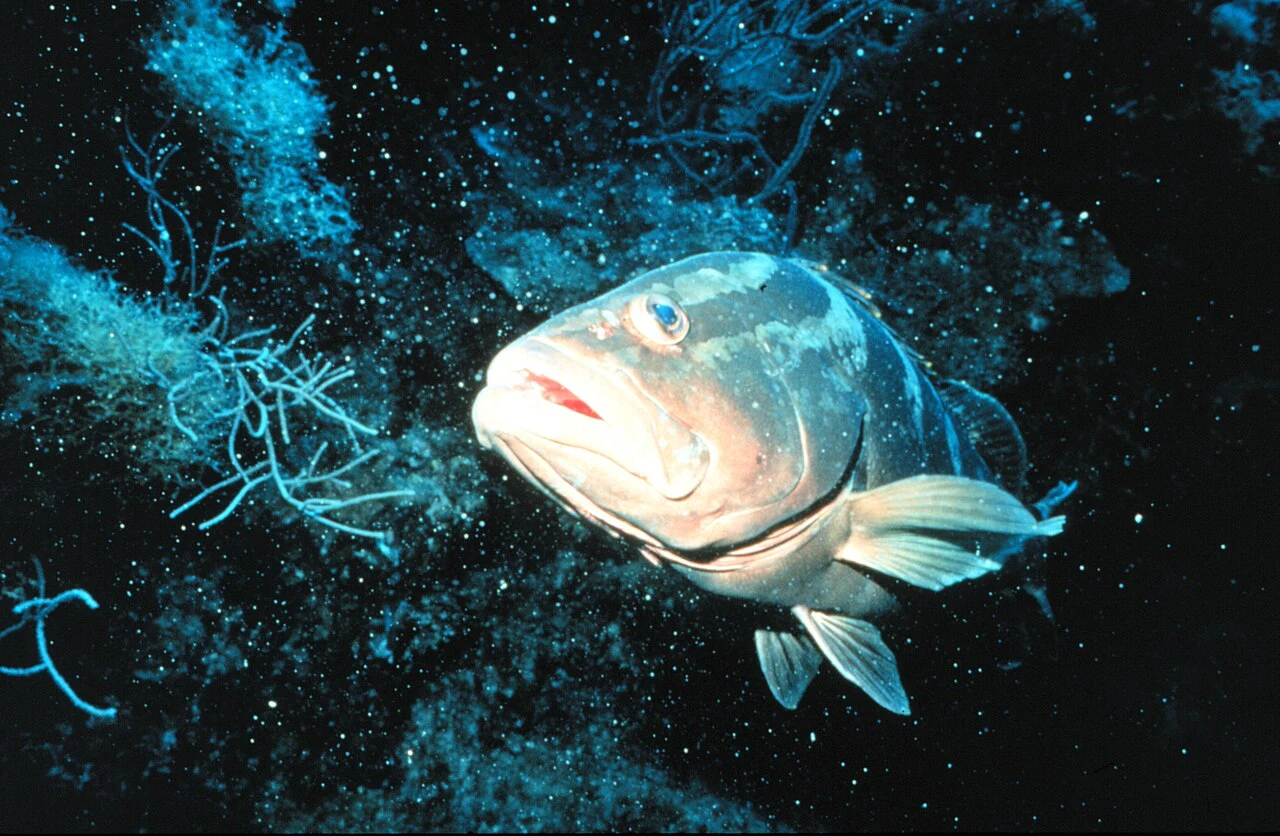
A Nassau grouper in the Bahamas. These portraits introduce the species; the seasonal gathering described here takes place at Little Cayman.
Photo: OAR / National Undersea Research Program; Caribbean Marine Research Center. Image source · Public domain. Resized and converted to WebP. No cropping, color changes, or content edits.

At Little Cayman’s western shelf edge
The well-studied Grouper Moon gathering lies off the western end of Little Cayman. The shelf there sits around 30 meters deep before dropping into much deeper water. In research footage, that geography explains why a dense mass of fish can appear suspended beside a wall with blue water beyond it. Grand Cayman and Cayman Brac have their own histories; footage and population estimates from the three islands should not be treated as interchangeable. 3
Watch the gathering across successive days, as the researchers do, and the moon becomes a seasonal cue rather than a starting whistle. Spawning occurs on a few evenings in the days after a winter full moon, commonly in January or February and sometimes March. The crowd assembles before the brief events that bring fish upward into open water. 4
This shelf-edge research site also brings depth, current, and exposure. Use the Grouper Moon team's footage to study the gathering, and consult the local operator and Department of Environment about access. A marker on a map identifies a place; it cannot tell you that a particular dive is open, appropriate, or within your training.
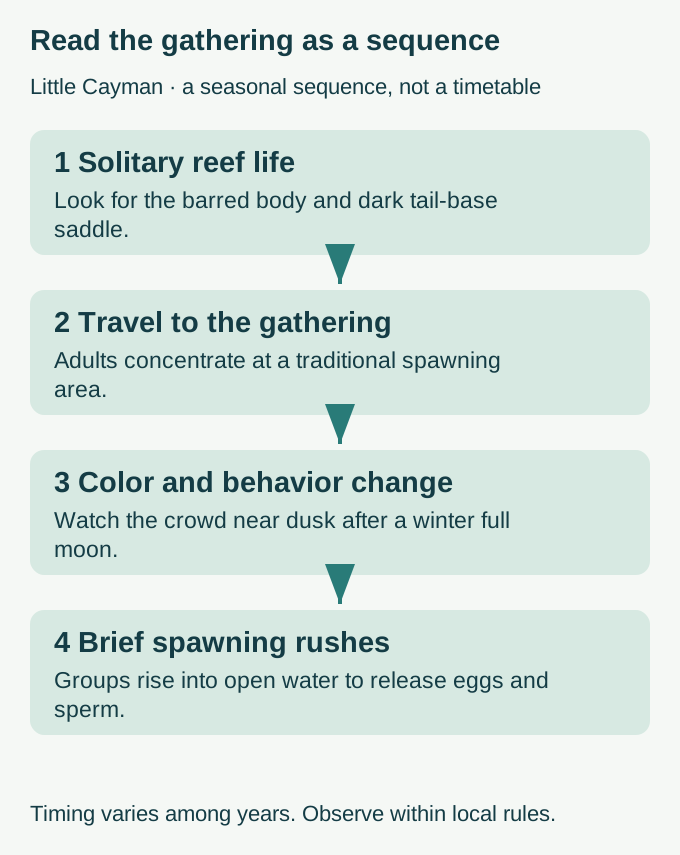
A sequence, not a visitor timetable: Nassau grouper leave reef home areas, assemble after a winter full moon, spawn during brief evening events, and disperse. Timing varies among years and sites. 2 4
Graphic: SeaLifeWiki. Research basis · Original SeaLifeWiki graphic. Original explanatory graphic; see caption for scope.
Watch the bars disappear
Pause a video of the aggregation and compare nearby fish. Some retain their everyday barred appearance; others look darker, have a pale belly, or show a conspicuous two-tone pattern. A quick glance can make them look like different kinds of grouper. Following one individual through the footage makes the change harder to miss.
Grouper Moon researchers tested the connection between those appearances and spawning by examining video across five spawning years. The fraction in the bicolor phase rose from about 5 percent early in the gathering to about 40 percent on the spawning day. That gave the changing crowd a readable signal: more fish wearing the pattern accompanied the approach of the event. 5
The useful observation is a shift across the group, not a countdown attached to one fish. Nor should a dark or pale individual automatically receive a sex label. The same work challenged earlier assumptions about who displayed particular phases. Record the markings you see; the timing and surrounding behavior help interpret them.
The release happens above the reef
As evening approaches, watch the hovering crowd for a sudden upward rush. Several fish leave the bottom together, release eggs and sperm into open water, and separate again. If you follow only the fish after they turn back, you can miss the short event for which they traveled to this shelf edge. 2 4
Rewind the footage once with your attention on the starting position, then again on the water above the fish. The first view reveals the movement; the second may show the release. You do not need to assign a motive to every chase to appreciate how much depends on several animals arriving at the same place at nearly the same moment.
After that moment, the next generation does not remain neatly within the scene. Released eggs enter moving water. The aggregation can fill your view while the early lives it starts spread beyond what a diver could follow. That is why an impressive spawning video and successful replenishment of the reef are connected questions, rather than the same measurement. 6
A crowd can hide a population’s weakness
A wall of fish looks like abundance. But if adults from a wide area collect at one small site, the crowd can remain a tempting target even as the wider population shrinks. The same predictability that lets researchers find the fish can let fishing effort find them. A successful catch at an aggregation is therefore a poor shortcut for judging the health of the population. 6
Read the research footage with that concentration in mind. A single camera frame shows only part of the gathering, and fish can move into and out of view. The Grouper Moon team combined video counts with tagging and resighting to estimate the number present. That work turns a visual impression into something that can be compared across years. 3
Protection has to last longer than a photogenic evening. Fish need opportunities to survive between spawning seasons and return as adults. REEF’s account of the recovery emphasizes sustained monitoring and changes to management, rather than one closure followed by an immediate rebound. 7
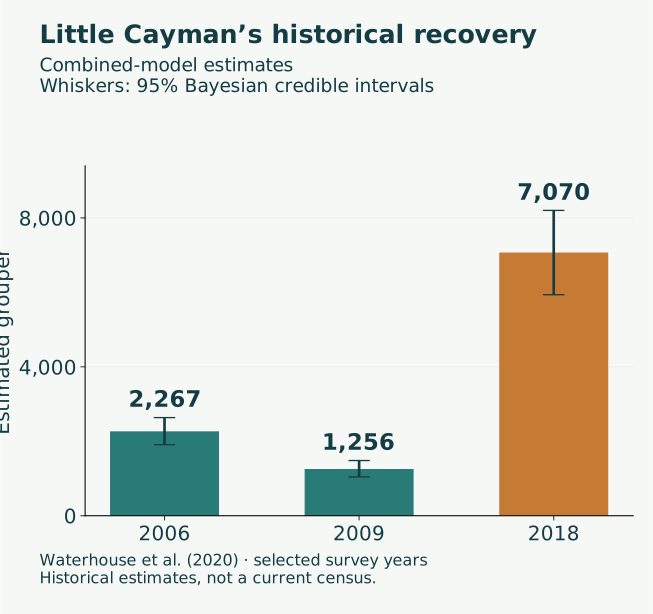
Historical estimates from the combined tagging-and-video model in Waterhouse and colleagues (2020). These describe attendance at the Little Cayman spawning aggregation, not a 2026 census or all grouper in the Cayman Islands. Bars show estimates; lines show 95% Bayesian credible intervals. 3
Graphic: SeaLifeWiki. Research basis · Original SeaLifeWiki graphic. Original explanatory graphic; see caption for scope.
What recovery looks like across years
The 2020 study documented a recovery in Little Cayman’s gathering. Its combined model estimated roughly 2,267 fish in 2006, a decline to about 1,256 in 2009, and an increase to about 7,070 in 2018. The last estimate was more than three times the 2006 estimate. The exact values depended on the model, but the increase appeared across the researchers’ approaches. 3
The dip matters. If you compare only the first and last pictures, the story can look like uninterrupted growth. The longer record shows why a few disappointing seasons do not automatically settle whether protection can work, and why a crowded year needs more than a celebratory head count.
Now look back at the solitary grouper beside the ledge. It is one of the animals whose repeated survival makes another gathering possible. The conservation story becomes easier to grasp when it belongs to that fish, occupying that patch of reef between the brief events that draw the cameras.
Carry three questions into the next sighting
Where does this fish stay? What markings can I actually see? What changes when another fish approaches? Those questions work on an ordinary dive, long before you ever see a spawning aggregation. Keep food out of the encounter and leave the fish its shelter; an undisturbed resident provides the better comparison.
Explore the Little Cayman map, then compare this gathering with the bluehead wrasse story. Both reward attention to changing appearances, but the changes mean different things. On the reef, recognizing the fish is the beginning. Watching what happens next is where the story starts.
Sources & further reading
- NOAA Fisheries — Nassau grouper — Identification, habitat, and life history.
- REEF — Grouper Moon Project — Field program and seasonal aggregation behavior.
- Waterhouse and colleagues (2020), Recovery of Nassau grouper in the Cayman Islands — PNAS 117, 1587–1595; location, methods, and historical population estimates.
- Cayman Islands Department of Environment — Grouper Moon Rising — Little Cayman setting, winter moon timing, and spawning observations.
- Archer and colleagues (2012), Patterns of color phase indicate spawn timing — Current Zoology 58, 73–83; five years of color-phase observations.
- NOAA Fisheries — Saving Nassau grouper by protecting spawning aggregations — Why concentrated reproduction makes the species vulnerable to fishing.
- REEF — Collaborative conservation approach yields results — Research-team account of the long-term recovery effort.