
Species & behavior
Port Jackson Shark Egg Cases: Why the Spirals Turn Up in Rock Cracks
A brown corkscrew lodged in an Australian reef crack can be a Port Jackson shark egg case, but its position does not tell you whether a shark or the surge put it there.
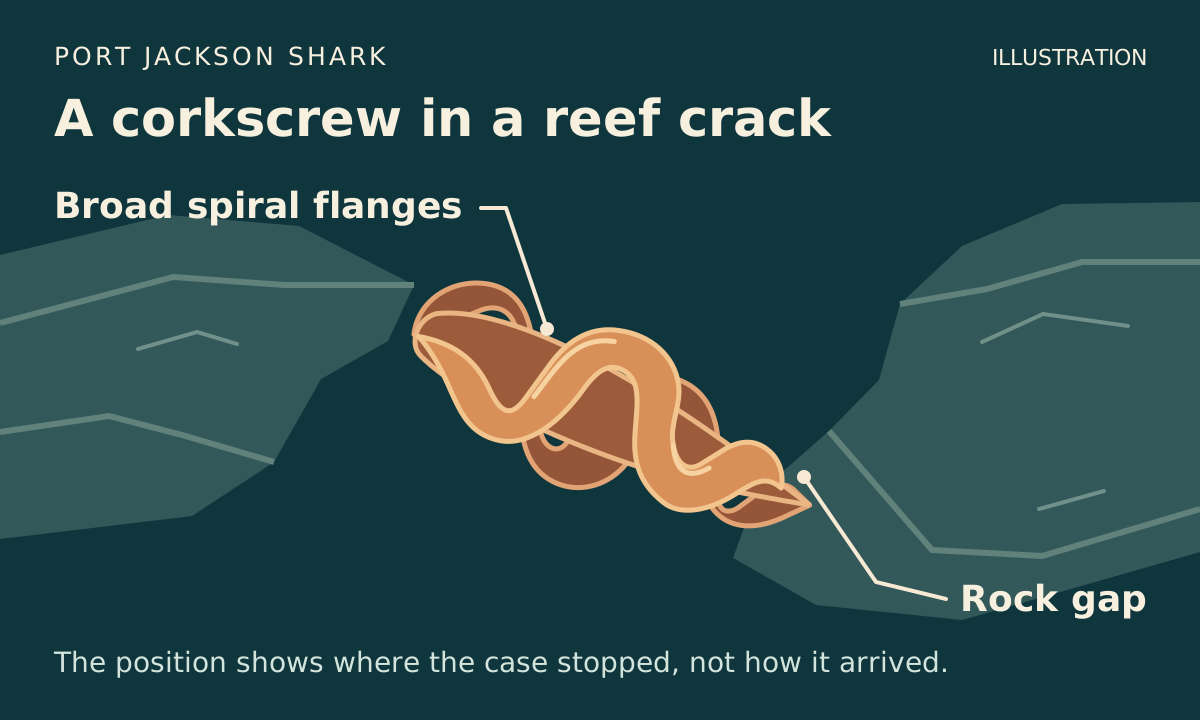
The broad spiral edges belong to the egg case; the rock gap is separate. Original explanatory illustration, not a photograph or a reconstruction of a particular reef. 1 2
Graphic: SeaLifeWiki. Research basis · Original SeaLifeWiki graphic. Independent schematic of a spiral capsule at a reef gap. Not to scale or a reconstruction; no photograph or research figure was copied or traced.
On a rocky reef in southern Australia, look for a brown corkscrew where two rocks meet. The broad spiral edges can identify a Port Jackson shark egg case, but the way it sits in the crack does not tell you how it got there. 1 2
The spiral is part of the case, not a shell coiled around it. At Terrigal Haven, on the New South Wales coast, researchers twice saw a female release a case near a crack and a small surge carry it into the gap. The case finished wedged between rocks without the shark pushing it in during either observation. That is one route into a crack, not a rule for every case on the reef. 1
The spiral wraps around a separate chamber
From the side, a Port Jackson shark case can look like a drill bit or a short screw. The comparison is useful for finding it, but look past the silhouette. The raised edges are flanges, also called keels: they follow a spiral around a central capsule that contains the egg. Where one ridge disappears behind the case, another section of its edge may come into view. The spiral does not wind inward like the chambers of a snail shell. 2 3
A side view also makes the meeting point with the rock easier to read. The broad edge can contact the rock while much of the capsule remains visible. From above, shadow can make the same case look like a flat scrap trapped under a ledge. Two views from open water can separate the outline from the shadow without changing the case's position. If only one brown edge shows, the shape may not be clear enough to identify.
The flanges give a loose case places to catch on irregular rock. They do not make it a self-turning screw, and a case lodged sideways is not necessarily wedged by a shark. In the field report, the gap and the movement of the water both mattered. The shape helps explain why a case can stay where the water moves it; the spiral alone does not tell you what it did on the way in. 1 2
At Terrigal, the water moved the case
The field team watched Port Jackson sharks along the central and southern New South Wales coast from 2002 to 2005. At Terrigal Haven, the two observed egg-laying events followed the same sequence: the female appeared to inspect a crack, raised her tail and released one capsule onto the rock nearby. A small surge washed it into the crevice, and the female left shortly afterward. The observation is of movement at a particular spot, not a demonstration that every female places eggs this way. 1
The Australian Museum's species account describes females taking cases in their mouths and wedging them into cracks. A diver who arrives after either kind of event sees much the same thing: a case against rock, with no record of what happened just before. The Terrigal observations are useful because someone saw the release and the surge, not because the finished position looked different. 1 3
Rock cracks can retain capsules, but a case does not become safe once it catches. In separate field work, researchers reported predation on Port Jackson shark egg cases. A case you see lodged on a reef is evidence of its position, not its eventual fate. A moving case, likewise, tells you that water can shift it at that moment, not that the same surge carried it all the way from where it was laid. 4
A short sequence can preserve the difference. With the case and a fixed edge of rock in view, it is possible to tell whether the entire case moves or only a strip of algae over it. A still frame records where it was. The sequence can record which way it shifted and whether it caught on a ridge. Neither requires moving the case to see what happens.
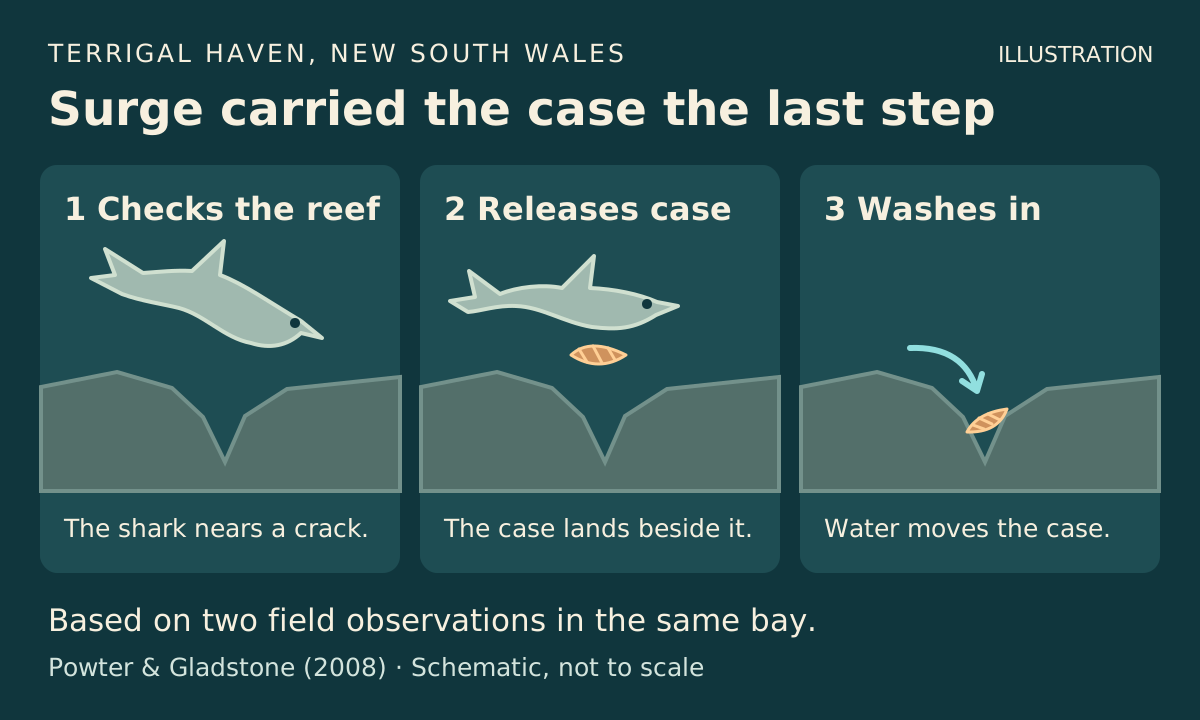
In two observations at Terrigal Haven, the female released the case near the gap and a small surge moved it in. This schematic shows the observed sequence, not a universal laying method. 1
Graphic: SeaLifeWiki. Research basis · Original SeaLifeWiki graphic. Independent three-panel schematic, not a photograph or a reconstruction of an individual reef; no published art was copied.
Broad flanges or long tendrils?
Port Jackson sharks are not the only bullhead sharks that leave spiral cases. The crested hornshark also occurs in eastern Australia and makes a case with twisted keels. Its long, curling tendrils at one end are a useful difference. In a comparison of museum cases, Port Jackson cases had broader keels relative to the capsule and lacked those long tendrils. Colour and a corkscrew outline alone are not enough to separate the two. 2 5
Follow the end of the case with your eyes if it is already visible. A tendril comes off the end; a torn strip of seaweed may cross the case and continue onto rock. Sometimes the end you need to see is buried, broken or in shadow. Not seeing a tendril then is different from seeing that the case has none. A photograph can preserve the useful side of the case even when a firm identification has to wait. 2 5
The adult and the case offer different clues. On the shark, dark markings cross the body like a harness, and a spine sits in front of each dorsal fin. On the egg case, it is the broad spiral and the visible ends that matter. An adult resting on the same reef helps establish which animals use the habitat, but its presence alone cannot identify a case or show that it laid one. 3
An adult's markings can be easier to make out than the ends of a case, especially from the surface. That does not make them a shortcut. A useful field note can hold two different observations: a shark with a harness pattern on the open reef, and a spiral capsule under a nearby ledge whose far end is out of view. Keeping them separate lets someone check the case identification later without losing the location or the features that were clear.
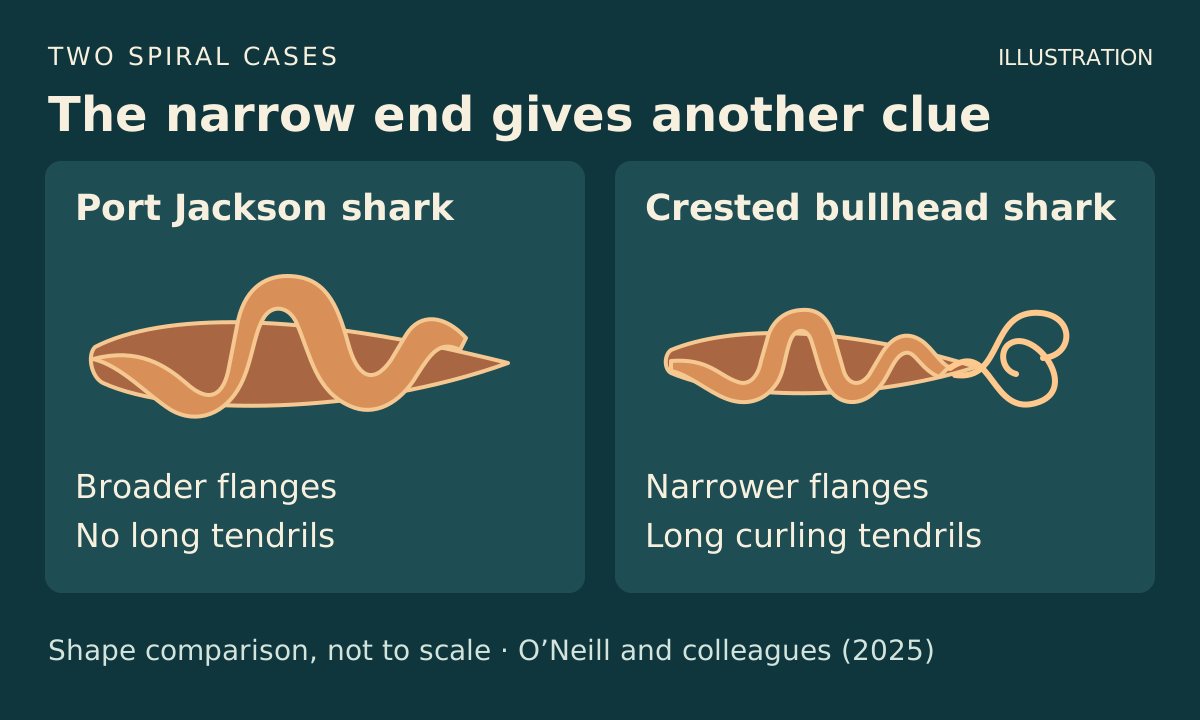
Compare the proportions of the flanges and the case ends, not the brown colour. A hidden end cannot establish that tendrils are absent. Original schematic, not to scale. 2 5
Graphic: SeaLifeWiki. Research basis · Original SeaLifeWiki graphic. Independent comparison of two egg-case outlines, not to scale; no photographs or published figures were copied or traced.
What the crack cannot show
Port Jackson shark young develop inside the case and can take about a year to hatch. A sound-looking case in a crack does not reveal when it was laid or whether a live embryo is still inside. An empty case washed onto a beach has already lost most of its reef context. Comparing its shape with one underwater can help with identification, but it cannot tell you which crack it came from or whether a shark hatched from it. 3 6
Leave a case in place whether or not it looks occupied. If the angle from open water is poor, do not reach into the crack, move a rock or pull on a flange to get a view of the end. A frame that shows the whole case beside its rock contact is more useful than a close-up that cuts both out. When water movement makes it hard to hold position without contact, leaving with a partial view is enough.
The Terrigal Haven regional map places the field observations on the New South Wales coast; it does not mark occupied cracks. SeaLifeWiki's sharks and rays guide puts bullhead sharks beside other groups, and the Canary Islands angelshark guide offers a different example of a shark encounter where the substrate is part of the clue.
On the next rocky-reef dive, the useful view is the place where a spiral edge meets the rock. If a pulse of water shifts nearby algae while that edge stays put, you can see how the gap is holding the case right now. You still do not need to decide how it got there.
Sources & further reading
- Powter & Gladstone (2008) — Reproductive biology and ecology of the Port Jackson shark in eastern Australia — Primary New South Wales field study. The full account describes two observed egg-laying events at Terrigal Haven, in which small surges carried released cases into crevices.
- O’Neill et al. (2025; online 2024) — Morphology of the unique egg cases of hornsharks — Primary comparative museum study of spiral keels, case shape and tendrils. Original site graphics are not adaptations of the paper's figures.
- Australian Museum — Port Jackson shark, Heterodontus portusjacksoni — Institutional species and egg-case reference; adult features, egg placement account and approximate incubation interval.
- Powter & Gladstone (2008) — Demographic analysis of the Port Jackson shark in eastern Australia — Primary visual census including egg capsule mortality and predation observations.
- Australian Museum — Crested hornshark, Heterodontus galeatus — Institutional comparison and specimen examples showing the long tendrils on the crested hornshark egg case.
- Fishes of Australia — Port Jackson shark — Museums Victoria species account supporting the spiral egg-case form and approximate year to hatching.
Read next
- Why Nurse Sharks Can Rest Without Swimming
When a nurse shark lies still beneath a ledge, watch its mouth, throat and gill slits—the repeating pulse reveals water moving while the shark does not.
- Why Male Yellowhead Jawfish Carry Eggs in Their Mouths
At a Caribbean sand burrow, watch for a yellowhead jawfish whose cheeks stay full and whose open mouth reveals a clustered egg mass—the male is brooding the next generation.
- Canary Islands Angelsharks: Finding a Shark Hidden in Sand
Scan the Canary Islands' sand–reef boundary for paired spiracles, fin tips and a faint outline—the patch that looks like a ray may be a buried angelshark.