
Species & behavior
Why Nurse Sharks Can Rest Without Swimming
When a nurse shark lies still beneath a ledge, watch its mouth, throat and gill slits—the repeating pulse reveals water moving while the shark does not.
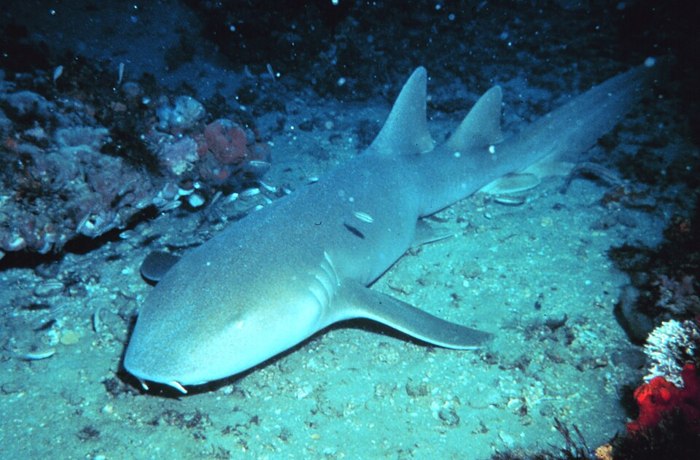
A resting nurse shark can ventilate its gills without swimming forward. The still photograph confirms species and bottom-resting context; it does not show breathing rate, sleep, comfort or feeding. Photograph: Dr. Mathew Gilligan / NOAA, public domain. 3 6
Photo: Dr. Mathew Gilligan / NOAA. Image source · Public domain (U.S. government work). Existing site photograph resized and JPEG-compressed to 700 by 460; no crop, content change or intentional color change.

On a reef ledge, watch a nurse shark's body remain still while its mouth, throat and gill slits make a repeating pulse. That small rhythm matters because the shark is moving water rather than moving itself: it can ventilate its gills without swimming forward.
The early answer is buccal pumping. Muscles expand and compress the mouth-and-throat space, drawing water in and pushing it across the gills; small spiracles behind the eyes can also admit water. That is why the familiar rule that every shark must swim to breathe does not fit a nurse shark resting on the bottom. 1 2
The shark is still; the water is not
Begin with a sequence, not the pose. Hold a stable position outside the ledge and watch several cycles. The mouth edge may part slightly, the floor of the mouth and throat changes shape, and the five gill slits pulse. When that order repeats while the trunk and tail remain on the bottom, the useful observation is active ventilation by a resting shark—not an animal that has stopped breathing.
Identification comes before interpretation. A nurse shark has two barbels hanging near its mouth, small eyes, two rounded dorsal fins set well back and a mouth positioned on the underside of a broad head. The barbels are often easier to resolve than the spiracles, which are small openings just behind the eyes. NOAA explains that bottom-associated sharks can draw water through spiracles while resting, but a diver should not approach simply to find that tiny opening. 2 3
Stillness alone cannot tell you whether the shark is asleep, comfortable, ill or accustomed to people. The Florida Museum species account describes nurse sharks resting on sandy bottoms and in caves or crevices during the day, with more activity at night. That makes rest a well-supported interpretation when the anatomy and setting agree; it does not turn one glance into a sleep study or a promise that the shark will remain there. 3
Compare the shark with its surroundings before deciding that the body itself moved. Surge can sweep algae, suspended particles and a loose pectoral-fin edge through the frame while the head stays planted. Watch a fixed point on the ledge and the order of the mouth-to-gill pulse. That reference helps separate ventilation from camera shake, your own hovering motion and water movement across the animal.
The same account warns that nurse sharks can bite when disturbed. A calm-looking body is therefore not permission to touch, pose beside, hold a fin or reach into a crevice. Read the ventilation pulse from the open-water side of the ledge and leave the animal an unobstructed exit.
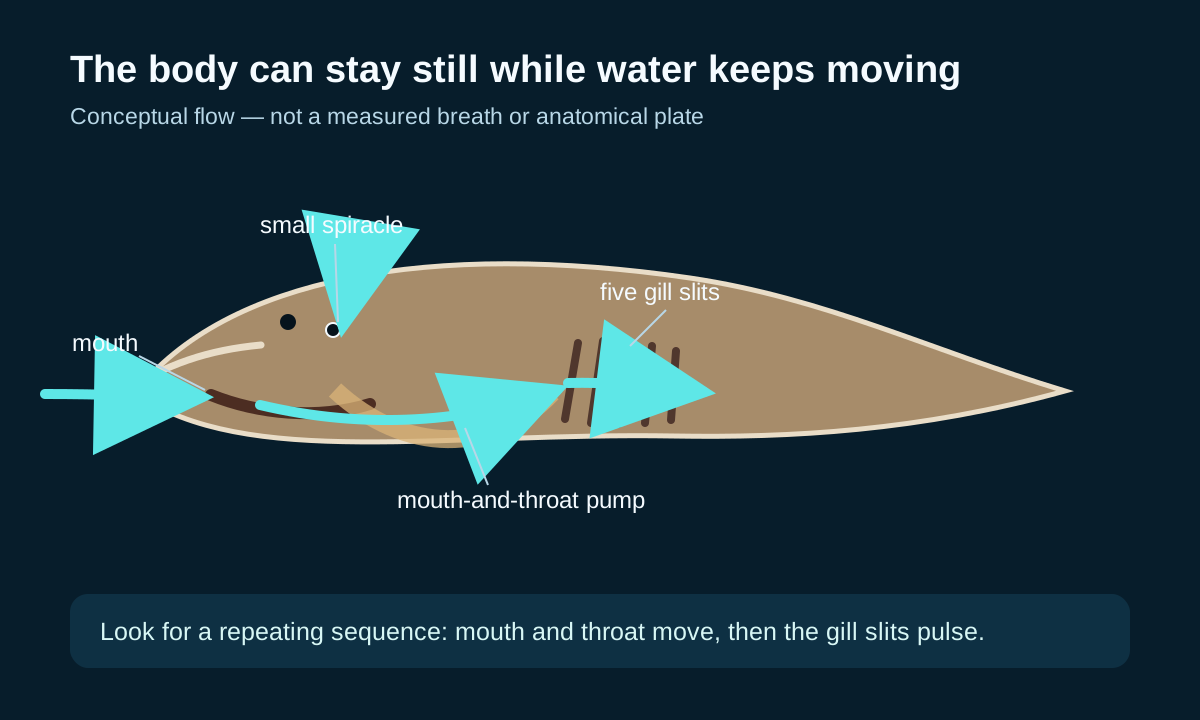
Buccal pumping moves water across the gills while the shark remains on the bottom. The flow is qualitative: arrows do not show a measured rate, pressure or the proportion entering through each opening. 1 2
Graphic: SeaLifeWiki. Research basis · Original SeaLifeWiki graphic. Original conceptual side view of mouth, throat, spiracle and gill flow; simplified and not to scale. It is not traced from a photograph, anatomical plate or research figure and does not depict a measured breath.
A pump replaces the forward rush
A swimming shark can use forward motion to send water through its mouth and across its gills, a process commonly called ram ventilation. A nurse shark need not rely on that forward rush while resting because the changing volume of its mouth and pharynx creates the pressure difference that keeps water moving. The visible clue is not merely an open mouth; it is the coordinated, repeated mouth-to-gill cycle.
Whitney and colleagues tested eight juvenile nurse sharks in respirometers at 23 and 30°C and measured them while resting and swimming. The study describes this benthic species as capable of resting on the bottom while buccal pumping and found a low-energy lifestyle in the studied animals. Those controlled measurements support the mechanism; they do not supply a universal breathing-rate threshold for a wild adult, or prove that every still shark has the same metabolic demand. 1
Current can add water movement around a ledge, but the scene still needs careful reading. A gill slit fluttering irregularly in surge is not the same evidence as a coordinated cycle beginning at the mouth and throat. Conversely, a pulse too subtle to resolve does not prove that ventilation has stopped. Distance, angle, low light and sediment can hide small movements.
Do not count pumps as a health test. Temperature, body size, activity and many conditions not visible to a diver can change respiratory demand, and the primary experiment covered a small set of juveniles under controlled temperatures. The field-safe conclusion is simpler: a repeated pump explains how this shark can remain still without depending on forward swimming.
The same mouth can breathe slowly and feed fast
Nurse sharks also use powerful suction to capture prey, so a mouth movement is not automatically a breath. In a primary feeding study, Motta and colleagues recorded rapid expansion of the mouth-and-throat region and effective suction at about three centimetres in front of the mouth. That close-range event was a prey-capture mechanism, not the small repeating ventilation rhythm visible during ordinary rest. 4
Context separates the two interpretations. A steady series of small mouth, throat and gill movements while the body remains settled supports ventilation. One fast expansion directed at nearby prey can support suction feeding, especially when followed by jaw or body movement. Neither absence of visible prey nor one open mouth proves what occurred; the stronger claim comes from seeing the sequence.
Time of day is supporting evidence rather than a clock. Nurse sharks often rest by day and forage more actively at night, but individual movement varies. A tracking study in the Dry Tortugas and lower Florida Keys found strong site fidelity alongside movements beyond a single resting place. The ledge is therefore a place where you observed a shark, not proof of its entire range or a location it will occupy on the next dive. 3 5
The evidence graphic keeps human labels out of the first observation. Repetition supports ventilation; a fast prey-linked event supports feeding; a single still frame supports only stillness. This order prevents the common mistake of converting a quiet-looking shark into a story about sleep, friendliness or distress.
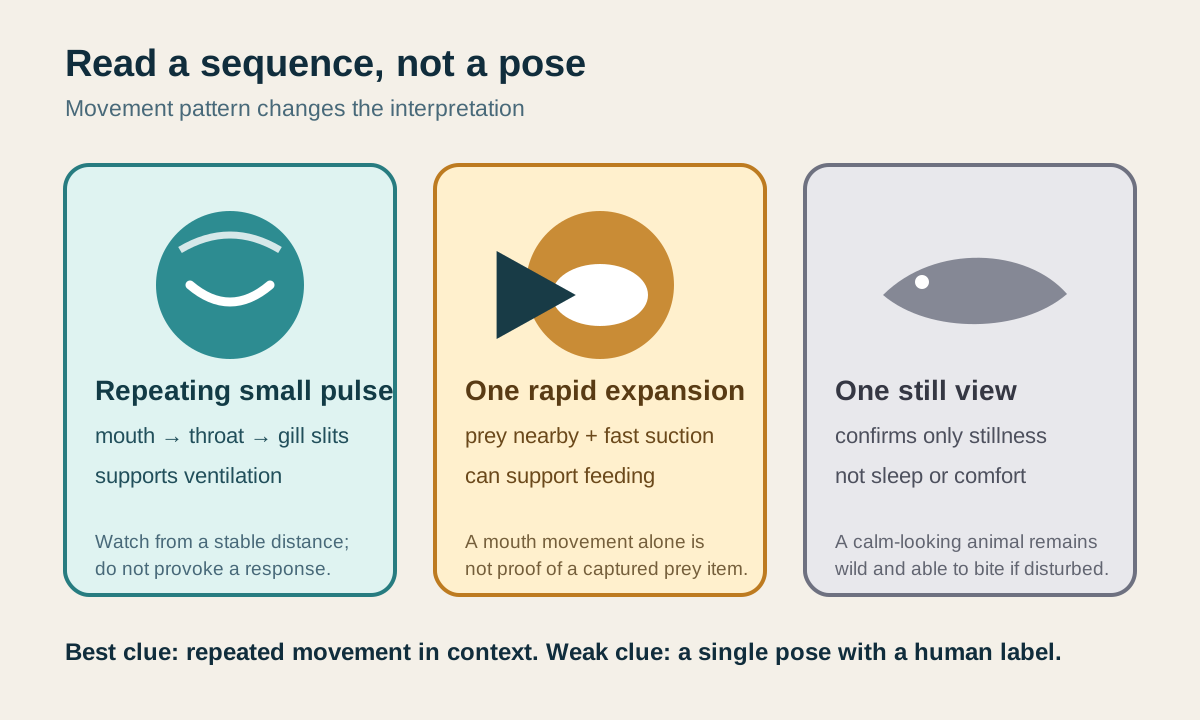
Movement pattern and context make the interpretation. A single pose carries less evidence than a repeated mouth-to-gill sequence, and no observation justifies provoking a reaction. 3 4
Graphic: SeaLifeWiki. Research basis · Original SeaLifeWiki graphic. Original evidence comparison of repeated ventilation, rapid suction and a single still view. Simplified symbols are not a timed sequence, feeding reconstruction, behavioral threshold or reproduction of a published figure.
Read the ledge without changing the scene
Approach the site as if the shark may leave at any moment. Settle your buoyancy away from the bottom, keep fins and equipment out of the sand, and avoid sealing the open side of a cave with divers. Do not shine a concentrated light into the eyes for a prolonged view, reach over the head to see the spiracle or place a camera beneath the mouth. The observation is successful only if the shark can continue or end its rest without negotiating around you.
If the shark lifts its head, changes orientation, increases body movement or leaves, do not follow it into a tighter space. Those changes show that the original scene is over; they do not reveal a single motive. Back away and let the animal choose its route. Feeding, touching or using bait would change the behavior you came to understand and can create risk for both shark and people.
A cluster of resting sharks calls for more space, not a tighter group photograph. Each animal may have a different route out of the shelter, and the nearest opening is not necessarily the one a diver expects. Keep the water column clear, follow local guide instructions and let the number visible remain an observation rather than a reason to surround the ledge.
Use the nurse shark profile to review the barbels, fin placement and habitat, then compare a very different shark signal in the grey reef shark threat-display guide. The Florida Keys map and Bonaire map provide regional context without promising a sighting; local rules, operators and conditions still govern access and distance.
On the next dive, look for three clues in order: a body resting on the substrate, a repeating movement of mouth and throat, and a following pulse at the gill slits. If the small opening behind the eye is visible from your existing position, it completes the picture—but do not close the distance to find it. The nurse shark may look motionless, yet the water crossing its gills shows that stillness is active work.
Sources & further reading
- Whitney et al. (2016): Effects of temperature and swimming speed on nurse shark metabolic rate — Primary respirometry study of eight juvenile nurse sharks at 23 and 30°C. Supports resting buccal pumping and the measured low-energy pattern in the studied animals; it is not used as a wild breathing-rate threshold or a universal result for all sizes and conditions.
- NOAA Fisheries: Fishing for Sharks in the Gulf of Mexico—spiracles and ventilation — Current institutional explanation checked November 2, 2026. Supports the location and function of spiracles and the distinction between sharks that must swim and bottom-associated species able to rest while moving water over the gills.
- Florida Museum: Nurse Shark species profile — Institutional species account checked November 2, 2026. Supports identification, daytime resting habitat, nocturnal activity and the warning that nurse sharks can bite if disturbed; typical patterns are not treated as a schedule for one animal.
- Motta et al. (2008): Functional morphology and suction performance of nurse shark feeding — Primary kinematic and pressure study, DOI 10.1002/jmor.10626. Supports rapid, close-range suction feeding and helps distinguish a prey-capture event from repetitive ventilation; it does not make every visible mouth movement a feeding attempt.
- Ferreira et al. (2013): Movement and activity patterns of nurse sharks — Primary tagging and telemetry study in the Dry Tortugas and lower Florida Keys. Supports site fidelity together with wider movement; a tagged sample does not make one ledge a permanent home or predict a future sighting.
- Wikimedia Commons: Nurse shark at Gray's Reef National Marine Sanctuary — Image record checked November 2, 2026. Identifies Ginglymostoma cirratum, Gray's Reef National Marine Sanctuary, photographer Dr. Mathew Gilligan and NOAA public-domain provenance. The still is not treated as a breathing-rate, sleep or feeding record.
Read next
- What a Grey Reef Shark's Hunched Posture Means Underwater
When a grey reef shark lowers both pectoral fins and stiffens into a hunched swim, read the whole sequence before deciding what it means—and give the shark more water.
- Why Male Yellowhead Jawfish Carry Eggs in Their Mouths
At a Caribbean sand burrow, watch for a yellowhead jawfish whose cheeks stay full and whose open mouth reveals a clustered egg mass—the male is brooding the next generation.
- How Snapping Shrimp Make a Reef Crackle
The reef's dry crackle begins with a hidden shrimp closing one outsized claw—but the sound comes from a collapsing bubble, not two hard claw parts striking.