
Species & behavior
How Snapping Shrimp Make a Reef Crackle
The reef's dry crackle begins with a hidden shrimp closing one outsized claw—but the sound comes from a collapsing bubble, not two hard claw parts striking.
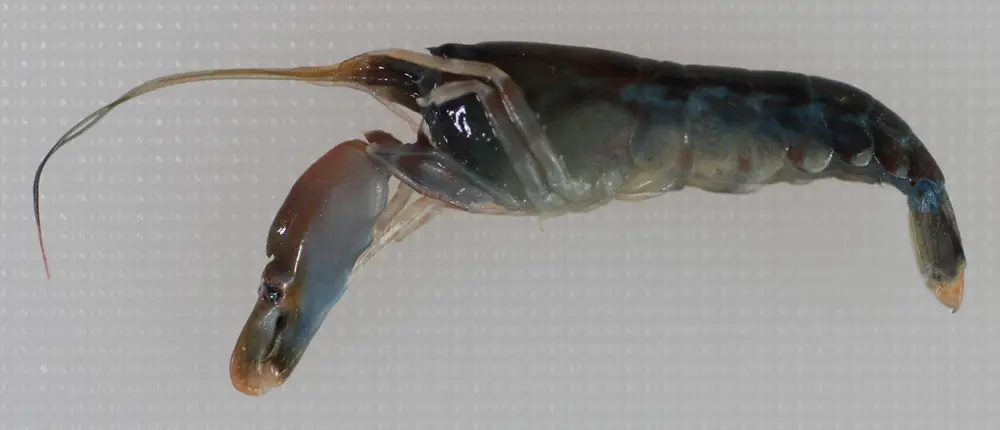
A 28-millimetre bigclaw snapping shrimp from lower Chesapeake Bay shows the unequal claws behind the group's name. This specimen view documents the apparatus, not a snap, water jet or natural posture.
Photo: Robert Aguilar / Smithsonian Environmental Research Center. Image source · CC BY 2.0. Full frame resized from 2048 by 880 to 1000 by 430 pixels, metadata removed and converted from JPEG to WebP; no crop.
_(13048410675).jpg)
During an ordinary breath near coral, rock or shell rubble, listen for a scattered, dry crackle: it matters because much of this busy soundscape can come from small shrimp you may never see. The claw starts each event by driving a fast jet of water, but the sharp sound arrives when the jet's cavitation bubble collapses—not when hard claw surfaces simply clap together. 1
That answer turns background noise into a sequence you can read without pulling a reef apart. First hear the collective crackle; then, only if an animal is already visible, look for the dramatically unequal claws. Keep the sound, the shrimp and its reason for snapping as separate observations: a pop alone does not identify the species, locate one hidden animal or reveal whether it was fighting, feeding or responding to something nearby. 3 4
Hear the pop before you find the shrimp
A reef crackle is a crowd, not a roll call. Snapping shrimp live in crevices in coral and oyster reefs, rocky ground and sponge cavities, and adults are often only a few centimetres long. Many snaps overlap before the source animals appear. Sound also travels farther than your view through a mask, so the loudest direction is not a reliable invitation to point at one hole. Describe the soundscape first: isolated ticks, a steady frying-like crackle, or a change as you pass from open sand toward broken structure. 3
If a shrimp is already out, the most useful visible clue is asymmetry. In the species studied for the snap mechanism, one claw is greatly enlarged and specialized for snapping. The body and small claw may look ordinary beside it, which makes the large claw easy to mistake for a pincer that hits an object. Watch from where you are. A photograph of the claw confirms equipment, not action; to connect a visible shrimp to a sound, you would need to see the rapid closure and hear the pop at the same moment. 1
Do not expect every member of the family Alpheidae to contribute the same sound. Hundreds of species occupy different habitats, and vigorous snapping is especially associated with the genera Alpheus and Synalpheus. Even then, a human listener cannot identify a species from one click. The World Register of Marine Species record for Alpheus is useful after a documented sighting, but the sound by itself should remain 'snapping shrimp' in a dive note. 3 5
Listen during normal breathing rather than holding your breath or pressing closer to the bottom. Your bubbles and boat noise may mask brief pops; that is part of the observation, not a reason to change safe diving practice. Compare like with like—similar depth, distance from hard structure and moment in the breathing cycle. The result is modest but useful: you can notice where the crackle strengthens without pretending that your ears have counted animals.
The claw fires water; the bubble makes the snap
The decisive experiment paired high-speed imaging with a hydrophone while the bigclaw snapping shrimp Alpheus heterochaelis fired its claw. The frames showed rapid closure pushing out a high-velocity water jet. Where pressure in that jet fell far enough, water formed a temporary vapour-filled cavity—a cavitation bubble. The sound peak lined up with the bubble's collapse, not the instant the claw shut. That timing is why 'the claw bangs closed' is an appealing but incomplete interpretation of what you hear. 1
Cavitation is the same word used for bubbles that form around fast propellers, but you do not need to see a propeller-like swirl beside the shrimp. Underwater, your direct clue is the single hard pop. The jet and bubble develop too quickly and too close to the claw for a diver to resolve as a three-step show. The diagram slows the mechanism down so the audible clue has an explanation; it is not a promise that you can watch the bubble unaided.
Laboratory work also recorded a very brief flash at bubble collapse. The researchers called the effect shrimpoluminescence, a cavitation-related emission rather than biological light made by glowing tissue. Do not use a glitter, camera reflection or a comb jelly's rainbow-like diffraction as proof that you saw it. The flash is a measured laboratory detail below ordinary diver perception, while the crack is the field clue that belongs in your log. 2
The mechanism was demonstrated in A. heterochaelis, so keep its anatomical details tied to that study instead of assuming every small reef shrimp has an identical claw. What transfers safely is the sequence behind vigorous snapping: specialized claw motion, water jet, cavitation bubble, collapse and sound. If the shrimp is visible between rocks, notice whether the enlarged claw remains raised, closes or disappears into the crevice; if it stays hidden, the sound alone is still a complete observation. 1 3
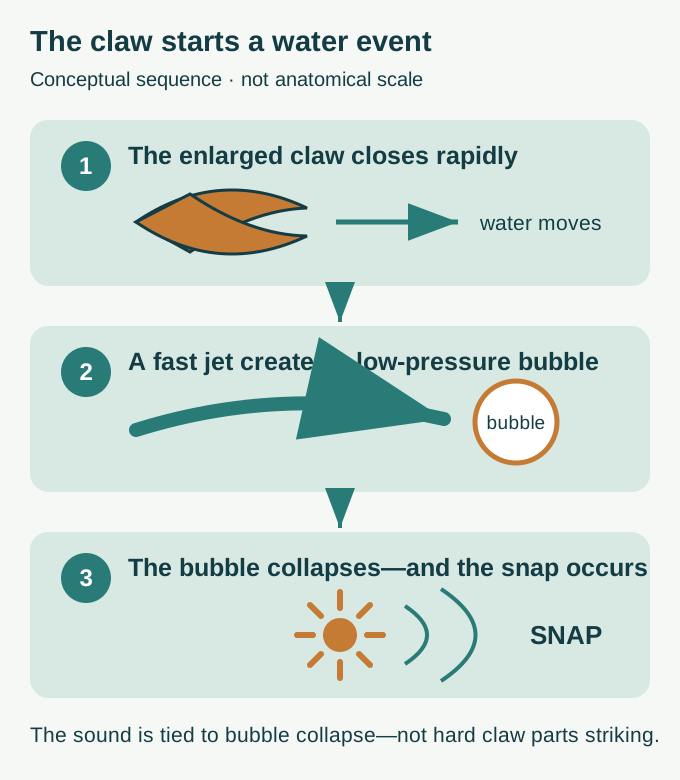
The enlarged claw closes, a fast water jet creates a cavitation bubble, and the bubble's collapse produces the snap. This conceptual sequence is not anatomical scale.
Graphic: SeaLifeWiki. Research basis · Original SeaLifeWiki graphic. Original conceptual graphic based on the cited synchronized high-speed imaging and hydrophone study; not anatomical scale and not documentary imagery.
One crackle does not reveal the reason—or reef health
Snaps occur in several contexts. Research has documented territorial and aggressive signaling in some species, while prey stunning and predator deterrence are also reported functions. NOAA's sanctuary soundscape account adds fights, burrowing and responses to the surrounding environment. None of those labels is audible in an isolated pop. Unless you can see an exchange, write down the sequence—two animals facing, a retreat into rubble, sediment moving—before naming the behavior. 3 4
A year-long hydrophone study at one subtidal oyster reef in North Carolina shows why a short listen needs restraint. At West Bay Marine Reserve, recordings from June 2011 through July 2012 contained roughly 1,500 to 2,000 detected snaps per minute in summer and fewer than 100 in winter. Snap rates rose with water temperature, and light influenced daily timing, but whether daytime or nighttime was busier shifted through the year. Those numbers describe one monitored sound field, not a universal healthy-reef threshold. 3
On a dive, structure and listening position change the result too. A wall, rubble patch or shell bed can shelter shrimp while open sand offers fewer crevices; shallow topography alters how sound reaches you, and a passing engine can cover the high-frequency crackle. A sudden quiet patch can therefore mean habitat changed, your distance changed, the animals changed activity or another sound masked them. It is a clue to compare, not a verdict that the reef is damaged.
Scientists can test trends with calibrated hydrophones, repeat visits and environmental measurements. A diver can make the small observation that helps such a question: note date, local time, depth, substrate, nearby boat noise and whether the crackle was continuous or intermittent. Compare the same ledge on another visit if conditions allow. Repetition turns 'the reef sounded loud' into context without converting your ears into an animal census or health meter. 3 4
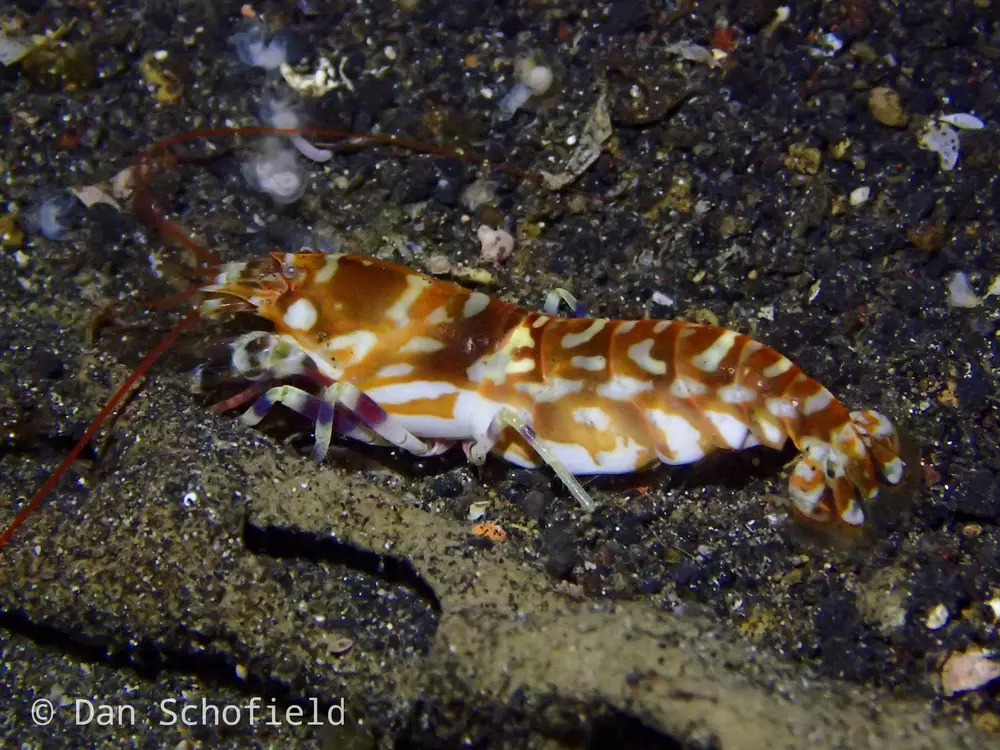
A tiger snapping shrimp rests on coarse substrate in Indonesia. It is a different species from the bigclaw shrimp used in the mechanism experiment, and the still does not document a snap or identify the source of a surrounding crackle.
Photo: Dan Schofield. Image source · CC BY 4.0. Full frame resized from 2048 by 1536 to 1000 by 750 pixels, metadata removed and converted from JPEG to WebP; no crop.

Listen without dismantling the source
The animal's habit of vanishing into a slit is not a puzzle to solve with your hands. Do not lift loose coral, roll rocks, break oyster clumps, probe holes or direct a jet of water into a crevice. Never bait or provoke a snap for a recording. Those actions disturb both the shrimp and the structure supporting the soundscape, and a replaced rock does not necessarily return a shelter to the way you found it.
Hold a stable position off the bottom, keep fins and gauges clear, and let an already visible shrimp set the viewing distance. If you photograph it, preserve enough surrounding rubble or sponge to show where it lives. Record the side carrying the enlarged claw only when the angle makes that certain. A big claw held open in one frame is an identification clue, not evidence of a shot, a threat or a successful hunt.
Use the Florida Keys regional guide to place reef and rubble habitat without treating any site as a guaranteed sighting. Compare this hidden soundmaker with the visible give-and-take at a cleaning station and the slow movement of a mushroom coral: in each case, the useful interpretation comes from a sequence, not the most dramatic single clue.
On your next reef or rubble dive, pause during an ordinary breath and listen across the boundary between open sand and crevice-rich structure. If the crackle thickens, notice the habitat before searching for a face. You may never see the shrimp, but you can still recognize what each hidden animal contributes: a claw-driven water jet, a collapsing bubble and one precise snap inside the reef's collective sound.
Sources & further reading
- Versluis, Schmitz, von der Heydt & Lohse (2000), How snapping shrimp snap: Through cavitating bubbles — Science 289(5487), 2114–2117; DOI 10.1126/science.289.5487.2114. Primary synchronized hydrophone and high-speed imaging study of Alpheus heterochaelis; supports the water jet, cavitation bubble and sound-at-collapse sequence.
- Lohse, Schmitz & Versluis (2001), Snapping shrimp make flashing bubbles — Nature 413, 477–478; DOI 10.1038/35097152. Primary laboratory measurement of the brief light emission at bubble collapse; supports only the qualified shrimpoluminescence passage, not a diver-visible flash.
- Bohnenstiehl, Lillis & Eggleston (2016), The curious acoustic behavior of estuarine snapping shrimp — PLOS ONE 11(1), e0143691; DOI 10.1371/journal.pone.0143691. Open primary study using 27,565 recordings from one West Bay oyster-reef station; supports habitat, seasonal, temperature and light-linked patterns and the limits of a short recording.
- NOAA National Marine Sanctuaries — Oh Snap! What Tiny Shrimp Can Tell Us About Habitat Health — NOAA Office of National Marine Sanctuaries, December 2021. Institutional account of diver-audible reef crackle, observed snapping contexts and SanctSound monitoring; supports treating sound as a variable clue rather than a one-dive health diagnosis.
- WoRMS — Alpheus Fabricius, 1798 — World Register of Marine Species taxon record, accessed September 25, 2026. Current authoritative record for the genus Alpheus; used for the related species link and taxonomic scope, not behavior inference.