
Species & behavior
What a Grey Reef Shark's Hunched Posture Means Underwater
When a grey reef shark lowers both pectoral fins and stiffens into a hunched swim, read the whole sequence before deciding what it means—and give the shark more water.
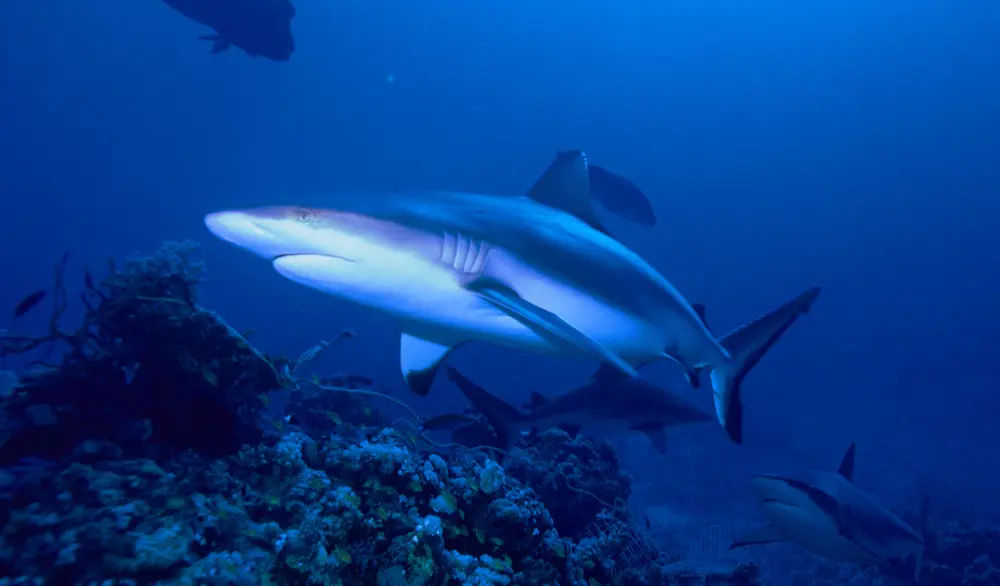
A grey reef shark swims in profile above the reef with a pectoral fin extended. This relaxed-looking still does not document the multi-part display described in field studies.
Photo: Albert kok. Image source · CC BY-SA 3.0. Full frame resized from 2487 by 1457 to 1000 by 586 pixels, metadata removed and converted from JPEG to WebP; no crop.

When a grey reef shark passes, compare both pectoral fins with the line of its back: a displaying shark can lower the fins, lift its snout and arch into a stiff, exaggerated swim. That combination matters because it is a graded warning documented in close encounters, giving a diver a reason to stop approaching and leave the shark a clear route. 1
The early field work did not identify one magic fin angle or show that every close pass predicts a bite. It recorded a sequence—four changes in posture plus two changes in movement—after sharks were closely approached. Read the whole animal and the encounter, not a frightening silhouette or one fin caught between strokes. 1
Read six changes, not one low fin
Start with the shark's ordinary swimming. A grey reef shark moving along a reef edge usually looks streamlined: the snout points into its path, the back keeps a smooth line and the paired pectoral fins extend to either side. The broad dark margin along the rear edge of the tail helps confirm the species before you interpret its posture; black-tipped fins alone can belong to a blacktip reef shark. 4
The classic 1973 study described four postural elements: the snout lifted, both pectoral fins dropped, the back arched and the body bent laterally. It also described two locomotor elements: an exaggerated side-to-side swim and rolling or spiral looping. A diver may not see every element at the same intensity, because the authors treated the display as graded, but the useful clue is several changes arriving together. 1
That is why one lowered fin is weak evidence. Pectoral fins help sharks control lift, pitch and turns; experimental swimming work on other shark species found fin angle changed with trajectory while the animals cruised. A grey reef shark banking around coral, holding depth in current or changing direction may alter a fin without displaying. Compare left with right, look again after the turn and ask whether the whole body has become hunched and stiff. 5
Distance and sequence beat a freeze-frame. If the fins look low for one instant but the back stays level and the shark continues a smooth route, record the movement and leave the interpretation open. If paired fin depression persists while the snout rises and the path becomes exaggerated, you have a stronger match to the documented display—and a clear reason to increase distance rather than swim closer for proof.
The famous display came from close approaches
The first detailed account came from Enewetak Atoll in January 1971. Richard Johnson and Donald Nelson observed the display on 23 occasions, filmed it at normal speed and in slow motion, and reported that it was directed mainly toward divers. The important field detail is the setup: these were close interactions used to elicit and document a response, not a survey showing that grey reef sharks routinely hunch whenever a person enters the water. 1
A follow-up paper examined agonistic approaches toward divers and submersibles and asked whether the response was antipredatory or competitive. That question mark matters underwater. The visible display shows conflict or disturbance; it does not let a diver see inside the shark and choose a single motive such as territory, fear or hunger. Describe what changed and what happened immediately before it—pursuit, crowding, a blocked path, food in the water—without turning motive into an observed fact. 2
The term agonistic is more precise than angry. In behavior research it covers actions connected with conflict, including warning, defense and attack. For a diver, the translation is simpler: the shark's ordinary route has changed during a close encounter. Whether the animal is defending space, trying to end a pursuit or responding to another pressure, the useful response is to remove pressure rather than test the label. 2 3
Do not confuse curiosity with the display. Grey reef sharks commonly approach divers, and an inquisitive pass can bring the animal close while its back, snout and swimming rhythm remain ordinary. Nor does the black edge of the tail signal mood; it is an identification mark. Keep species clues, distance and posture as separate observations, then combine them only when the sequence supports it. 4

This Wake Island view shows the head, back and nearer pectoral fin during ordinary swimming. A still image cannot establish the repeated, exaggerated movement required to identify an agonistic display.
Photo: CRED/PIFSC, NOAA. Image source · Public domain — U.S. NOAA. Full frame resized from 1600 by 1200 to 900 by 675 pixels, metadata removed and converted from JPEG to WebP; no crop.

A repeated pass gives you context, not permission
On a reef pass, current can bring the same shark across a diver's view more than once. Use the background to separate a circuit from a closing approach: note whether the shark follows the same ledge, crosses the same current seam or shortens the distance on each pass. A repeated silhouette is not automatically a charge, and a head-on angle can make both pectoral fins look lower than they do from the side.
Now watch the transitions. Does the shark remain fluid as it turns, or does its path become stiff and laterally exaggerated? Do both fins stay depressed after the turn? Does the snout lift while the back arches? The 2007 review compared these postural and movement elements across reported shark displays, but it also emphasized that displays are species- and situation-specific. Use the grey reef sequence for grey reef sharks; do not export it unchanged to every shark you meet. 3
Other motion can imitate part of the pattern. A shark trying to dislodge an attached sharksucker may flex, roll or jerk; ordinary steering can change fin angle; current can alter its path around a pinnacle. Those possibilities do not make a hunched approach safe to investigate. They explain why the reliable field note includes the attached fish, current, reef shape and order of movements instead of naming the behavior from a single dramatic twitch. 3 5
Keep your camera subordinate to the observation. A wide video that holds the shark, reef edge and your distance in one frame preserves the changes that matter. Chasing a tight portrait removes the route from the record and adds the very pressure that made the original experiments informative. If the animal turns away, let it leave; a departing shark is not a missed chance to complete the sequence.
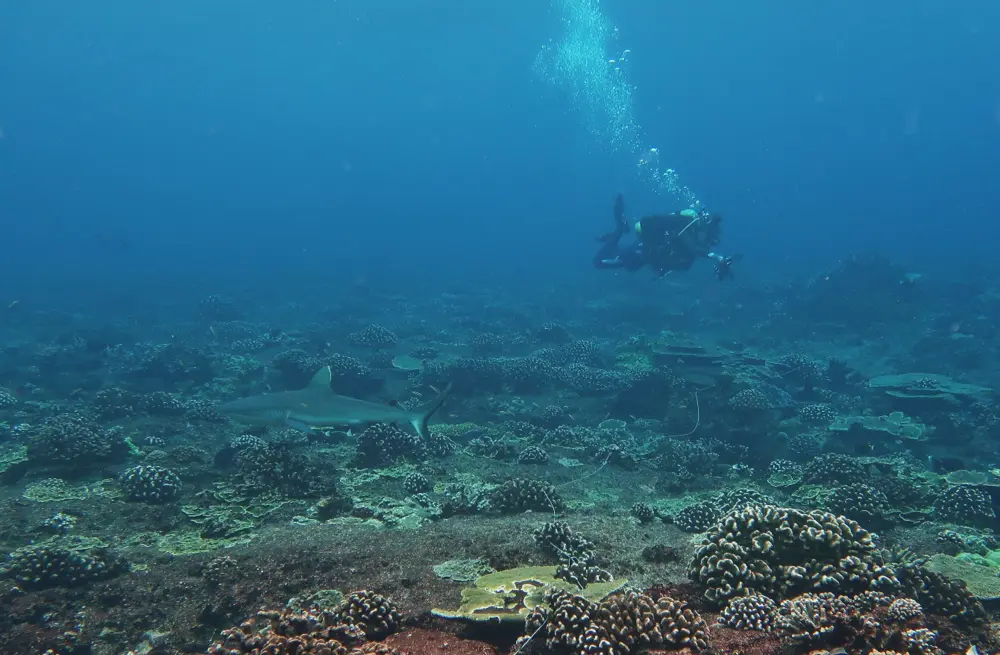
A grey reef shark and NOAA survey diver share a wide Baker Island frame. The image documents spacing and reef context; it does not establish that the shark is displaying or approaching the diver.
Photo: NOAA Fisheries / Dani Escontrela. Image source · Public domain — U.S. NOAA. Full frame resized from 1341 by 878 to 1000 by 655 pixels, metadata removed and converted from PNG to WebP; no crop.

Open the route and end the experiment
If several display elements appear together, stop advancing. Stay with your buddy, keep the shark in view without swimming after it, and make your movement controlled rather than sudden. Move out of its path and leave open water between the animal and the reef edge or exit it was using. Follow the site briefing and your dive professional's direction; conditions, current and the number of animals can change the safest route to the boat or reef.
Do not corner the shark against reef structure, descend onto it, intercept its turn or use a camera for one closer pass. Never touch, feed or provoke it. The goal is not to discover how far the display will escalate. The original observations connect continued close pressure with stronger responses, and the Florida Museum notes that a threatened or cornered grey reef shark may flee or deliver a quick bite before retreating. 1 4
Use the Palau regional guide for reef-pass context, not as a sighting promise, and the Florida Museum species account to confirm the dark tail margin. Compare the way a manta changes its feeding posture and how cleaning-station behavior depends on a full exchange: in each case, one body part becomes meaningful only inside a sequence.
On the next dive with grey reef sharks, establish the relaxed baseline before you look for drama. Notice the tail margin, the line of the back and both pectoral fins on the first smooth pass. If the snout rises, the back arches, both fins stay low and the swim turns stiff, you will recognize a request for space—and the most informative next observation is the shark returning to ordinary swimming after you give it that space.
Sources & further reading
- Johnson & Nelson (1973), Agonistic Display in the Gray Reef Shark and Its Relationship to Attacks on Man — Copeia 1973(1), 76–84; DOI 10.2307/1442360. Original field account of 23 displays at Enewetak Atoll, filmed at normal speed and slow motion; supports the four postural and two locomotor elements, the graded sequence and the close-approach context.
- Nelson, Johnson, McKibben & Pittenger (1986), Agonistic attacks on divers and submersibles by gray reef sharks: antipredatory or competitive? — Bulletin of Marine Science 38(1), 68–88. Follow-up primary report on agonistic approaches toward divers and submersibles; supports treating the display as a conflict response without assigning a single visible motive.
- Martin (2007), A review of shark agonistic displays — Marine and Freshwater Behaviour and Physiology 40(1), 3–34; DOI 10.1080/10236240601154872. Scientific review comparing shark agonistic displays and their interpretation; supports the sequence-based, species-specific reading and the warning about similar movements from other causes.
- Florida Museum — Grey Reef Shark — Florida Museum of Natural History species profile, updated February 3, 2025. Institutional identification account for the dark caudal-fin margin, similar-species distinction, diver approaches and documented threat posture.
- Fish & Shannahan (2000), The role of the pectoral fins in body trim of sharks — Journal of Fish Biology 56, 1062–1073; DOI 10.1006/jfbi.1999.1228. Primary kinematic study of pectoral-fin angles in swimming sharks; supports the limited point that pectoral fins also function in ordinary trim and changes of trajectory. The study did not test grey reef shark displays.