
Species & behavior
Why Manta Rays Unroll Their Head Fins to Feed
When a manta unrolls the two fins beside its mouth, follow what happens next: an open mouth and a repeated run, somersault or feeding chain reveal how the ray works a patch of plankton.
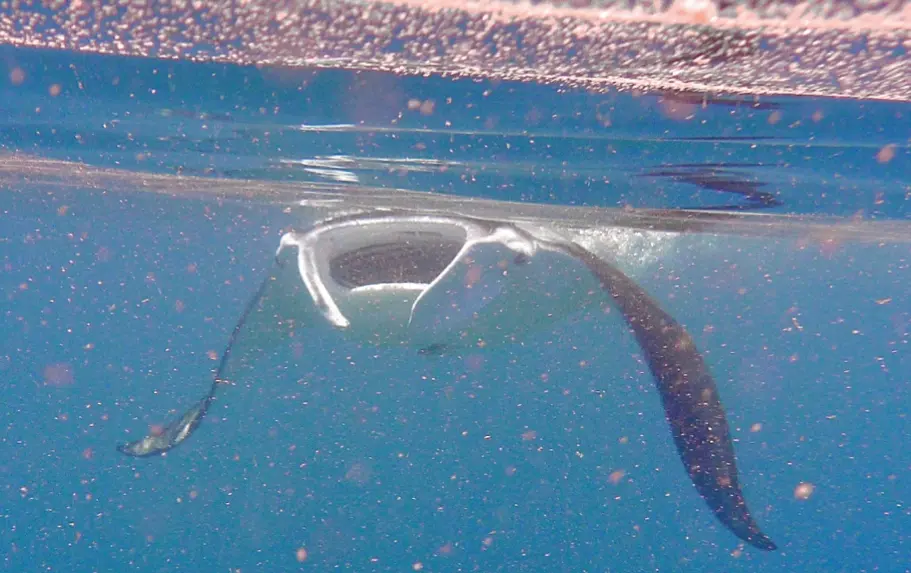
The feeding switch is visible at the front of the animal: the cephalic fins are unrolled beside the open mouth, forming a channel for plankton-bearing water. A still photograph shows the posture, not the density or identity of the prey.
Photo: Fabrice R. A. Jaine, Lydie I. E. Couturier, Scarla J. Weeks, Kathy A. Townsend, Michael B. Bennett, Kym Fiora and Anthony J. Richardson / PLOS ONE (2012), Figure 2C. Image source · CC BY 2.5. Complete published Figure 2C image converted from JPEG to WebP; no crop or resampling.

On your next manta encounter, look at the two hornlike fins beside the mouth: when they unroll forward and the mouth opens, the ray has shifted from travelling to feeding. Then follow its path—a straight run, tight backward loop or line behind another manta tells you how it is working a patch of plankton you may not be able to see. 1 4
Those apparent horns are flexible cephalic fins, also called cephalic lobes. Rolled into spirals, they streamline the front of a cruising manta; opened around the mouth, they guide water and suspended prey inward. The mouth position tells you that feeding has begun, while the route reveals whether one ray is crossing the food patch, returning through it or joining others moving through it.
The two horns are feeding fins
Begin at the head rather than the wing tips. A reef manta ray, Mobula alfredi, carries one cephalic fin on each side of its broad, front-facing mouth. When the animal is not feeding, those fins can be rolled into compact spirals. During feeding they spread forward, changing the entrance from a flat opening into a guided channel. Watch for the combination: fins unfurled, mouth open and forward movement through the water. 4
That combination matters because an open-looking mouth in a single angled photograph can be deceptive. If the head is partly hidden, follow the cephalic fins through several seconds of video. A ray with both fins rolled while gliding past has not shown the feeding posture described here. A manta with the fins open but the mouth obscured is a possible feeding observation, not a complete one.
Keep the species distinction modest too. Reef mantas and giant mantas can both feed with open mouths and unfurled cephalic fins. The local reef manta profile gives the identification context for this article, but feeding posture alone does not separate the two species. Location, body markings and a clear view of diagnostic features still matter.
Once the water enters, it passes over filtering structures associated with the gills and exits through the gill slits. The cephalic fins are therefore the visible entrance to a process whose smallest parts remain hidden from a snorkeler. Instead of trying to see individual prey, record the larger sequence you can verify: the fins open, the mouth stays open and the animal holds or changes its feeding path.
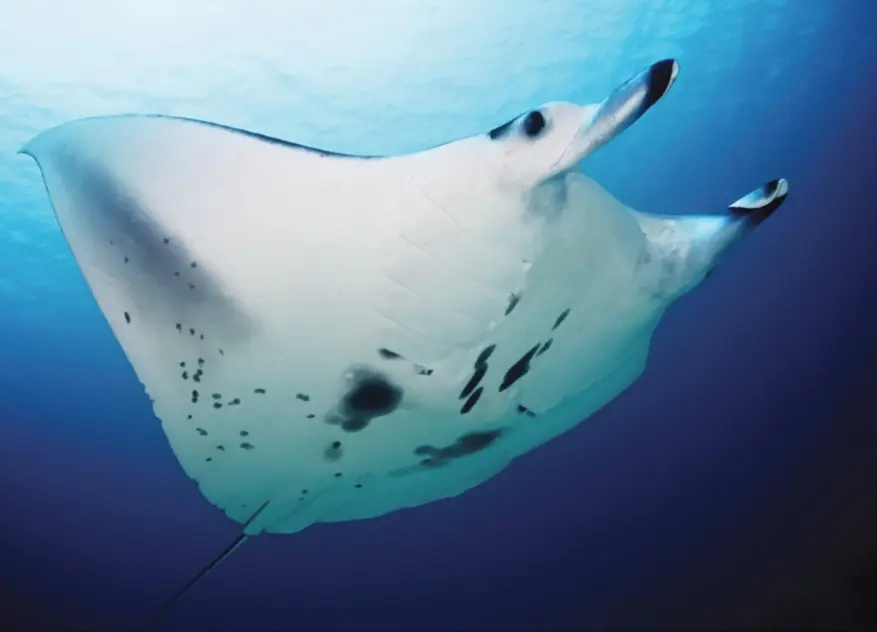
In the matched cruising view, the mouth is closed and both cephalic fins are rolled into tight spirals. Compare that front-end posture with the open fins and mouth in the feeding photograph above.
Photo: Fabrice R. A. Jaine, Lydie I. E. Couturier, Scarla J. Weeks, Kathy A. Townsend, Michael B. Bennett, Kym Fiora and Anthony J. Richardson / PLOS ONE (2012), Figure 2A. Image source · CC BY 2.5. Complete published Figure 2A image converted from JPEG to WebP; no crop or resampling.

A loop is not the same turn as a barrel roll
After you find the feeding posture, follow the animal's centre rather than one wing tip. In straight feeding, the manta moves through the water on a level run and turns back at the end. In somersault feeding, it makes a tight backward loop and can repeat the loop. The common phrase ‘barrel roll’ can blur the geometry: the useful field clue is a complete backward circle that brings the open mouth through nearby water again. 4
A 2024 study in eastern Baa Atoll, Maldives, analysed 3,106 filmed foraging events involving 343 individually identifiable reef mantas over three years. It included eight previously described strategies; somersault, straight and chain feeding were the most frequently recorded. The researchers identified individuals from the spot patterns on their undersides, so repeated clips of the same animal were not treated as a series of strangers. 1
Those observations do not make every loop a meal. A manta can turn, bank or change depth without completing the feeding sequence. Keep the mouth and cephalic fins in frame. A backward loop with them open supports somersault feeding; a distant silhouette turning once with the head hidden leaves the reason unresolved.
Several mantas can also feed in a head-to-tail line. The Baa Atoll researchers called two or more animals within two body lengths a feeding group, and group feeding became more likely when more mantas were present in the wider aggregation. Three hours before high tide, group feeding was also more likely than after high tide at those study sites. That result describes the observed atoll and survey years, not a tide table that guarantees feeding on another island. 1
In the water, count the route rather than the crowd. Are the animals following one another through the same line, crossing independently, or simply occupying the same bay? A row with mouths open and cephalic fins extended is a feeding chain. Several mantas cruising near one another have not yet shown that behaviour.
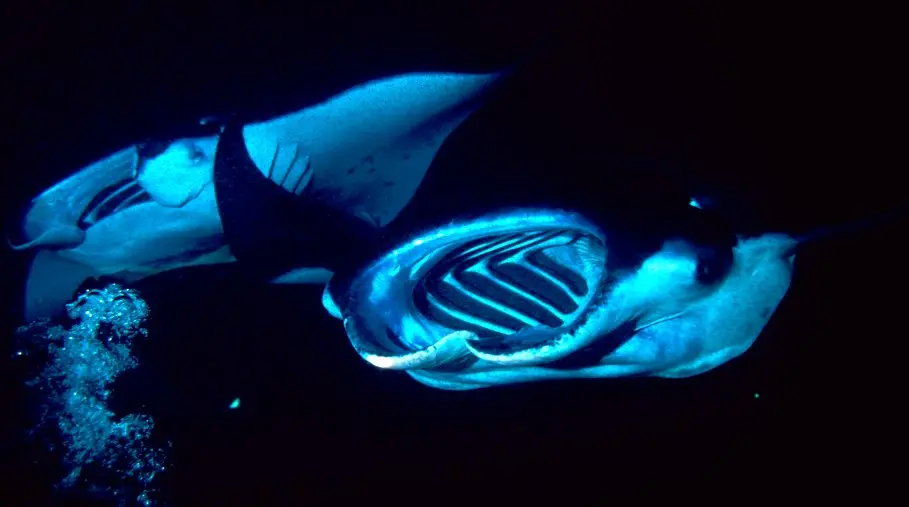
Both mantas have open mouths, and the nearer animal exposes the filter plates behind the entrance. Two feeding animals in one frame do not by themselves establish chain feeding; their head-to-tail path must also be visible.
Photo: Paul Hirst. Image source · CC BY-SA 2.5. Complete JPEG converted to WebP; no crop or resampling.

The hidden filter does not work like a kitchen sieve
The mouth can look like an enormous scoop, but the gill filter behind it is not simply a mesh with holes smaller than every item of food. In a 2018 experiment, Raj Divi, James Strother and Misty Paig-Tran built physical and computer models from filter structures of giant manta rays, Mobula birostris, and Chilean devil rays, Mobula tarapacana. Their models showed particles striking leaflike filter lobes and bouncing back into faster flow above the pores while water passed through. They called the process ricochet separation. 3
In the giant-manta model, the pore was about 340 micrometres wide, yet calculated filtration increased sharply for particles larger than about 200 micrometres. The result explains how food smaller than a pore can remain in the mouth rather than washing straight through, while the moving water helps the filter resist clogging. It was a model of preserved anatomy and flow, not a camera inside a living reef manta, so it supports the mechanism without making every number a reef-manta measurement. 3
Return to the animal in front of you. Water enters the open mouth and leaves through the gill slits; the prey becomes concentrated inside. You will not see a copepod ricochet from a filter lobe. What the hidden mechanism changes is your interpretation of the visible posture: the manta is not waiting for large pieces to fall into a bag, and an apparently empty mouth can be processing prey too small for your mask to resolve.
Nor does an open mouth tell you that the surrounding water is equally rich everywhere. At D'Arros Island in the Seychelles, researchers made weekly surveys and collected 89 plankton samples during feeding, non-feeding and manta-absent observations from November 2022 through March 2024. Surface feeding was associated with higher plankton biomass, and their site-specific model placed the point where feeding probability exceeded one half at 26.9 milligrams of dry plankton per cubic metre. Earlier studies reported different thresholds elsewhere. 2
That regional difference is something a diver can respect even without a plankton net. One manta feeding beside you does not convert the whole bay into a uniform soup, and a known aggregation site does not promise an event on schedule. Watch where the ray turns back, where a chain forms and where the mouths close. Those boundaries are visible hints that the useful food patch is uneven and temporary.
Stay beside the route, not inside it
A feeding manta needs an open path more than it needs another camera in front of its mouth. The Manta Trust's encounter code advises entering quietly, remaining at least 3 metres away, approaching from the side and never chasing or touching. Follow the operator's instructions and any stricter local rules; the code is a baseline, not permission to close the distance wherever a site regulates access differently. 5
Choose a position that lets the feeding route continue. If a manta makes repeated straight runs, stay outside the turn at the end rather than swimming into the next pass. If it somersaults, do not hover over the loop to obtain a face-on frame. If several animals form a chain, leave room for the line to bend and for new animals to join without meeting a wall of snorkelers.
Film wide enough to preserve the head, cephalic fins and at least one complete change of direction. A tight mouth portrait can show the feeding entrance; a wider sequence is needed to distinguish straight, somersault and chain feeding. If the ray closes its mouth, rolls its cephalic fins or changes course as people approach, increase the distance rather than following the new route.
For place context, explore the Maldives regional guide without treating the map as a sighting forecast. Compare the manta's feeding posture with the stillness of a client at a reef cleaning station: the same animal can use an aggregation site for different activities, and an open mouth with unfurled fins is the clue that separates feeding from a slow pass or a cleaning visit.
On the next encounter, look first at the two fins beside the mouth. If they remain rolled, keep watching without filling in a meal that you cannot see. If they open, let the animal's next path answer the second question: straight through, back around or into line?
Sources & further reading
- Murray and colleagues (2024), Individual flexibility in group foraging behaviour of reef manta rays — Behavioral Ecology and Sociobiology 78, 57. Primary three-year Baa Atoll study of 3,106 filmed foraging events involving 343 identifiable Mobula alfredi; supports the eight-strategy framework, common observed strategies and qualified group-foraging results.
- Pouponeau and colleagues (2026), Manta munchies: plankton dynamics and feeding behaviour around D'Arros Island — Frontiers in Marine Science 12, published January 20, 2026; DOI 10.3389/fmars.2025.1645268. Primary D'Arros Island study linking surface feeding with measured plankton biomass. The 26.9 mg/m³ threshold is site-specific and differs from previous regions.
- Divi, Strother & Paig-Tran (2018), Manta rays feed using ricochet separation — Science Advances 4, eaat9533; DOI 10.1126/sciadv.aat9533. Primary physical and computational flow study using giant-manta and Chilean-devil-ray filter structures; supports the qualified explanation of ricochet separation, not a live reef-manta measurement.
- Manta Trust — Mobulid behavioural ecology and feeding strategies — Specialist conservation organization's field guide to cephalic-fin posture and eight named feeding strategies. Used for observable definitions; primary studies govern numerical claims.
- Manta Trust — How to Swim with Manta Rays — Manta Trust's research-informed ten-step visitor code. Supports the minimum distance, side approach, no-chase, no-touch and clear-path guidance; local regulations and operator instructions may be stricter.