
Observation & identification
Jellyfish, Comb Jelly, or Salp? What to Look For Underwater
When a clear animal drifts past, watch for a pulsing bell, moving rainbow rows, or a squeezing barrel—the motion helps separate a jellyfish, comb jelly, and salp.
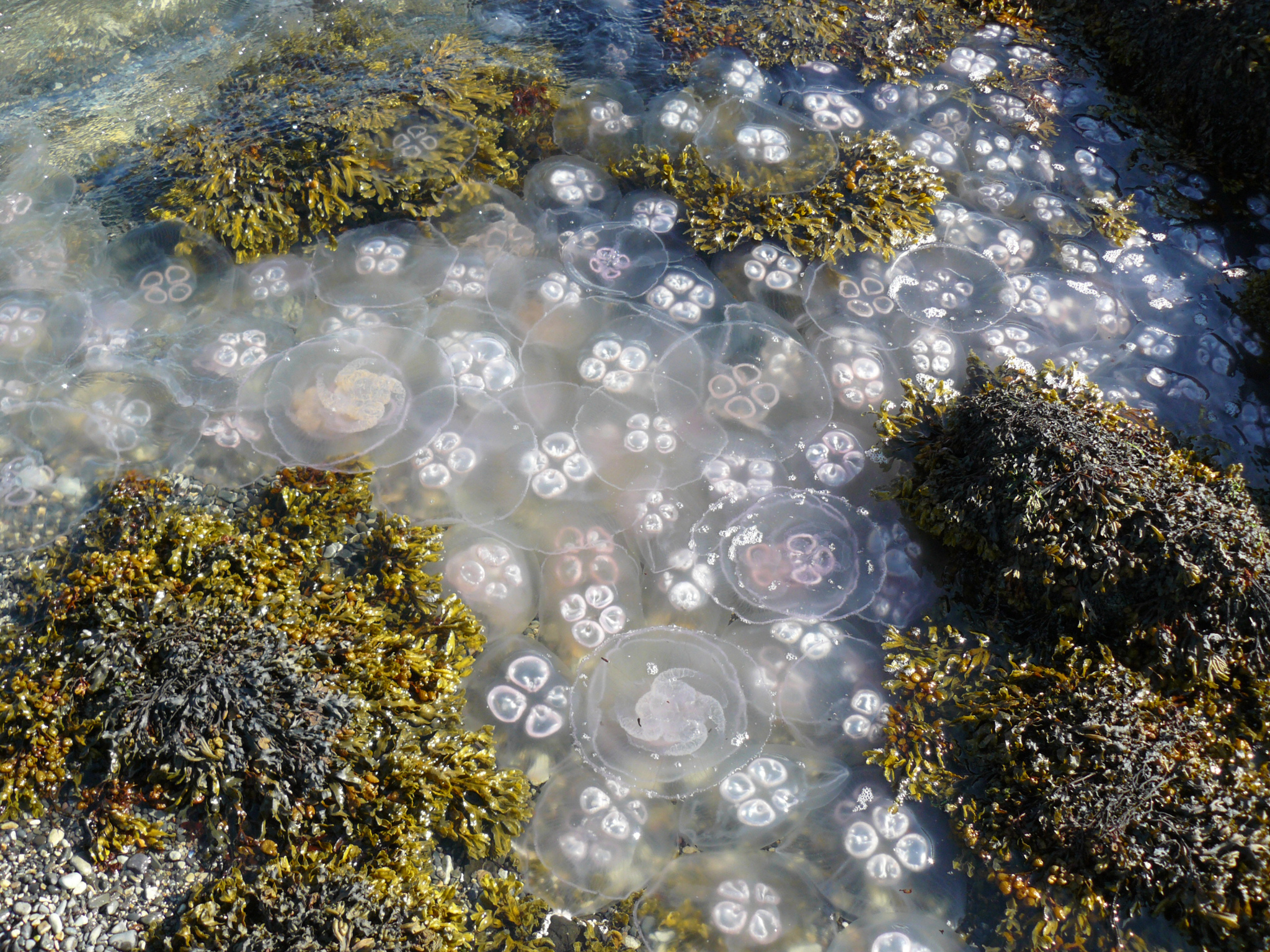
Moon jellies (Aurelia aurita) in an Icelandic rock pool show translucent, saucer-shaped bells and four pale horseshoe-shaped gonads. The short marginal tentacles are difficult to resolve in this top-down view; use movement, not the four internal shapes alone, to identify the broader jellyfish group.
Photo: Felicia Seichter. Image source · CC BY 4.0 International. Unmodified original image; full frame retained. Archive thumbnails use a display crop.

When a transparent animal drifts past your mask, stop and watch how its body moves: a bell may pulse, bands of rainbow light may travel in lines, or a barrel may squeeze as part of a chain. That motion matters because similar-looking bodies can belong to three different groups—jellyfish, comb jellies, and salps—with different structures hidden inside the clear tissue. 1 3 5
The quick answer is to follow the part doing the work. A jellyfish contracts a bell. A comb jelly beats eight rows of tiny paddles called combs. A salp pumps water through a barrel-shaped body, sometimes while linked to others. Shape helps, but a few seconds of video often records the decisive clue better than a still photograph.
Start with movement, not with transparency
Hold your position and watch one complete movement cycle before swimming closer. Does an umbrella-shaped edge draw inward, followed by a glide? Do narrow rows shimmer one after another while the body keeps roughly the same outline? Or do muscle bands around a clear tube tighten as water passes through an opening? Those are three different engines wearing the same nearly invisible colour.
Jellyfish and comb jellies are commonly grouped together in conversation, but they belong to different animal phyla: Cnidaria and Ctenophora. Salps belong to Tunicata, within the chordates. Those names matter only because they warn you not to turn a resemblance into an identification. 'Gelatinous' describes how the animal looks and feels to the water; it does not place everything transparent on one branch of the animal tree. 1 3 5
Begin with three field notes: body outline, repeated motion, and anything trailing or linked. A bell plus a pulse supports jellyfish. Lengthwise rows with moving rainbow flashes support comb jelly. A barrel with openings and encircling muscle bands, alone or joined into a train, supports salp. Use 'supports' deliberately. Siphonophores, pyrosomes, larvaceans, egg masses, and drifting plastic can also enter a diver's frame. If the movement or structure is hidden, 'gelatinous animal' is a better record than a confident wrong name.
Orientation can change the first impression. A jelly viewed edge-on can look like a clear disc; a salp viewed through one opening can look round; a lobed or ribbon-shaped comb jelly may not resemble the oval examples in a guide. Move yourself only enough to gain a side view without chasing the animal. Let its next turn reveal the structure.
A contracting bell points to a jellyfish
Look for an edge that folds inward around most of the body at once. In the familiar swimming medusa—the free-swimming jellyfish form—that contraction pushes water and moves the bell forward. The following relaxation opens the bell again. Research using high-speed video and flow measurements found that some jellies also gain thrust from water motion after the active contraction ends. Underwater, the useful clue is the visible pulse-and-glide sequence, not an attempt to see the vortex itself. 1 2
Next, look below and around the bell. Tentacles may trail from the margin, while thicker or frillier oral arms hang nearer the mouth. The moon jelly pictured above has short marginal tentacles rather than the long threads many people expect, so 'no long tentacles' does not rule out a jellyfish. Its central structures can show through the translucent bell, but internal markings that help with one genus should not become a test for all jellies. 1
Jellyfish carry microscopic stinging structures called nematocysts. You cannot judge their presence or their effect on people from a distant view, and tentacles can extend beyond the part your mask resolves. Do not touch an unfamiliar jelly, swim beneath its trailing structures, or handle a stranded one. The field mark is the bell and its contraction; apparent harmlessness is not an identification feature. 3
Film from the side if the animal's path and your buddy position allow it. Keep the full bell and the space below it in frame. A close crop of the centre can hide both the pulsing rim and the tentacles you need. If current carries the animal past without an obvious pulse, note the bell shape and trailing parts, but do not claim that it was actively swimming.
Moving rainbow rows point to a comb jelly
Turn your attention from the outline to the surface. A typical comb jelly carries eight lengthwise rows of comb plates made from fused cilia—tiny hair-like structures beating together. As those rows move, light can break into travelling rainbow colours. The body may glide while the coloured bands appear to race along it. That combination is more useful than calling every clear oval a jellyfish. 3
The rainbow is a commonly mistaken clue. It is produced when available light interacts with the packed, moving cilia; it is not proof that the animal is making light. A study of Beroe cucumis comb rows linked the shifting colours to their optical structure and viewing angle. True bioluminescence is chemically produced light and can occur in many ctenophores, but a torch-lit rainbow in your photograph does not document it. Change the light angle slightly and the colour pattern may change with it. 3 4
Do not make tentacles the deciding feature. Many comb jellies use a pair of retractable, branched tentacles armed with sticky colloblast cells rather than the nematocysts of jellyfish. Others have broad lobes, ribbon shapes, or no tentacles at all. The shared clue across these forms is the comb rows, although a distant or poorly lit view may not resolve all eight. 3
Use video to preserve the direction of the travelling shimmer. A still can freeze several coloured dashes without showing whether they belonged to rows or to reflections on disturbed water. Keep the animal against open water when possible, without moving it or placing a hand behind it for contrast. Its transparent body is fragile, and the observation improves when the animal remains intact and in control of its path.
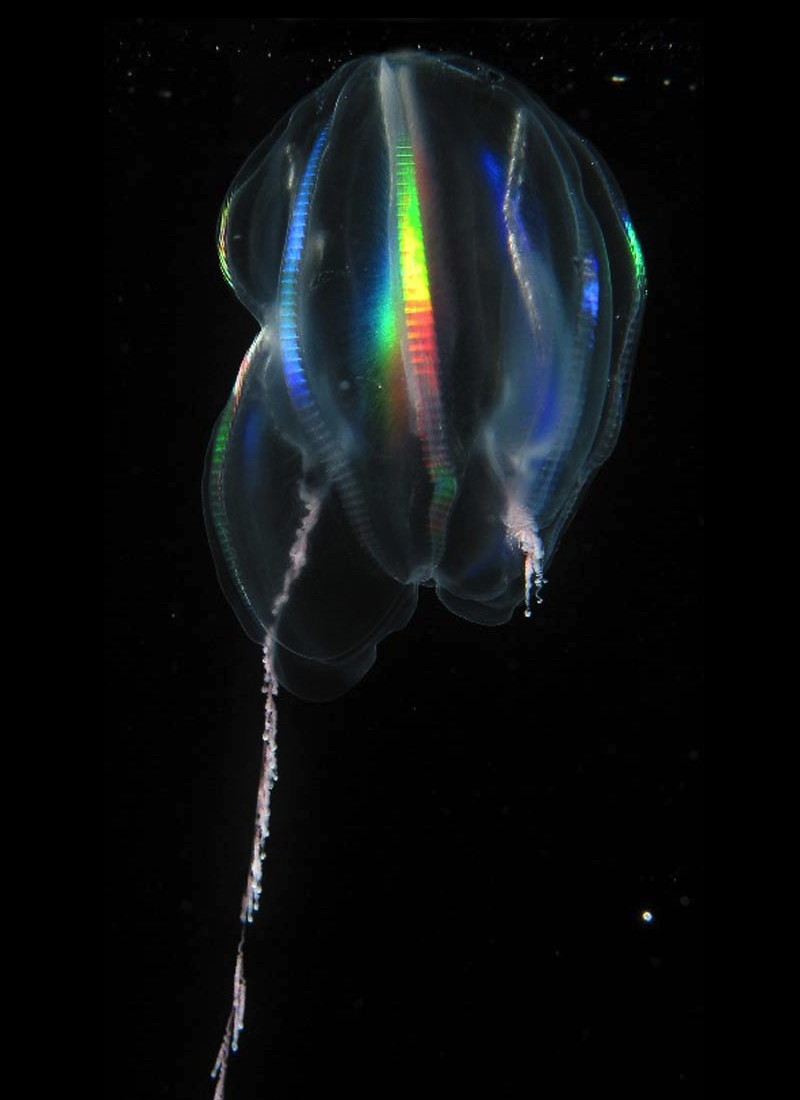
A Mertensia ovum comb jelly shows repeated rainbow lines along its beating comb rows and one extended tentacle. The colours seen under ambient light or a dive light are an optical effect of light on the comb rows; they are not, by themselves, bioluminescence.
Photo: Kevin Raskoff / NOAA. Image source · Public domain — United States government work (NOAA). Unmodified original image; full frame retained. Archive thumbnails use a display crop.

A barrel or chain can reveal a salp
Now look for a clear cylinder with an opening at each end and bands wrapping around it. When those bands contract, the salp pumps water through its body. The same flow that drives it forward also passes through an internal feeding filter. A darker digestive mass may be visible inside the otherwise transparent barrel. Follow the water-facing openings and the squeeze, rather than searching for a jellyfish bell that is not there. 5
Salps can appear alone, but linked animals make the distinction easier. A chain repeats the same barrel unit several times. Research on chains of Salpa fusiformis and Weelia cylindrica showed that individuals pulsing at different times produced smoother motion and reduced drag compared with a fully synchronized pattern. That finding explains why a train may move steadily even while separate barrels squeeze; it does not mean every chain you meet belongs to those species or follows the same timing. 6
A chain alone is not enough. Colonial siphonophores can form long arrangements, and pyrosomes can resemble transparent tubes made of many small animals. Before writing 'salp,' try to resolve repeated barrel-shaped units and their muscle bands. If you see one continuous tube studded with many tiny points rather than linked barrels, or a chain with specialized shapes that are not repeated, keep the identification broader and consult a regional guide later.
Observe from beside the animal, not from its path. Avoid pushing water at it with a hand, collecting it, or lifting it toward the surface for a clearer photograph. A wide video showing the complete chain and several contractions is more useful than a close image that cuts off the repeated structure. Keep fins still so your own turbulence does not supply the movement you are trying to interpret.
For a likely moon jelly, compare your view with the Aurelia species profile and the Monterey Bay regional map. For the rainbow clue, revisit why underwater photographs change colour: a camera records the light reaching it, so an iridescent comb row and chemical bioluminescence are different observations. On your next dive, give a transparent drifter one full cycle before naming it—pulse, shimmer, or squeeze.
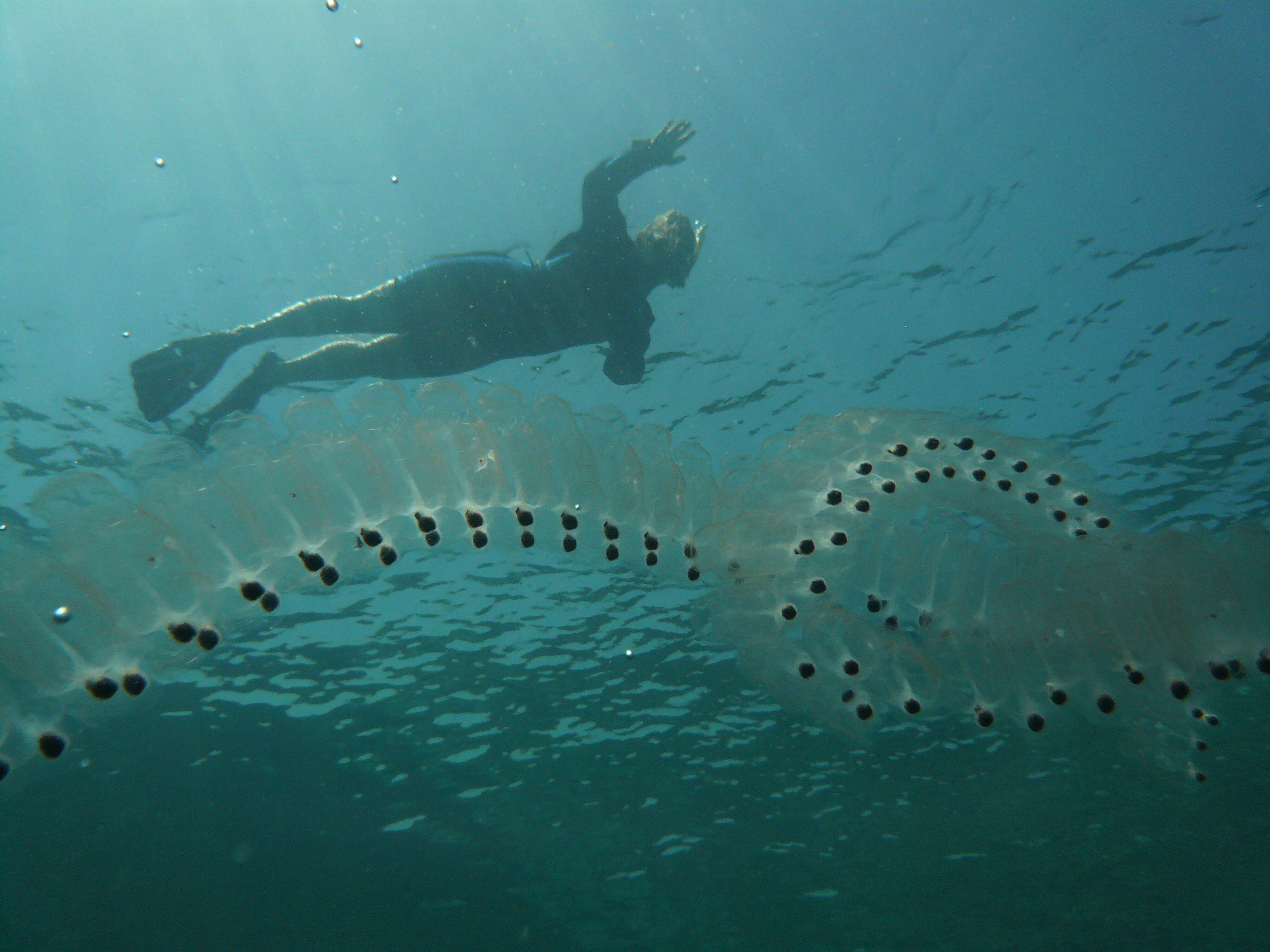
A linked salp colony repeats the same clear, barrel-shaped unit; the dark spots are gut masses, not openings. Follow the surrounding muscle bands and repeated barrels rather than treating every transparent chain as a salp.
Photo: Lars Plougmann. Image source · CC BY-SA 2.0 Generic. Unmodified original image; full frame retained. Archive thumbnails use a display crop.

Sources & further reading
- Monterey Bay Aquarium — Moon jelly — Species account for Aurelia labiata, including the translucent bell, short marginal tentacles and oral arms.
- Gemmell and colleagues (2013), Passive energy recapture in jellyfish contributes to propulsive advantage over other metazoans — Proceedings of the National Academy of Sciences 110, 17904–17909. Primary flow-visualization and swimming study; the article uses it only to interpret the visible contraction-and-glide sequence.
- Smithsonian Ocean — Jellyfish and Comb Jellies — Expert-reviewed comparison of Cnidaria and Ctenophora: bells, comb rows, nematocysts, colloblasts, body forms and the distinction between optical rainbow effects and bioluminescence.
- Welch and colleagues (2006), Optical properties of the iridescent organ of the comb-jellyfish Beroe cucumis — Physical Review E 73, 041916. Primary optical study of colour from coherently packed locomotory cilia; one species, not a claim about every photographed colour.
- Woods Hole Oceanographic Institution — Creature Feature: Salp — Institutional account of salp anatomy, water pumping, filter feeding, solitary and chain stages.
- Sutherland & Weihs (2017), Hydrodynamic advantages of swimming by salp chains — Journal of the Royal Society Interface 14, 20170298. Laboratory and field flow observations of two salp species; supports the qualified explanation of asynchronous chain movement.