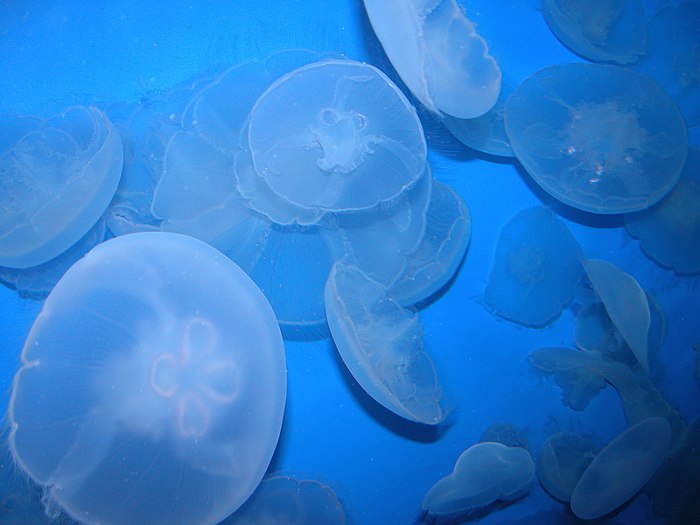
Photo: Roger Myers · CC BY 3.0 · Source and license. Displayed as a resized crop. Photograph illustrates the species.
Habitat
Sheltered bays, estuaries, and coastal surface waters
Viewing zone
Surface–10 m
Viewing activities
Snorkeling · Scuba diving · Offshore
What to look for
A transparent, rounded bell with four conspicuous horseshoe-like internal structures is a useful clue to a moon jelly. Short marginal tentacles and oral arms are also present. These features do not reliably separate every Aurelia species.
What it eats
Moon jellies capture small planktonic animals and other prey that contact their feeding surfaces.
Identification and naming
This page uses Aurelia spp. for a group of closely similar species. The linked Aurelia aurita account supplies general context; it does not confirm the species identity of every photograph or local record.
Field context
Coastal waters; seasonality varies with local conditions. Treat as a species complex: the 2003 California photo was identified as A. aurita before many modern taxonomic refinements.
Observing responsibly
Moon jellies form a species complex. A photograph alone may not support identification to species.
When to look
The available records do not establish a reliable local viewing season. Use the map’s month filter to inspect dated observations; it does not predict an encounter.
These destination links use the same area and date cutoff as the map: 40 km circles, except for the four named regional rectangles. Checked 2026-09-19. Counts describe source records, not individual animals or sighting odds.
No matching destination records appear in the current bounded index. This may reflect incomplete coverage or naming differences; it does not establish absence.