
Gear & techniques
Why Your Dive Compass Can Point Straight While You Still Miss the Boat
When the north arrow stays boxed but the exit drifts sideways, check whether the compass is level and what the current is moving—the dial shows heading, not your position.
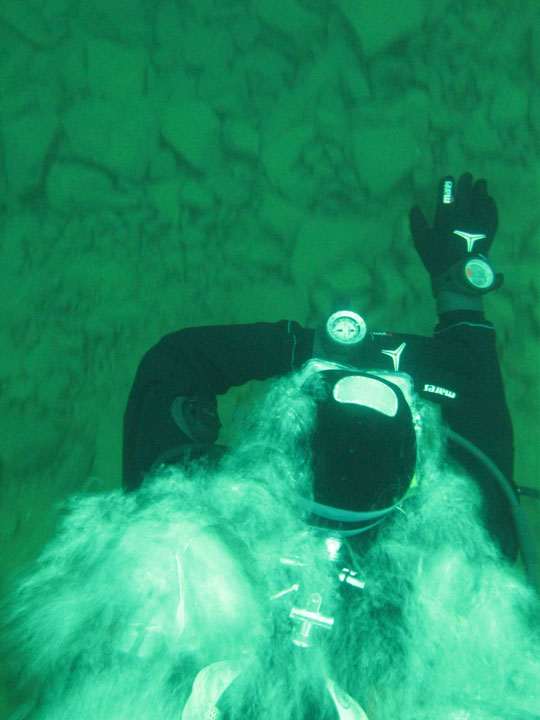
A diver checks a wrist compass above fixed rock in green water. The compass can show the direction the housing faces, but this photograph cannot show whether current is carrying the diver sideways.
Photo: Yu Diving. Image source · CC BY-SA 2.0 Generic. Unmodified original image; full frame retained. Archive thumbnails use a display crop.

If the north arrow stays boxed but the anchor line appears off to one side—or not at all—look at the compass tilt, nearby metal, and the way suspended particles or vegetation move across your path. Those clues matter because a dive compass reports heading, not position: it can show where your body points while a cross-current carries the whole dive team sideways. 1 2
The early answer is to separate three questions. Is the instrument reading freely? Is your body actually following its lubber line? Is the water shifting your track across the bottom? Level the compass, keep its direction-of-travel line aligned with your body, and use fixed features to check where you are going rather than treating a steady card as proof that you are on course.
The lubber line points your body, not your track
Start with the line printed through the compass face. That is the lubber line: aim it in the direction you intend to swim, then turn your whole body until the chosen heading or bezel reference is aligned. If your wrist points ten degrees left while your fins drive forward, the compass can be internally consistent and still describe a line that your body is not following. Hold it where you can glance along the line without twisting your forearm away from your direction of travel. 1 3
Now look beyond the dial. A magnetic heading is the direction the compass housing faces relative to magnetic north. It is not a location fix, a distance measurement, or a track drawn over the bottom. On a still-water training swim, heading and track may nearly agree. In moving water, they can separate: your mask and compass keep pointing toward the boat while the entire scene slides sideways.
A cross-current produces the clue divers often misread as a bad compass. Watch a piece of suspended material pass across your view, notice kelp leaning consistently, or compare your motion with a fixed rock. If the rock keeps shifting toward one side while the arrow remains boxed, the compass may be reporting the heading correctly while the water changes your net path. DAN describes the practical response as maintaining the intended compass heading while angling the kick direction into the current so the resulting movement follows the planned line. The needed angle depends on conditions; the dial cannot calculate it for you. 2
Do not use a moving animal as the reference that proves drift. A turtle, ray, jelly or school of fish can change speed and direction. Choose a fixed feature that can stay in the same frame as your compass check, and leave the animal’s route unobstructed. The useful observation is the background sliding across the lubber line, not a chase to keep one subject centered.
A steady card can still be a bad reading
Before blaming current, watch the card itself as you slowly change direction. A fluid-filled analog compass contains a magnetized card that should settle toward magnetic north. If the housing is tilted beyond the movement allowed by that model, the card can touch the housing and stick. DAN’s practical test is simple: hold the compass level enough for the card to rotate freely. A card that does not respond smoothly as you turn is not a heading to trust. 1
Tilt tolerance is a property of a particular instrument, not a universal number. Suunto’s SK-8 guide, for example, lists model-specific handling and compensation limits while still instructing the user to hold the compass level. That specification should not be copied onto another analog compass. Check the guide for the instrument you actually carry, then practice the viewing position in shallow, controlled water before relying on it during a navigation leg. 4
Nearby magnetic material creates a different failure. Steel, magnets and some equipment can deflect a magnetic compass even when the card moves freely. DAN specifically warns that a steel wreck—and even metal fasteners or cargo on a wooden wreck—can produce an erroneous reading. The visible clue is disagreement: the heading changes when you move the compass away from the object, or it conflicts sharply with the site’s fixed layout. Treat that as interference to investigate from a safe, open position, not as a reason to penetrate or approach a wreck. 2
Digital compasses remove the card that can bind, but they still use magnetic sensors and may require calibration or have their own tilt limits. Follow the manufacturer’s displayed calibration procedure and mounting instructions rather than assuming every digital compass is level-proof. Keep magnetic accessories away during the check. If two devices disagree, the solution is not to choose the number you prefer; stop the navigation exercise, regain a known reference, and resolve the equipment difference with your training and dive plan.
Do this comparison before leaving the descent or entry reference. Point the lubber line toward a known feature, move the compass through its normal viewing position, and confirm that the card or display settles repeatably. A bubble, sluggish card, failed calibration or large unexplained disagreement is an equipment problem to address before the feature disappears behind you.
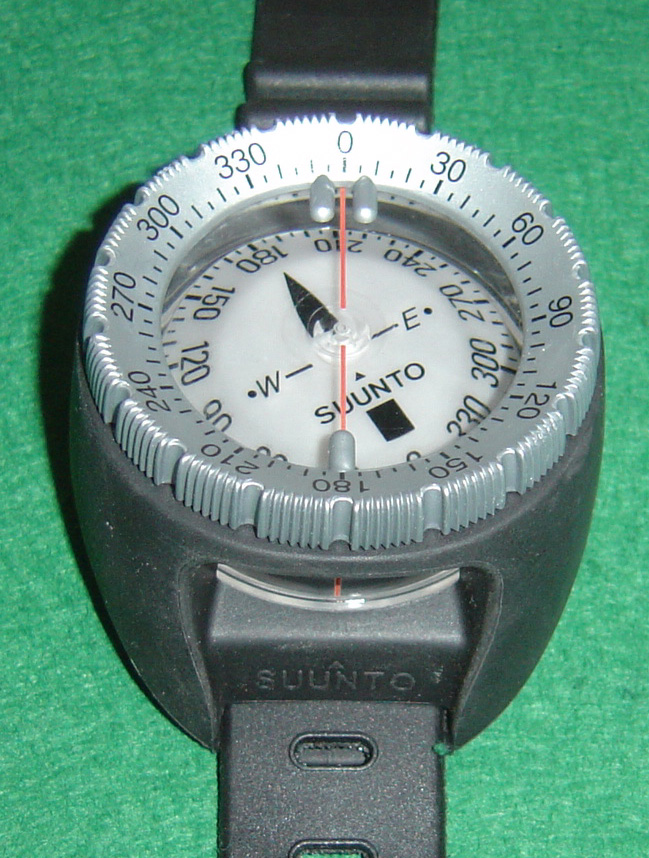
On an analog dive compass, separate the moving card from the rotating bezel and the fixed lubber line. The card must turn freely; the bezel records a reference, and the lubber line shows the direction the housing is aimed.
Photo: Peter Southwood. Image source · CC BY-SA 3.0 Unported. Unmodified original image; full frame retained.

The reciprocal reverses direction, not everything that happened
For a simple out-and-back, set the bezel so its index marks bracket the north-seeking arrow while the lubber line points outbound. At the turn, rotate your body—not the bezel—until the arrow aligns with the opposite index. The numerical version is the same geometry: add 180 degrees to headings below 180, or subtract 180 from headings of 180 or more. That gives the reciprocal heading, the direction opposite the outbound one. 1 3
The reciprocal does not rewind distance. If you swam outbound for six minutes, stopped for photographs, circled a coral head, and then followed the reverse heading for four minutes, the compass has not promised the entry point. Track time or calibrated kick cycles only under conditions similar to those in which you practiced them. Speed changes with current, trim, task loading and effort, so a memorized count is an estimate rather than a tape measure.
Current also refuses to reverse just because you do. Imagine an outbound heading held perfectly while water carries you to the right. Turning 180 degrees reverses the direction your body faces, but the same current can keep moving you to its right across the map. An equal time on the reciprocal can therefore produce two parallel legs rather than one line out and the same line home. Watch a fixed feature soon after the turn: if it slides sideways again, you need to account for the water rather than tightening your grip on the compass.
This is where the phrase “the compass was right” becomes useful instead of defensive. The instrument may have preserved heading while the navigation plan failed to include current, distance, or an intermediate checkpoint. Record those separately after the dive: heading used, estimated time or kick cycles, observed current direction, and where the team actually arrived. That turns a miss into information without pretending the dial measured more than it did.
Practice reciprocal swims in open water with minimal current, a known start, a buddy, and the supervision appropriate to your training. A study of 120 soldiers compared underwater straight-line swimming in poor visibility after some received three months of additional orientation training; its military setting is not a recreational performance benchmark, but it supports the modest conclusion that directional swimming is a practiced skill rather than an instinct supplied by buying a compass. 5
Let the reef audit the compass
Use the compass to hold the broad direction, then let the site supply checkpoints. A reef edge, isolated rock, mooring block, depth contour or transition from sand to seagrass can show whether your mental map still matches the water. DAN calls this combination practical navigation: compass spot checks joined to natural features, rather than staring at the dial for the entire dive. 1
Look back after passing a checkpoint. The overhang that was obvious on approach may merge into the reef from the opposite side; a pale rock may sit against a different background on the return. Photographing a landmark is optional, but turning your head and seeing its reverse view while you are still beside it prepares you to recognize it later. Keep buoyancy and buddy position first—no checkpoint is worth contact with the bottom or separation from the team.
Sand ripples, sunlight, surge and vegetation can help, but none is a universal arrow. Near some beaches, ripples may run roughly parallel to the shoreline; elsewhere local waves, tide, bottom shape or intersecting patterns complicate the clue. Use the dive briefing and a known feature to establish what a pattern means at that site. Then check whether the pattern stays consistent as depth and current change. 1 2
Animals are observations, not signposts. A resting nurse shark may leave its ledge, and a grazing green sea turtle may surface. Do not alter your route to keep either animal fixed in your map. For a place where canopy, rocks and bare patches offer strong natural references, explore the Monterey Bay map and the article on reading the boundary between kelp forest and urchin barren. The links provide context, not a substitute for local training or a site briefing.
This article covers open-water recreational observation, not cave, wreck-penetration, ice or other overhead navigation; those environments require specialized training and a continuous route to open water. On your next ordinary dive, make one deliberate compass check beside a fixed feature. Level the instrument, align the lubber line with your body, then lift your eyes: if the background walks sideways, the current has told you something the arrow cannot.

A distinct reef edge can become a natural-navigation checkpoint. Look back after passing it: the same wall and coral shapes can appear different from the return direction.
Photo: Derek Keats. Image source · CC BY 2.0 Generic. Unmodified original image; full frame retained. Archive thumbnails use a display crop.
.jpg)
Sources & further reading
- Divers Alert Network (2012), Underwater Navigation — Institutional guide to analog compass parts, level use, magnetic interference, bezel and reciprocal headings, distance estimates, and combining instrument with natural navigation.
- Divers Alert Network (2024), Advanced Underwater Navigation — Institutional guidance on current-driven cross-track movement, reverse-view checkpoints, limited visibility, metal interference near wrecks and the limits of relying on equipment without practiced skills.
- PADI (2025), How To Use a Compass To Navigate Underwater — Training-agency overview of lubber-line alignment, level compass position, bezel use, reciprocal headings and practice. No product recommendation or test is inferred.
- Suunto — SK-8 Dive Compass User Guide — Manufacturer documentation used only as a model-specific example of handling and tilt specifications; its limits are not generalized to other compasses.
- Filipek, Research on Underwater Directional Swimming Skills of Divers — Primary study of 120 soldiers and a three-month additional training program with underwater straight-line swimming tests in poor visibility. The article uses it only to support practice, not as a recreational benchmark.