
Destinations & habitats
Why Galápagos Marine Iguanas Leave Cold Water for Black Lava
Follow a Galápagos marine iguana from algae-covered rock to a sunlit lava ledge: its route shows how cold water, body size and the tide shape where it feeds.
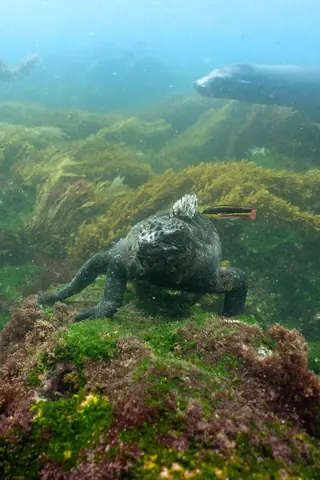
The marine iguana is underwater above an algae-covered seabed off Fernandina. Its blunt head, strong limbs and the food-coated rock are visible, but this instant does not show the snout contacting algae, so the photograph establishes habitat rather than a completed bite.
Photo: Sodacan. Image source · CC BY-SA 4.0. Full portrait frame resized to 320 by 480 pixels, metadata removed and converted from JPEG to WebP; no crop.
_feeding_underwater_off_Fernandina_Island,_Gal%C3%A1pagos_Islands.jpg)
On a Galápagos snorkel, watch where a marine iguana's blunt snout meets algae-covered rock, then follow its route back toward the lava shore. The shift from submerged grazing to a still body spread on sunlit rock matters because feeding in cold water carries a heat cost, and the complete route helps you read which part of the shore the animal is using. 1
The answer appears in the sequence: marine iguanas feed almost entirely on marine algae, but they do not all reach it the same way. Some work the intertidal around low tide, while others swim and dive to submerged feeding rock; afterward, a pause on sunny lava can be part of the same foraging trip rather than simple inactivity. 1
The meal is attached to the rock
Start with the surface under the animal, not the open water around it. Marine iguanas scrape or crop algae growing on rock, so a head held close to a green, brown or reddish coating is a more useful clue than an iguana simply swimming past. In a clear sequence, look for the snout meeting the substrate, a short pull or scrape and repeated repositioning over the same patch. The photograph above shows the right underwater setting, but because the snout is lifted it cannot prove a bite occurred at that instant. 1
The Galápagos shoreline makes that meal available at two connected levels. Intertidal rock is exposed or washed as the tide falls; subtidal rock stays below the surface. A snorkeler may therefore see one animal working a shallow pool or wave-washed ledge while another crosses open water and disappears toward a deeper rock face. Both can be feeding on attached algae, but only the complete path tells you whether the animal remained between the tide marks or left them for a subtidal trip.
Do not name the algae from colour alone. Water depth, surface sheen, sediment and the mix of species can change the colour you see through a mask. The reliable field record is the contact: which rock face the snout reaches, whether the animal repeats the action and whether the patch is exposed, awash or continuously submerged. That description preserves what you actually observed without turning a distant green film into a species identification.
The animal's position can also prevent a false feeding call. An iguana crossing above an algal bed may be travelling between shore and a feeding patch; one braced against rock may be pausing; only repeated snout-to-rock contact establishes grazing. Keep the tail and limbs in the wider frame. Their movement shows whether the animal is holding station, advancing over the bottom or swimming past, while the head tells you whether the food surface is actually being worked.
Body size changes which side of the surf becomes a feeding ground
A long-running field study on Caamaño, near Santa Cruz, and at Cabo Hammond on Fernandina found two consistent routes. Subtidal feeders swam out and dived to submerged algae; intertidal feeders stayed near the colony and foraged around low tide on rock that was exposed, pooled or washed by breakers. The subtidal dives recorded for 11 animals lasted 60 to 815 seconds, with a median of 175 seconds, but that measured sample is context—not a stopwatch for identifying every dive you see. 1
Size, not sex by itself, best separated the strategies in the 60 marked animals. In those colonies, animals below about 1,200 grams were intertidal feeders, almost all above about 1,800 grams were subtidal feeders, and some between used both. The authors warned that the crossover can differ among islands with algal supply, intertidal area and colony density. Underwater, you can make the safer comparison—smaller animal close to the wave-washed edge versus larger animal swimming offshore—without estimating its mass or assigning a universal rule. 1
Tide and swell add another visible distinction. Intertidal feeding in the study shifted with low tide, and rough breakers shortened or interrupted bouts; subtidal feeding occurred from late morning into early afternoon with less dependence on the tide. That does not turn a tide table into a sighting guarantee. It tells you what to include in an observation: the waterline, whether algae-covered rock is exposed, how frequently waves cover it and whether the iguana keeps feeding or retreats between surges. 1
One pass is rarely enough to classify a strategy. The researchers could call individuals consistent because marked animals were seen repeatedly; a visitor usually sees an unmarked animal for minutes. Describe the route you saw that day—intertidal, subtidal or unresolved—rather than turning it into a permanent label. A large iguana in a tide pool has not disproved the size pattern, and a small silhouette offshore has not been weighed or followed to its feeding rock.
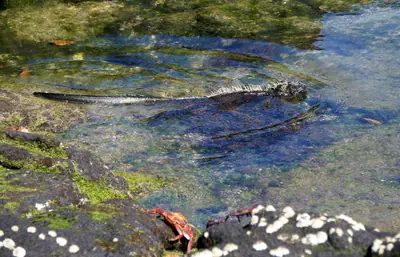
At Punta Espinosa, the iguana's body stays near the surface while its long tail extends behind it. This frame documents the swimming route in shallow coastal water; it does not show a surf exit or reveal where the animal fed.
Photo: putneymark. Image source · CC BY-SA 2.0. Full frame resized to 400 by 257 pixels, metadata removed and converted from JPEG to WebP; no crop.

The return to lava is part of the feeding route
Now keep watching after the animal leaves the water. Marine iguanas are ectotherms: the water draws down body temperature, and the 1986 study found smaller animals cooled faster during immersion. At Fernandina, water measured 16.5 to 21.3 degrees Celsius during the relevant returning-animal comparisons, and many subtidal feeders came back with body temperatures barely above the water. Some sprawled on sunlit rocks before another bout or the walk back to the colony. 1
A flattened body on a sunny ledge therefore belongs in the same field note as the swim. Record whether the animal has just crossed the shallows, whether it stops on an exposed surface and whether it later moves again. Do not infer an exact body temperature from posture or assume every resting iguana has just dived: marine iguanas also bask before foraging, and a still photograph cannot supply the missing sequence. 1 3
A pale crust around the nostrils provides a different clue. Specialized nasal salt glands remove excess salt, and the concentrated fluid can be expelled through the nostrils, leaving crystals on the snout. A sudden puff from the nose or fresh white deposit is therefore not automatically sand or illness. It is evidence of salt handling, although a single crusted face does not tell you when the animal last fed or how long it spent in the sea. 2 3
Keep the two shore clues separate. Sprawling in sun concerns heat exchange; fluid expelled at the nostrils concerns salt balance. They can occur in the same animal on the same ledge, but one does not prove the other. A useful clip preserves the order—landing, settling, basking posture, nasal expulsion if it happens—instead of using a white snout to reconstruct a dive that the camera never recorded.
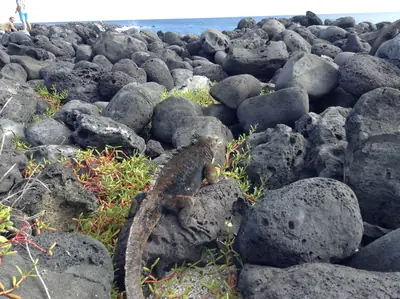
A marine iguana rests among dark coastal lava at Las Loberias. The image supports the shore setting and a basking posture, but it does not document a salt sneeze or show that this individual has just returned from feeding.
Photo: MusikAnimal. Image source · CC BY-SA 4.0. Full frame resized to 400 by 299 pixels, metadata removed and converted from JPEG to WebP; no crop.

Keep the water-to-lava corridor open
The most informative place to watch is also the route an iguana needs to use. Galápagos National Park guidance says to remain at least 2 metres away, even for photographs, and to avoid touching or feeding wildlife. Stay with an authorized guide and follow any site instruction that requires more distance. If an iguana approaches, the distance rule still applies: move aside without stepping into its algae-covered feeding patch or blocking the landing point. 4
Frame the sequence wide. Underwater, include the snout, the rock and enough surrounding water to show whether the animal is in a pool, the surf zone or a subtidal patch. At the edge, leave room to see the swim direction and shore. On land, use no flash and do not circle between the animal and the water for a front-facing portrait. A wide route is better evidence than three close photographs whose order cannot be established. 4
Use the Galápagos regional guide for place context and the marine iguana species account for identification. Compare this route-based reading with the way a manta's mouth and path reveal feeding or how a kelp-forest boundary connects animals to habitat. None is a promised sighting; each is a way to record the clue before interpreting it.
On the next Galápagos snorkel, look for two contacts rather than one dramatic moment: first the snout meeting algae-coated rock, then the body returning toward sunlit lava. If you can keep the animal's route open and both transitions in view, the shore stops looking like separate land and water scenes—it becomes one feeding habitat with a cold side and a warm-up side.
Sources & further reading
- Trillmich & Trillmich (1986), Foraging strategies of the marine iguana, Amblyrhynchus cristatus — Behavioral Ecology and Sociobiology 18, 259–266. Primary field study of marked marine iguanas at Caamaño and Cabo Hammond; supports the intertidal/subtidal routes, qualified mass relationship, tide and swell effects, dive observations, cooling measurements and sunlit-rock pauses.
- Dunson (1969), Electrolyte excretion by the salt gland of the Galápagos marine iguana — American Journal of Physiology 216, 995–1002; DOI 10.1152/ajplegacy.1969.216.4.995. Primary physiological study supporting the nasal salt-gland explanation; it is not used to assign a recent feeding history from visible salt alone.
- Galápagos Conservation Trust — Marine iguana — Current specialist-conservation species account supporting the accepted name, endemic range, algae feeding, basking and visible salt-crystal context. The primary field paper governs the numerical and strategy claims.
- Charles Darwin Foundation — Galápagos National Park Rules — Current visitor guidance from the Charles Darwin Foundation reproducing Galápagos National Park rules: keep at least 2 metres from wildlife, do not touch or feed, use authorized guides and services, leave the landscape unchanged and avoid flash.