
Species & behavior
How a Mourning Cuttlefish Sends Two Messages at Once
When three mourning cuttlefish gather, compare both sides of the smaller male: stripes may face the female while mottled camouflage faces the larger rival, turning one body into two messages.
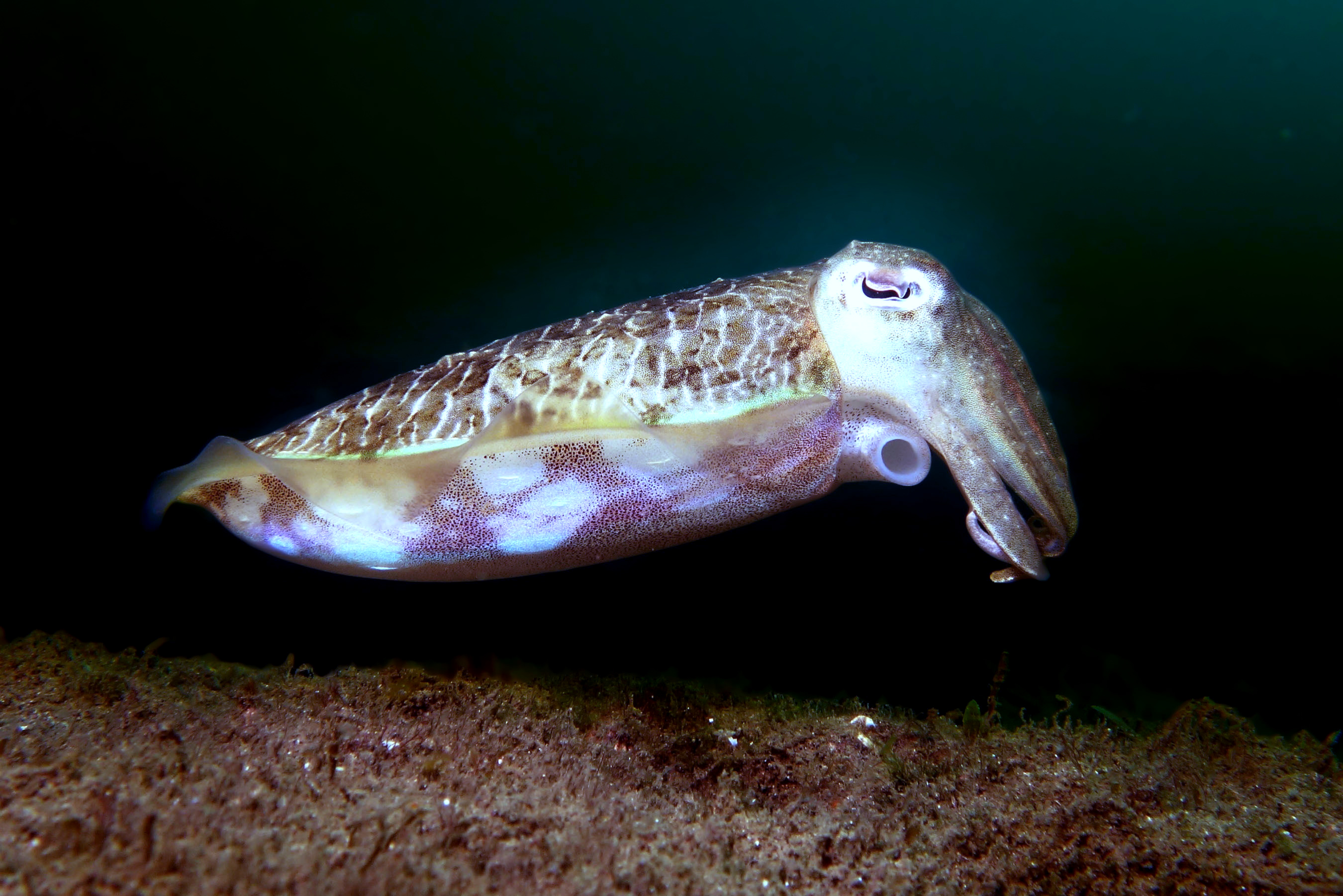
A mourning cuttlefish, Sepia plangon, in eastern Australian coastal habitat. Before interpreting its pattern, notice the animal's orientation and which side each nearby cuttlefish could see; a portrait of one animal does not document the split courtship display.
Photo: John Turnbull. Image source · CC BY-SA 2.0 Generic. Complete Commons file; colour adjusted by the uploader in 2020; no additional SeaLifeWiki crop. Archive thumbnails use a display crop.

On an eastern Australian dive, keep a trio of mourning cuttlefish in one wide view and compare both sides of the smaller male: moving stripes can face the female while mottled coloration faces the larger rival. The direction matters because the same animal may be sending different signals to two neighbours at once, prolonging courtship without immediately advertising a challenge. 1
The answer is written across the middle of the body. Researchers call it a dual-lateral display: one half carries a male courtship pattern toward a potential mate, while the other resembles a female-facing pattern toward the competing male. It is a specific tactic, not the normal appearance of every courting cuttlefish, and you need the positions of all three animals to read it. 1 2
Read the triangle before reading the colours
Start with the arrangement, not the brightest colour. Is there one cuttlefish alone, a pair, or two males positioned around one female? Which neighbour faces each side of the animal in the middle? A tight photograph of the striped half can erase the rival from the story and make an audience-specific display look like a whole-body costume.
Mourning cuttlefish, Sepia plangon, live along eastern Australia. The Australian Museum describes shallow bays and harbours, often around 3–9 metres, with juveniles commonly associated with seagrass and adults near rocky reef and dwarf-kelp stands. A resting animal may hold a tripod posture on the bottom, with two lower arms raising its head. Those habitat and posture clues can help you stay with the correct subject before a social exchange begins. 3
During courtship, a male can show pale, wavy transverse stripes and bands near the fins. Females are often more plainly or mottled patterned. But colour by itself is not a safe sex test: the behaviour in this article works precisely because one male can display a female-like mottle on part of his mantle. The researchers used arm morphology as well as pattern to identify sex; a diver should record the visible pattern and orientation rather than assign sex from one still frame. 1 3
Keep the full triangle in view for several seconds. If stripes remain on the side facing one animal while the opposite side stays mottled toward another, you have a stronger observation than 'the cuttlefish changed colour.' If the animals turn and the split disappears, record that too. The message is tied to who can see which side, not just to the pigment visible through your mask.
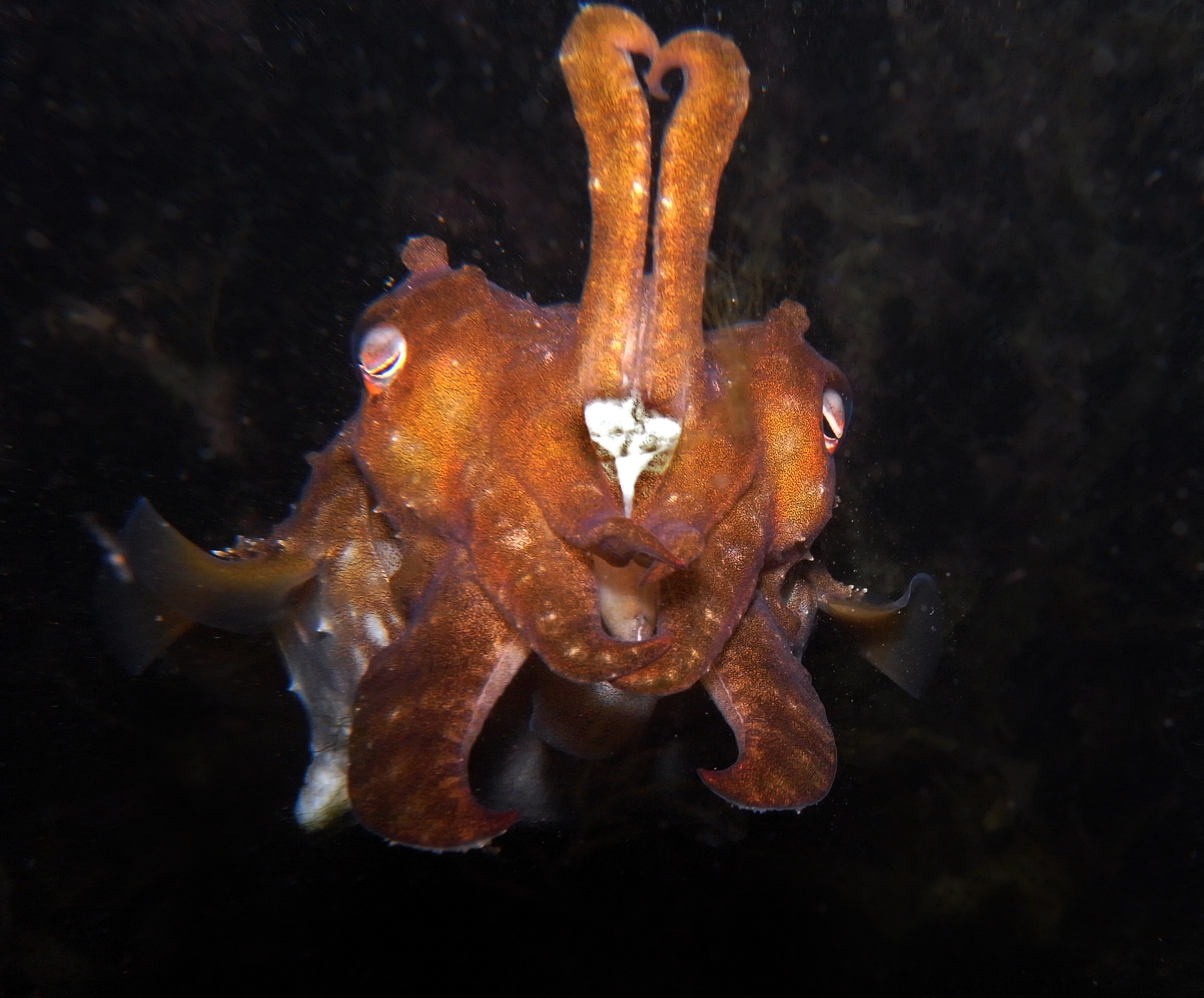
A mourning cuttlefish at Clovelly Pool raises two arms while the others frame its face. The photograph documents posture and colour in the exact species; it does not establish the animal's sex, courtship or a dual-lateral display.
Photo: Sylke Rohrlach. Image source · CC BY-SA 2.0 Generic. Complete downloadable Commons frame; the source indicates processing or resampling from the original camera file; no additional SeaLifeWiki crop.
_(15901916283).jpg)
One mantle can face two audiences
The original field study followed mourning cuttlefish in Sydney Harbour over six breeding seasons, from July through November, at shallow subtidal sites 2–9 metres deep. Divers photographed 108 social groups, representing 138 male observations, and scored only images that showed both sides of every animal. That design matters to your own view: the claim came from seeing the display and both intended audiences together. 1
The split display appeared only when one male courted one female in the presence of one rival male. Within that particular three-animal arrangement, males used it in 39 percent of observed groups; the researchers did not see it in other social groupings. A trio therefore creates the opportunity for the tactic, not a guarantee that it will appear. Two females would also make the geometry harder: one courting side cannot face both females while the opposite side stays hidden from a rival. 1
Follow the animal's midline. Toward the female, the courting half can carry the male's pulsating or zebra-like pattern. Toward the rival, the other half can retain the female-like mottle. The body itself screens one side from the other audience when the male holds the right position. If the rival moves around him, that visual partition can fail—and the study reports that discovery could lead to fighting. 1
The authors used 'tactical deception' for this audience-specific signal. That term describes the mismatch presented to the rival; it does not require a diver to infer human-style planning or dishonesty from the animal's expression. In a large study aquarium, researchers saw males using the display complete mating on two occasions, but those were casual observations, not a controlled success-rate experiment. Keep the useful conclusion modest: the orientation can reduce interruption long enough for courtship to continue. 1
The display is a sequence, not a single badge
A later University of Queensland study makes the colour change harder to reduce to one on/off signal. Across 41 hours of laboratory video, researchers identified 18 body patterns and 57 pattern components in Sepia plangon. The visible vocabulary included stripes, mottles, dark eye rings, smooth or raised skin, stretched or flattened bodies, arm positions and forward movement. For an observer, that means the next action can change what the previous colour appeared to mean. 2
Use the six-panel sequence below as a viewing exercise. The male begins with raised arms, switches into a strong zebra pattern, then changes contrast, body shape and skin texture as the female changes her own pattern and posture. The experiment described ordered sequences rather than one magic marking that caused mating. Painted three-dimensional models carrying individual static features did not trigger courtship or mating, another reason not to treat a frozen stripe as the complete message. 2
The same study again observed five smaller males, each with a mantle under 80 millimetres, using the dual-lateral display when placed between a larger male and a female. Four of those five later mated. That 80 percent belongs to five animals in the laboratory; it is not a field probability for the next small cuttlefish you meet. The earlier six-year field record supplies the broader behavioural context, while the captive work shows the tactic recurring under observed three-animal conditions. 2
Watch for responses as well as signals. A female moving away with dropped arms is different from one remaining close; a rival extending an arm or turning laterally changes the exchange. Do not label a quick darkening as acceptance, rejection or aggression unless the surrounding movement supports it. A useful video preserves the before, the pattern change and what both neighbours did next.
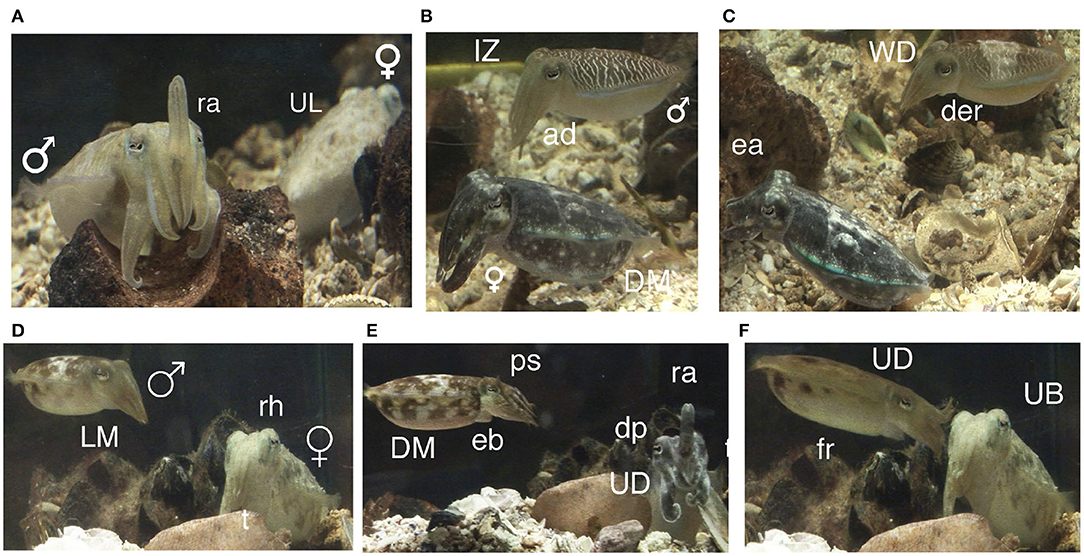
Laboratory courtship sequence from López Galán, Chung and Marshall, Figure 3. Read the pair from A to F: the male changes stripes, mottling, posture and skin texture while the female also changes pattern and arm position. The panels show one interaction, not a universal script for every pair.
Photo: Alejandra López Galán, Wen-Sung Chung and N. Justin Marshall / Frontiers in Physiology (2020), Figure 3. Image source · CC BY 4.0 International. Complete published Figure 3; labelled A-F composite of selected research frames; no SeaLifeWiki crop.
Stay outside the audience
Frame the group from one position rather than swimming around the middle animal to collect both sides. Circling can put you where the rival or female had been, break the sightline that makes the display possible, or turn an ordinary orientation change into a response to the diver. A wider clip with all three animals is better evidence than a close portrait with one spectacular striped flank.
Do not herd two cuttlefish together, separate a rival, or block an animal's route to the bottom. If one jets away, releases ink or repeatedly turns from you, widen the distance and let the encounter end. The Australian Museum identifies jet escape, inking and rapid camouflage as normal capabilities; provoking them would replace the social sequence you wanted to observe with an escape response. 3
Write down the pieces that a video may not preserve: approximate depth, habitat, number of animals, their relative sizes, and which side faced each neighbour. A cuttlefish mottling against seagrass while alone is a camouflage observation, not the dual-lateral courtship tactic. A striped animal beside another cuttlefish is still incomplete if the rival and the opposite half remain out of frame.
For species context, use the Australian Museum mourning cuttlefish account. The Great Barrier Reef regional map provides eastern Australian context within the species' range, but it is not a map of the Sydney Harbour study sites or a promise of a sighting. Compare this audience-dependent signal with the bluehead wrasse's changing social role and the broader cephalopod scene at the Octopus Garden.
On your next dive with more than one cuttlefish in view, resist following the brightest animal alone. Keep the neighbours in the frame, find the body's midline, and ask who can see each half. The pattern may be telling two different stories at the same time.
Sources & further reading
- Brown, Garwood & Williamson (2012), It pays to cheat: tactical deception in a cephalopod social signalling system — Biology Letters 8, 729–732; DOI 10.1098/rsbl.2012.0435. Primary six-year Sydney Harbour field study of 108 groups and 138 male observations, with limited mesocosm observations. The 39 percent result applies only to one-male, one-female, one-rival groups.
- López Galán, Chung & Marshall (2020), Dynamic Courtship Signals and Mate Preferences in Sepia plangon — Frontiers in Physiology 11, 845; DOI 10.3389/fphys.2020.00845. Primary captive study of courtship sequences, sex-ratio treatments, body patterns and five small males using the dual-lateral display. Figures reused only where identified under the article's CC BY 4.0 terms.
- Australian Museum — Mourning Cuttlefish, Sepia plangon — Institutional species account supporting eastern Australian distribution, shallow-bay habitat, tripod resting posture, camouflage, escape behaviour and the visible male courtship pattern.